 Warble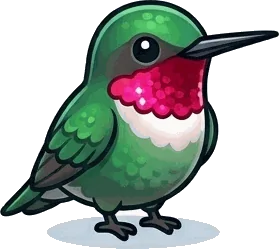
A Ruby-throated Hummingbird sounds mostly like its wings: a low, steady hum, like a large bee passing close to your ear, that sharpens to a whir when the bird darts off. The voice is a set of rapid, squeaky chips and twitters, thin and mouse-like, given mainly as a threat when two birds meet at a feeder. There is no real song. In spring the male's pendulum display adds a whir on each swing and a dry tik-tik from the wings.
The song, such as it is
This hummingbird does not sing. What you hear first is the hum that named the family: wings beating up to 80 times a second while the bird hovers, close to a bumblebee but steadier, and loud enough to make you turn your head before you see anything. When the bird shoots off after a rival the hum sharpens into a brief whir and is gone.
The voice itself is small. Field guides call it mouse-like twittering squeaks, or a run of chips, squeals and twitters, and most of it is spent on arguments. Two birds at one feeder will chip and squeal at each other in bursts while they chase, which is why a feeder with several hummingbirds is far noisier than one with a single tame regular.
If you want a hummingbird that truly sings, you need the Pacific Coast, where the male Anna's Hummingbird gives a buzzy song from a perch. East of the Great Plains, the hum and the chips are the whole repertoire.
The call: squeaky chips
The everyday call is a rapid, squeaky chip, often doubled or run into a short twitter. It is high and thin, easy to lose against traffic or wind, and it usually means one bird has noticed another. Listen near a feeder or a patch of cardinal flower in late afternoon, when several birds are trying to feed at once.
Warble identifies birds by sound alone, and a hummingbird gives it little to work with: the hum is faint and the chips are short. A squabble at a busy feeder is the best chance for a clear recording, and it can still come back unsure.
When and where you hear it
The Ruby-throated Hummingbird is the only hummingbird that breeds in eastern North America, and it is a summer bird. In Missouri, in the middle of the range, the first birds show up in early April, nesting starts around mid-May, southbound movement begins in mid-August, and most are gone by early October. Males move north ahead of the females each spring.
Winter is spent in southern Mexico and Central America, as far as western Panama, with some birds in Florida and the West Indies, and many make the crossing of the Gulf of Mexico in a single nonstop flight of roughly 900 miles. In summer, look for the bird at wood edges, clearings, gardens and city parks, anywhere with tubular flowers. Red ones such as trumpet vine and cardinal flower are favorites, and a feeder of sugar water works just as well.
There are an estimated 34 to 36 million of them across the eastern breeding range, so if you have a feeder and a hedge, you probably already have one.
The dive display: a whirring pendulum
In spring a male courts by swinging through a wide U-shaped arc in front of a perched female, like a pendulum, and his wings whir at the bottom of each swing. He rises about 8 to 10 feet above her, then switches to short, fast passes back and forth in front of her. During these passes the wings make a dry tik-tik tik-tik, and the outer tail feathers add a repeated whine on the dives. It lasts a few seconds and is one of the few times the bird is easier to hear than to see.
What it looks like
Three to three and a half inches long and weighing a tenth of an ounce or so. Both sexes are metallic green above and whitish below. The male has a forked black tail and the ruby throat, which looks black in most light and only flashes red when the sun hits it straight on. The female has a plain grayish-white throat and a rounded tail with white tips on the outer feathers; young birds look like her.
A Ruby-throated Hummingbird drinks two to three times its body weight in nectar a day and adds small insects and spiders for protein. If you feed them, use four parts water to one part white sugar, never honey or artificial sweeteners, and clean the feeder often. The flash of the throat is the field mark; the hum is how you knew to look.
Birds that sound similar
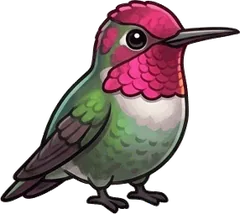 Anna's Hummingbird
Anna's actually sings: a buzzy, scratchy song from a perch, plus a sharp chip and a fast chee-chee-chee. Its dive ends in a loud pop, not a whir. It is a Pacific Coast bird, so range settles most cases.
- ?Black-chinned Hummingbird
The western twin. Its call is a low tup, softer than the Ruby-throat's squeaky chip, and females of the two are nearly identical, so the call note matters. A few stray east in fall and winter near the Gulf Coast.
- ?Rufous Hummingbird
An abrupt, high zeee and thin squealing notes, sharper than a Ruby-throat's chips. Many now winter in the Gulf states and strays turn up widely in the East, so a December hummingbird in the South deserves a second look.
Where the Ruby-throated Hummingbird card lives
In Warble the same bird can be an easy card in one state and a prized one in another, because each album ranks its birds by how often people really report them there. The Ruby-throated Hummingbird appears in 35 state albums:
 Heard one? Open Warble, tap the green button while it sings, and the Ruby-throated Hummingbird card flips into your album. Get the app free.
Questions people ask
Do hummingbirds sing?
Ruby-throated Hummingbirds do not. Their vocal range is a set of squeaky chips, squeals and twitters used mostly to threaten other hummingbirds. Some western species do sing, and the male Anna's Hummingbird of the Pacific Coast gives a buzzy song from a perch.
What makes the humming sound?
The wings. A hovering Ruby-throated Hummingbird beats them up to 80 times a second, fast enough to produce a steady hum that rises to a whir when the bird accelerates. The male's display flight adds a tik-tik from the wings and a whine from the outer tail feathers.
When do Ruby-throated Hummingbirds arrive and leave?
In the central United States the first birds arrive in early April, males before females, and southbound movement starts in mid-August; most are gone by early October. They winter from Florida and southern Mexico south to western Panama, and many cross the Gulf of Mexico nonstop.
What should I put in a hummingbird feeder?
Four parts water to one part plain white sugar, boiled so it ferments more slowly. Never use honey or artificial sweeteners, and clean the feeder often. The birds drink two to three times their weight in nectar a day, so a busy feeder empties fast.
Sources
- National Audubon Society, Guide to North American Birds: Ruby-throated Hummingbird. www.audubon.org/field-guide/bird/ruby-throated-hummingbird
- Wikipedia: Ruby-throated hummingbird (vocalizations, wingbeat, display, migration, population). en.wikipedia.org/wiki/Ruby-throated_hummingbird
- Missouri Department of Conservation, Field Guide: Ruby-throated Hummingbird. mdc.mo.gov/discover-nature/field-guide/ruby-throated-hummingbird
- National Audubon Society, Guide to North American Birds: Black-chinned Hummingbird (lookalike call). www.audubon.org/field-guide/bird/black-chinned-hummingbird