 Warble
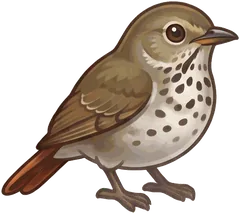
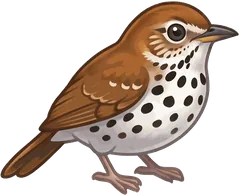
Listen to how each phrase is built. A Wood Thrush sings in three parts: a few faint, low notes, then a loud, ringing ee-oh-lay, then a trill-like ending in which it sounds two notes at once. A Hermit Thrush opens each phrase with one clear, piping note, follows it with a reedy, falling tremolo, and sings the next phrase on a different pitch. The calls settle it too: a low tuck from the Hermit, a sharp pit-pit-pit from the Wood. In view, the Hermit's red is in its tail; the Wood Thrush wears it on its head.
Side by side
| Hermit Thrush | Wood Thrush | |
|---|---|---|
| Song | One clear, piping opening note, then a reedy, falling tremolo; each phrase on a new pitch | Faint low notes, a loud ee-oh-lay, then a trill-like ending of two notes at once |
| Call | A low tuck | A sharp pit-pit-pit-pit; a soft bup bup when agitated |
| Size | 6.3 to 7.5 inches | About 8 inches |
| Color | Reddish tail against a duller brown back | Cinnamon crown and nape, plainer brown behind |
| Spots | Dark spots on the breast, grayish or brownish flanks | Large, round, dark spots over the breast and belly |
| Habit | Perches low, flicks its wings, slowly raises and lowers its tail | Flips leaves on the forest floor, sometimes out onto a lawn |
| Where and when | Breeds in northern and mountain conifer or mixed woods; winters across the southern US | Breeds in eastern deciduous woods, April to late summer; winters in the tropics |
By ear: one note and a run, or ee-oh-lay
Both birds sing slow, flute-like phrases with pauses in between, so do not judge by mood. Listen to the inside of one phrase.
A Wood Thrush phrase has three pieces. First come a few faint, low notes you only catch when you are close. Then the loud middle, the part that carries through the woods, usually written ee-oh-lay. Then a trill-like flourish that shimmers, because the male can sing two notes at the same time. So the shape of every Wood Thrush song is quiet, loud, shimmer, pause.
A Hermit Thrush phrase starts with one clear, piping note, alone, and then breaks into a reedy tremolo that runs downhill, with a pensive, minor-key sound. Then comes a pause, and the next phrase starts on a different pitch, higher or lower, so a long bout seems to try the same tune in one key after another. Researchers who measured the notes found them related by simple whole-number pitch ratios, a pattern not found in other birds studied the same way. There is no loud middle phrase and no doubled trill at the end. The shape is single note, flutter, pause, new key.
The calls are easier still. A Hermit Thrush gives a low tuck. A Wood Thrush gives a sharp, fast pit-pit-pit-pit, plus a bup bup bup that grows louder and higher when the bird is upset. On migration nights a buzzy heeh overhead is a Wood Thrush flight call. Wood Thrushes sing hardest just before sunrise and again at dusk, and mostly go quiet by the end of July.
By sight: red tail or red head
Both are brown above and white below, with spotted breasts, white eye rings and pink legs, so look at where the warm color sits. On a Hermit Thrush it is the tail: a reddish-brown tail that stands out against a duller back. On a Wood Thrush it is the front end: a cinnamon-brown crown and nape that fade to plainer brown toward the tail.
The spots differ too. A Wood Thrush has large, round, dark spots scattered over a bright white breast and belly, bolder than on any other brown thrush. A Hermit Thrush has dark spots mostly on the breast, with grayish or brownish flanks. The Wood Thrush is also bigger, about 8 inches against 6.3 to 7.5 for the Hermit.
Behavior gives the Hermit away. Flush one from the forest floor and it often lands on a low branch, stares back, flicks its wings and slowly lifts and lowers its tail. A Wood Thrush feeds by flipping dead leaves with its bill, sometimes out on an open lawn, and it seems less shy than the other brown thrushes.
Where you will meet each one
The Wood Thrush is a summer bird of the eastern half of the continent, breeding from southern Canada to northern Florida and west to the Missouri River and the eastern Great Plains. It wants deciduous or mixed woods with tall trees, moist ground and leaf litter, often near a stream. Birds reach the Gulf Coast in the first week of April, and fall migration runs from mid-August to mid-September, many birds crossing the Gulf of Mexico at night on their way to the lowland forests of southern Mexico and Central America. Its numbers have fallen by roughly half since 1966.
The Hermit Thrush breeds farther north and higher up: across Canada and southern Alaska and in the Northeast and the western mountains, in spruce woods, sphagnum bogs, dry pine forest, burns and spruce-fir slopes. It is the state bird of Vermont. It comes north earlier in spring and stays later in fall than the other brown thrushes, and it winters in woods, thickets and parks across the southern United States, with some staying north along the coasts.
That makes the calendar a strong clue. A spotted thrush in the United States in winter is almost surely a Hermit, the only one normally found here at that season. In a midsummer hardwood forest south of the Hermit's breeding range, the flute is a Wood Thrush. Where both breed, in the Northeast and southern Canada, let the shape of the phrase decide.
 Still not sure which one is outside? Warble listens while it sings and tells you, then adds the card to your album. Get the app free.
Questions people ask
Which thrush sings ee-oh-lay?
The Wood Thrush. Ee-oh-lay is the loud middle of its three-part song, between a few faint low notes and a trill-like ending. A Hermit Thrush has no such middle phrase: it opens with one clear note and then a falling, reedy run.
What brown thrush with spots is in my yard in winter?
Almost certainly a Hermit Thrush. It is the only spotted thrush normally found in North America in winter, in woods, thickets and parks across the southern states. The Wood Thrush spends the winter in southern Mexico and Central America.
Sources
- National Audubon Society, Guide to North American Birds: Hermit Thrush. www.audubon.org/field-guide/bird/hermit-thrush
- National Audubon Society, Guide to North American Birds: Wood Thrush. www.audubon.org/field-guide/bird/wood-thrush
- Wikipedia: Hermit thrush (song, pitch ratios, plumage, range, winter status). en.wikipedia.org/wiki/Hermit_thrush
- Wikipedia: Wood thrush (three-part song, calls, singing times, migration, decline). en.wikipedia.org/wiki/Wood_thrush