 Warble


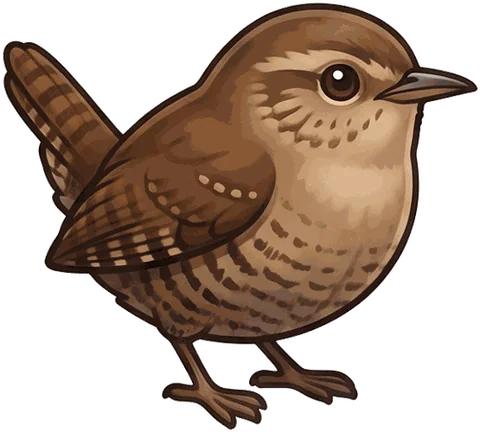
A Winter Wren sounds like a music box that has been wound too tight and let go. The song is a long, high, tumbling run of trills and chattering notes, delivered at about sixteen notes a second and far louder than seems possible from a bird that weighs a third of an ounce. Males sing in spring and summer from conifer forests across the North and high in the Appalachians, often from a high perch. The call is a sharp, explosive kit or kit-kit.
What the song sounds like: the long, tumbling one
The Winter Wren is often identified by song alone, and once you have heard it you will understand why. It is a rapid, high-pitched series of musical trills and chatters that keeps changing as it goes, tumbling up and down without settling into a phrase you could whistle back. And it goes on and on, ringing through the trunks of a quiet spruce woods.
The speed is hard to take in at normal listening. According to BirdNote, the eastern Winter Wren fits sixteen notes into each second of song, so what reaches your ear as a shimmering blur is actually a precise, complicated sequence.
Then there is the volume. BirdNote reports that, gram for gram, a Winter Wren has about ten times the crowing power of a rooster. If a sound that big seems to be coming from a stump or a tangle of roots, you have probably found the singer.
The call: an explosive kit
Away from the song, the Winter Wren gives a sharp, explosive kit! or a doubled kit-kit!, often from somewhere low and out of sight. In fall and winter, listen for it around brush piles, streambanks and fallen logs. Because the bird spends so much time creeping through dense cover, the call is often the easiest way to find it.
When and where you hear it
Winter Wrens breed in moist coniferous forest, especially spruce and fir, from British Columbia east to the Atlantic, usually where there is a dense understory and often near water. One subspecies also breeds high in the mountains from West Virginia to Georgia. In spring the males climb to high perches in the conifers to sing, which is your best chance to see one.
Despite the name, they leave most northern areas for the winter. They pass through and winter across southeastern Canada and the eastern half of the United States, and that is where the name makes sense: in much of the East this is a bird of the cold months, skulking along streambanks and through tangles, brush piles and fallen logs. Migration comes relatively early in spring and late in fall. The species name, hiemalis, is Latin for "of winter."
Nesting happens low, in natural cavities under about six feet: upturned tree roots, rotten stumps, old woodpecker holes, rock crevices, holes in streambanks and now and then the space under a cabin porch. The male builds several extra nests that stay unlined until a female chooses one, and some males have more than one mate. In hard weather Winter Wrens may roost together in a snug hole to stay warm.
What it looks like
A tiny, dark brown wren weighing 8 to 12 grams, with rounded wings and a very short tail that it often cocks straight up. With its short neck it looks like a small brown ball. It is warm brown above, grayer below, and finely barred with darker brown, most strongly on the flanks, with a pale eyebrow over the eye. It looks like a House Wren but has a much shorter tail. It creeps steadily through roots and logs, and its flights are short, quick and direct, on tiny whirring wings.
Birds that sound similar
- ?Pacific Wren
Its western twin sings the same kind of long, tumbling song but even faster, up to 36 notes a second against the Winter Wren's 16. By ear the two are best separated by range and by call notes.
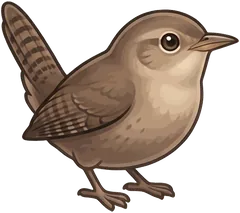 House Wren
A House Wren also bubbles and gurgles, but its song is a short burst that rises and then falls, sung from yards, orchards and woodlots. The Winter Wren's is a long, high run of trills from dark, wet conifer woods.
Where the Winter Wren card lives
In Warble the same bird can be an easy card in one state and a prized one in another, because each album ranks its birds by how often people really report them there. The Winter Wren appears in 6 state albums:
 Heard one? Open Warble, tap the green button while it sings, and the Winter Wren card flips into your album. Get the app free.
Questions people ask
What tiny bird has a very long song in the woods?
In northern and Appalachian conifer forests it is very often a Winter Wren. Its song is a long, high, tumbling run of trills, packed with about sixteen notes a second, and it is shockingly loud for a bird so small.
Why is it called a Winter Wren?
Because across much of the eastern United States it is mostly seen in winter, creeping through brush piles and streambank tangles. In summer it moves north and into the mountains to breed. Its scientific name, hiemalis, means "of winter" in Latin.
How loud is a Winter Wren?
Very, for its size. BirdNote reports that, gram for gram, its song has about ten times the crowing power of a rooster. The whole bird weighs only about a third of an ounce.
Is the Winter Wren the same bird as the Pacific Wren?
Not anymore. They were treated as one species until 2010, when the eastern birds kept the name Winter Wren and the western birds became the Pacific Wren. Studies of their songs and genetics where the two overlap showed they do not interbreed freely.
Sources
- National Audubon Society, Guide to North American Birds: Winter Wren. www.audubon.org/field-guide/bird/winter-wren
- Wikipedia: Winter wren (taxonomy, range, nests, plumage). en.wikipedia.org/wiki/Winter_wren
- BirdNote: Winter Wren (notes per second and song power). www.birdnote.org/node/13746
- National Audubon Society, Guide to North American Birds: Northern House Wren. www.audubon.org/field-guide/bird/northern-house-wren