 Warble


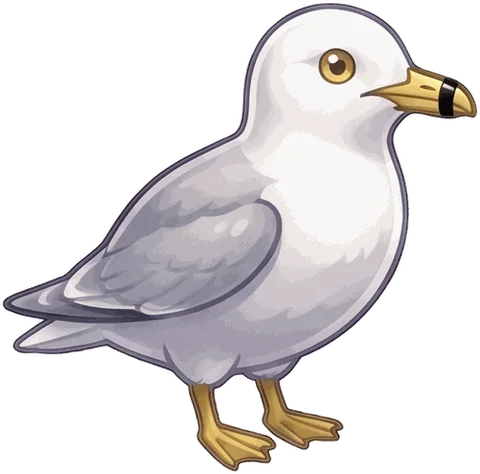
A Ring-billed Gull sounds like the classic seagull, pitched up: a loud, raucous, mewing cry that the Missouri Department of Conservation writes as two syllables, kyah keeya. Audubon and the Missouri guide both say it resembles the Herring Gull's call but is higher. This is the gull most people hear inland, calling over fast-food parking lots, landfills, plowed fields, lakes and reservoirs, and in winter along the Gulf, Atlantic and Pacific coasts. Concentrations at colonies and winter feeding sites can reach tens of thousands of birds.
What the mewing sounds like
Gulls do not sing, but a Ring-billed Gull's call does the job of announcing itself. It is a loud, raucous, mewing cry, and the Missouri Department of Conservation breaks it into two syllables: kyah keeya. Audubon describes the pattern as flat or falling and files it with screams and raucous calls.
The easiest way to learn it is by comparison. Both Audubon and the Missouri guide say it is very like the Herring Gull's call but higher pitched. If you already know a Herring Gull's call, shift it up in pitch and you have the ring-bill in a parking lot.
Parking lots, beaches and the flock
Ring-billed Gulls are sociable all year, and their calls are rarely solo. Flocks rest on parking lots, work the scraps around fast-food restaurants, gather at landfills and search freshly plowed fields for grubs and earthworms. They also congregate at beaches, marinas, docks and parks, especially wherever people feed them, and many beachgoers consider them pests because they steal unguarded food.
Their diet is anything they can get: insects, fish, earthworms, mussels, grain, rodents, eggs, carrion and human food. They forage while walking, wading, swimming or flying, and they steal from other birds. At the nest, chicks peck at a spot on the parent's bill, which prompts the adult to bring up food for them.
When and where you hear it
Audubon calls this often the most common and widespread gull in North America, especially inland, and the Missouri Department of Conservation calls it the inland gull seen most often in the eastern United States. It nests near lakes, rivers and coasts across most of Canada and the northern United States, with big colonies around the Great Lakes. Many inland birds of large lakes and rivers never see salt water at all.
In winter the flocks move south, often following coastlines and major rivers, to the United States and northern Mexico, many of them to the Gulf Coast and the Atlantic and Pacific shores. They are less hardy than Herring Gulls and generally winter farther south. In Missouri they arrive in October, peak from December through February near open water at locks, dams and big reservoirs, and head north in March and April. In Warble the ring-bill is a common card in states such as Illinois, Michigan and New York.
Colonies and a comeback
Ring-bills nest in colonies on the ground near water, often on islands and increasingly on flat factory roofs, sometimes alongside California or Herring Gulls. Courting birds stretch upright and turn toward and away from each other, and the male feeds the female. The nest is a shallow cup of grass, twigs and moss holding two to four eggs, and both parents incubate for 23 to 28 days. Chicks can leave the nest by their second day and fly about five weeks after hatching. Adults tend to return to the same nest site year after year, though not necessarily to the same mate.
It was not always this easy to find one. Egging and hunting for plumes badly depleted the species in the late 1800s. It has since recovered strongly, helped by food from landfills and farm fields, and in some places it now crowds out Common Terns and other nesting birds. One ring-bill seen in Cleveland in 2021 was 28 years old.
What it looks like
A medium-sized gull, 17 to 21 inches long, with a wingspan around four feet. Adults are white with a pale silver-gray back and wings, black wingtips with small white spots, yellow legs, pale eyes and a yellow bill circled near the tip by a neat black ring. Young birds start out largely brown, with pink legs and a pink bill with a dark tip, and they are paler and grayer than young Herring or California Gulls of the same age. The ring is a good mark, but Audubon warns that some Herring Gulls show a dusky ring in winter.
Birds that sound similar
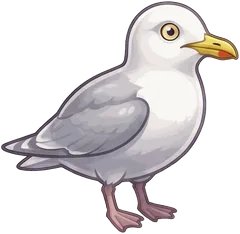 Herring Gull
Audubon and the Missouri Department of Conservation both describe the Herring Gull's call as similar but lower. A higher mewing kyah keeya is the ring-bill. By sight, look for the ring-bill's yellow legs and neatly ringed bill.
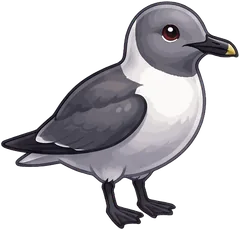 Laughing Gull
The Laughing Gull of Atlantic and Gulf beaches gives a long, high ha-ha-ha-haah-haah-haah laugh of many notes. A ring-bill's call is a shorter, two-part mewing cry. Laughing Gulls also have dark bills and legs.
Where the Ring-billed Gull card lives
In Warble the same bird can be an easy card in one state and a prized one in another, because each album ranks its birds by how often people really report them there. The Ring-billed Gull appears in 47 state albums:
 Heard one? Open Warble, tap the green button while it sings, and the Ring-billed Gull card flips into your album. Get the app free.
More about the Ring-billed Gull on this site
Questions people ask
Why are there seagulls in parking lots far from the ocean?
They are almost always Ring-billed Gulls. This is the common inland gull of North America, nesting around lakes and rivers and feeding on whatever people drop. Flocks rest on parking lots and scavenge around fast-food restaurants and landfills, often far from salt water.
What is the difference between a ring-billed gull and a herring gull call?
Pitch. Both give a loud, raucous, mewing cry, but the Ring-billed Gull's version is higher. The Missouri Department of Conservation writes it as a two-syllable kyah keeya.
Do ring-billed gulls go to the ocean?
Many do in winter, when flocks move to the Gulf Coast and the Atlantic and Pacific shores. But plenty of inland birds on large lakes and rivers never encounter salt water at all.
Why is it called delawarensis?
The scientific name refers to the Delaware River. George Ord described the species in 1815.
Sources
- National Audubon Society, Guide to North American Birds: Ring-billed Gull. www.audubon.org/field-guide/bird/ring-billed-gull
- Missouri Department of Conservation, Field Guide: Ring-billed Gull (call, seasons, foods). mdc.mo.gov/discover-nature/field-guide/ring-billed-gull
- Wikipedia: Ring-billed gull (range, nesting, beach behavior, name, population history). en.wikipedia.org/wiki/Ring-billed_gull
- National Audubon Society, Guide to North American Birds: Laughing Gull. www.audubon.org/field-guide/bird/laughing-gull