 Warble


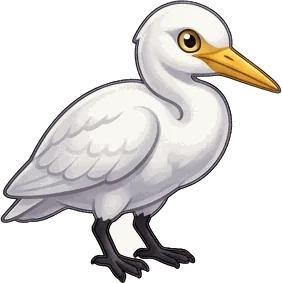
A Great Egret sounds nothing like it looks. For such an elegant white bird, the voice is a low, hoarse, guttural croak, usually given when the bird is disturbed or flushed. Most of the time it is silent. The exception is the nesting colony, where Great Egrets give a loud, croaking cuk cuk cuk and higher squawks, adding to the general din of herons and other waterbirds nesting together. Missouri's field guide notes the voice is like a Great Blue Heron's, only lower and less resonant.
What the croak sounds like
There is no song. Wikipedia describes the Great Egret as not normally vocal, and the call you are most likely to hear is a single low, hoarse croak, given when the bird is disturbed. Audubon calls it guttural. It sounds like someone clearing a rough throat, and it is often the only sound the bird makes as it lifts off a pond edge and flaps slowly away.
The contrast is what sticks. This is the snow-white, long-necked symbol of the National Audubon Society, and startled, it sounds about as ungraceful as a bird can.
At the colony: cuk cuk cuk and squawks
Great Egrets nest in colonies, usually in trees near water and often mixed in with other wading birds, cormorants and Anhingas, and that is where they get noisy. Wikipedia describes a loud, croaking cuk cuk cuk and higher-pitched squawks at breeding colonies, and Audubon mentions loud squawks there too.
Courtship adds more. The male picks a spot, drives other birds away, and then displays for females with calling, a circular display flight and a pose with the neck stretched up and the bill pointed at the sky. If you visit a colony in spring, keep your distance: Missouri's guide warns that alarmed herons may abandon or damage nests, chicks can fall into the water, and bird droppings at colonies can expose people to histoplasmosis, a fungal lung disease.
When and where you hear it
Great Egrets live in temperate and tropical regions around the world, and in the United States they are common across the Sun Belt, especially the South. Look for them in marshes, ponds, lake edges, mudflats, shallow coastal lagoons, estuaries and along wooded rivers, and sometimes in open fields near cattle. They adapt well to people and turn up at wetlands in towns and suburbs. In Warble the egret is a common card in the Florida, Louisiana, Mississippi, South Carolina and Texas albums.
In winter they pull back from northern breeding areas and stay only where water remains open. After breeding they often wander north in late summer. In the 1930s and 1940s these movements were huge, with more than 1,500 birds reaching Massachusetts in 1948, though nothing like those numbers has been seen since. In Missouri they are around from late March to mid-November, with peaks in the first half of May and from mid-July to mid-October, often in big groups on floodplain wetlands such as Eagle Bluffs, Ted Shanks and Schell-Osage Conservation Areas.
The bird's history is the reason it is the Audubon symbol. In the late 1800s plume hunters, killing at nesting colonies for the white breeding feathers used to decorate hats, nearly wiped out the species in the United States. Missouri's guide notes that the slaughter helped lead to the founding of the National Audubon Society. Protection worked: Audubon now estimates about 9.5 million Great Egrets, and the breeding range has been spreading north, though some southern populations have declined with the loss of wetlands.
What it looks like
A tall, all-white heron about three feet long, with a long neck, a yellow bill and black legs and feet. In breeding season long, delicate plumes grow from the back and the bare skin on the face turns bright green. Males and females look alike. In flight it pulls its neck back in, like other herons, and beats its wings slowly.
Great Egrets hunt by standing still or wading slowly in shallow water, then striking fast with the bill. Fish are the main food, plus frogs, crayfish, snakes and insects, and in fields they take grasshoppers and rodents. Nests are big stick platforms, often 10 to 40 feet up. Both parents incubate the eggs for about 23 to 26 days, and the young fly at 6 to 7 weeks. Missouri's guide notes they can live at least 22 years.
Birds that sound similar
 Great Blue Heron
Missouri's field guide notes the two have similar voices, but the egret's croak is lower and less resonant. That is a fine distinction by ear, so look: the egret is all white with black legs. In Florida, the white form of the Great Blue Heron is larger, with pale legs.
 Snowy Egret
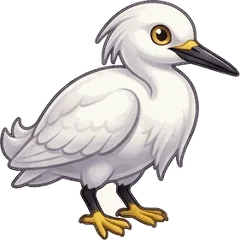
Audubon describes the Snowy Egret's call as a harsh, raucous, croaky squawk, similar to the Great Egret's colony squawks. Settle it by sight: the Snowy is smaller, with a slender black bill and bright yellow feet.
Where the Great Egret card lives
In Warble the same bird can be an easy card in one state and a prized one in another, because each album ranks its birds by how often people really report them there. The Great Egret appears in 36 state albums:
 Heard one? Open Warble, tap the green button while it sings, and the Great Egret card flips into your album. Get the app free.
More about the Great Egret on this site
Questions people ask
What sound does a Great Egret make?
Mostly a low, hoarse, guttural croak, given when the bird is disturbed. Great Egrets are usually quiet, but at nesting colonies they give a loud, croaking cuk cuk cuk and higher squawks.
Why is the Great Egret the symbol of the National Audubon Society?
Because its rescue is the society's founding story. Plume hunters nearly wiped out the species in the United States in the late 1800s, and the fight to stop the killing and protect the colonies helped lead to the National Audubon Society.
How do you tell a Great Egret from a Snowy Egret?
Look at the bill and feet. The Great Egret is larger, with a yellow bill and black legs and feet. The Snowy Egret has a slender black bill and bright yellow feet. Their calls, a croak and a harsh squawk, are not much help.
Is it safe to visit an egret colony?
From a distance. Disturbed herons may abandon or damage their nests, and droppings at colonies can expose people to histoplasmosis, a fungal respiratory disease. Missouri's Department of Conservation advises keeping back and using binoculars or a scope.
Sources
- National Audubon Society, Guide to North American Birds: Great Egret. www.audubon.org/field-guide/bird/great-egret
- Wikipedia: Great egret (calls, range, breeding, plume trade, Audubon symbol). en.wikipedia.org/wiki/Great_egret
- Missouri Department of Conservation, Field Guide: Great Egret. mdc.mo.gov/discover-nature/field-guide/great-egret
- National Audubon Society, Guide to North American Birds: Snowy Egret. www.audubon.org/field-guide/bird/snowy-egret