 Warble


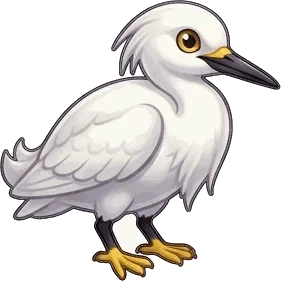
A Snowy Egret sounds much rougher than it looks. It has no song, just a harsh, flat squawk with a croaking, almost quacking quality, given when the bird is disturbed, squabbling with a neighbor or calling at the nest. Most of what you hear comes from breeding colonies in spring, where the squawks and croaks of many egrets and other waders pile into a raucous din and the chicks add soft, buzzing begging calls. Listen in marshes, mangroves, tidal creeks and shallow bays, all year in Florida and along the southern coasts.
What it sounds like: a harsh squawk
Do not expect a song. Audubon's field guide sums up the whole voice in two words, a harsh squawk, and tags it as flat, simple and falling, with a croaking or quacking edge. Coming from such a dainty white bird, it sounds like a ballerina clearing her throat, and you mostly hear it in moments of conflict or courtship.
Animal Diversity Web describes two registers in the adult voice. Low-pitched calls go with aggression, and the sign that a fight is about to start is visual as much as vocal: the egret stands tall with every feather raised before it attacks another bird. High-pitched calls are mostly a male sound, used to attract a mate, and are also linked to good feeding sites. Greeting calls are common, and calls also help defend the nest.
Nestlings make soft, buzzing calls, a thin sound that is easy to miss under the squawking adults.
At the colony: displays and din
The breeding colony, usually shared with other wading birds, is where a Snowy Egret is easiest to hear. The male picks the nest site and displays there to drive off rivals and attract a female. He points his bill straight up, raises all his plumes and pumps his head up and down while calling. He may also fly circles around the site, climb high and then tumble back down.
Both members of the pair build a platform of sticks, usually 5 to 10 feet up in a tree, shrub or mangrove, though some nest on or near the ground in a marsh. A clutch is usually three to five pale blue-green eggs, both parents incubate for around three weeks, and both feed the chicks. The last chick to hatch sometimes starves.
When and where you hear it
Snowy Egrets live year round in parts of Florida, along the southern coasts and in the Pacific lowlands. Birds that breed farther north leave for winter, generally heading south in September and returning from early March, and egrets banded in the United States have turned up as far away as Panama and Trinidad. In recent decades the species has pushed its breeding range far north of its old limits, and it now nests as far north as Nova Scotia. Some also wander north after nesting.
Look for them in marshes, swamps, ponds and shorelines, in fresh water and salt. On the coast they favor sheltered bays, salt-marsh pools, tidal channels and mangroves; inland they stick to large wetlands. Nesting starts in late March or early April, so colonies are loudest in spring. Snowies are most active at dawn and dusk and spend much of the middle of the day resting, so early morning and evening are the times to watch and listen.
A feeding Snowy Egret walks or even runs through the shallows, stirs the mud with one foot to flush prey, hovers briefly before dropping to the water, or follows cattle in a field to grab the insects they kick up. It takes fish, crabs, crayfish, frogs, snakes, worms and insects. Since the bird gives you only a squawk now and then, a colony in spring is the easiest place to get one on a recording for Warble.
What it looks like
A small, slim, all-white heron, 22 to 26 inches long with a wingspan of a little over 3 feet, weighing under a pound. The bill is thin and black, the bare skin in front of the eye is yellow, and the black legs end in bright yellow feet, the famous golden slippers. In breeding season adults grow long, lacy plumes on the back, and the feet turn from yellow toward orange. Young birds have greenish legs at first and a gray base to the bill.
Those plumes nearly ended the species: in the late 1800s hunters shot so many snowies for hat feathers that few were left. Legal protection let the egret recover, and Audubon now counts it as widespread and common, with a population around 2.1 million that is probably still growing. The oldest known wild Snowy Egret, in Utah, lived almost 23 years.
Birds that sound similar
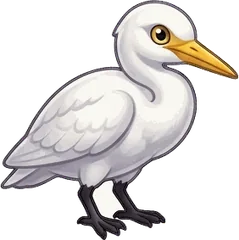 Great Egret
Its voice is a guttural croak, with loud squawks at the colony, so by ear the two egrets are hard to split. The Great Egret is far bigger, about 3 to 3.5 feet long, with a yellow bill and black feet.
- ?Little Blue Heron
Usually silent, it squawks when alarmed and croaks and screams at colonies, so a squawk proves little. Young Little Blues are white too: look for gray skin in front of the eye and dull greenish legs instead of yellow lores and golden feet.
Where the Snowy Egret card lives
In Warble the same bird can be an easy card in one state and a prized one in another, because each album ranks its birds by how often people really report them there. The Snowy Egret appears in 17 state albums:
 Heard one? Open Warble, tap the green button while it sings, and the Snowy Egret card flips into your album. Get the app free.
More about the Snowy Egret on this site
Questions people ask
What noise does a Snowy Egret make?
A harsh, flat squawk with a croaking or quacking sound. It does not sing. Adults use higher calls in courtship and lower ones in fights, and chicks give soft buzzing calls. The noise is loudest at nesting colonies in spring.
Why is the Snowy Egret called golden slippers?
Because its black legs end in bright yellow feet, which look like a pair of slippers when the bird wades. In breeding season the feet shift toward orange.
Were Snowy Egrets hunted for their feathers?
Yes. In the late 1800s plume hunters killed so many for the lacy breeding feathers used on hats that the species was decimated. Legal protection allowed it to recover, and it is common and widespread today.
Sources
- National Audubon Society, Guide to North American Birds: Snowy Egret. www.audubon.org/field-guide/bird/snowy-egret
- Animal Diversity Web: Egretta thula, snowy egret (communication, breeding, behavior, lifespan). animaldiversity.org/accounts/Egretta_thula/
- National Audubon Society, Guide to North American Birds: Great Egret (voice and size). www.audubon.org/field-guide/bird/great-egret
- National Audubon Society, Guide to North American Birds: Little Blue Heron (voice and immature plumage). www.audubon.org/field-guide/bird/little-blue-heron