 Warble
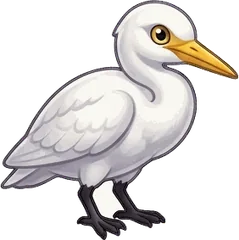
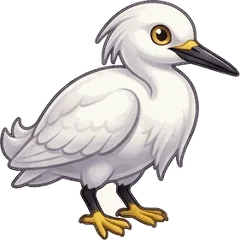
Look at the bill and the feet. A Great Egret has a long yellow bill and black legs and feet, and it is three feet long or more. A Snowy Egret is about two feet long, with a slim black bill and black legs that end in bright yellow feet, the famous golden slippers. Behavior backs it up: the Great Egret stands still and waits, while the Snowy rushes about stirring the mud with its feet. Neither says much. A Great Egret croaks low; a Snowy gives a harsh squawk.
Side by side
| Great Egret | Snowy Egret | |
|---|---|---|
| Size | 35 to 41 inches long, wingspan about 4 feet 7 inches | 22 to 26 inches long, wingspan 3 feet 3 to 3 feet 7 inches |
| Bill | Long, heavy and yellow | Slim and black, yellow skin in front of the eye |
| Legs and feet | Black legs, black feet | Black legs, bright yellow feet |
| Breeding plumes | Long, lacy plumes on the back | Plumes on the head, neck and wings |
| Feeding style | Stands still or wades slowly, then strikes | Walks, runs and hops, stirring the bottom with its feet; may hover |
| Voice | Seldom heard: a low, hoarse croak; croaks and squawks at colonies | A harsh, flat, falling squawk, raucous at colonies |
| Where and when | Marshes, ponds, shores, mudflats; common in the South, leaves frozen country in winter | Fresh and salt marshes, sheltered bays; resident in Florida, southern coasts and Pacific lowlands |
By sight: the bill and the feet
Both birds are white from head to tail, so skip the plumage and look at the two ends. The Great Egret's bill is long, heavy and yellow, and its legs and feet are black all the way down. The Snowy Egret reverses the pattern: a slim black bill with a patch of bare yellow skin in front of the eye, and black legs that finish in bright yellow feet. Once you have seen those golden slippers flash under the water, you will not mix the two up again.
Size helps when they stand together. A Great Egret is only a little shorter than a Great Blue Heron and averages a little over two pounds; a Snowy weighs roughly 13 to 15 ounces. In the breeding season the Great Egret grows long plumes from its back, the Snowy from its head, neck and wings.
Two other white birds cause most of the trouble. A young Snowy has greenish legs and a grayish base to the bill, much like a young Little Blue Heron, which has a gray bill with a black tip and gray skin in front of the eye rather than yellow. The Cattle Egret is smaller than either, with a short, thick yellow bill and, as an adult, yellow legs.
By behavior: the statue and the dancer
How each bird hunts is almost as good as a field mark. A Great Egret is a patient stalker. It stands in shallow water or wades forward very slowly, neck stretched out, waits for a fish or frog to come within reach, then strikes with one quick thrust of the bill. It also hunts grasshoppers and rodents in dry fields.
A Snowy Egret hunts with its feet. It walks or runs through the shallows, sometimes hops, and stirs up the bottom to flush fish, crabs and crayfish before spearing them. It may hover before dropping onto prey. A white egret dashing back and forth with its feet churning the mud is almost certainly a Snowy. In the air both pull the neck back against the body, as herons do, and the Great Egret flies more slowly.
By ear: a croak and a squawk
Away from a nesting colony you will seldom hear either egret. The Great Egret is not normally vocal. One you flush from a ditch lifts off with a low, hoarse croak, which Audubon calls guttural, and at a nesting colony it adds louder croaking and higher squawks.
The Snowy's call is a harsh squawk, flat and falling, closer to a raucous croak or quack than to a voice. It sounds far too rough for such a dainty bird, and it is loudest at the colony. So a low croak from a big white bird flushing off a pond suggests a Great Egret, and a harsh squawk from a small one suggests a Snowy. But both birds croak and squawk, so check the bill and feet before you decide.
Where you will meet each one
The Great Egret uses marshes, ponds, shores and mudflats, estuaries and wooded rivers, and it adapts well to people, turning up at town and suburban wetlands. It is common in the South, and its breeding range has crept north into southern Canada. In winter it leaves places where water freezes; in late summer many birds wander well north of where they nested.
The Snowy Egret works fresh and salt water alike, favoring sheltered bays on the coast and large wetlands inland. It stays all year in parts of Florida, along the southern coasts and in the Pacific lowlands. Northern breeders winter from the Gulf Coast to South America; birds banded in the United States have turned up in Panama.
Both nest in mixed colonies, where the Great Egret tends to build high, usually 10 to 40 feet up, and the Snowy lower, often 5 to 10 feet. Both were nearly wiped out by plume hunters in the late 1800s and recovered under protection, and the Great Egret's comeback made it the symbol of the National Audubon Society.
 Still not sure which one is outside? Warble listens while it sings and tells you, then adds the card to your album. Get the app free.
Questions people ask
What is the difference between a Great Egret and a Snowy Egret?
The bill and the feet. A Great Egret has a yellow bill and black legs and feet, and it is three feet long or more. A Snowy Egret is about two feet long, with a black bill and bright yellow feet on black legs.
What sound does an egret make?
Usually none. Great Egrets are not normally vocal; a disturbed bird gives a low, hoarse croak, and colonies are noisier. Snowy Egrets give a harsh, flat squawk, loudest around the colony.
What white heron has yellow legs?
Not an adult Snowy Egret, whose legs are black with only the feet yellow. A small white heron with yellow legs and a short, thick yellow bill is an adult Cattle Egret. Young Snowy Egrets and young Little Blue Herons have greenish legs.
Sources
- National Audubon Society, Guide to North American Birds: Great Egret. www.audubon.org/field-guide/bird/great-egret
- National Audubon Society, Guide to North American Birds: Snowy Egret. www.audubon.org/field-guide/bird/snowy-egret
- Wikipedia: Great egret (voice, flight, size, similar species, range). en.wikipedia.org/wiki/Great_egret
- Missouri Department of Conservation field guide: Snowy Egret (similar species, breeding plumes, foraging, winter range). mdc.mo.gov/discover-nature/field-guide/snowy-egret