 Warble


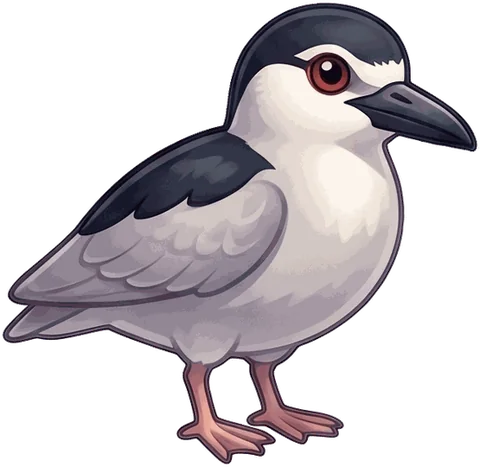
A Black-crowned Night-Heron sounds like a single, loud bark in the dark: a deep, guttural quok!, also written kwok, quawk or woc. You hear it most at dusk and at night, often from a bird flying over toward its feeding grounds, so plenty of people hear it without ever seeing the bird. At nesting colonies the same species becomes very noisy, with a mix of croaks, barks and other harsh calls. Its scientific name, Nycticorax, means night raven, which fits the sound well.
What the quok sounds like
The call people search for is one short, loud note. Audubon describes a loud, barking kwok! or quawk!, and Missouri's field guide a deep, guttural quoc or qwoock heard as the birds move about in darkness and twilight. It has no melody and no rhythm to speak of. It sounds like a single word shouted once, often by a bird you cannot see.
Flying over darkened ground, it gives a wok. Because the birds commute at dusk from daytime roosts to feeding areas, the classic encounter is a lakeshore or riverside park at nightfall: a heavy shape flapping over in the last light, and that one barking note.
Its name tells the same story. The scientific name Nycticorax comes from ancient Greek words for night and raven, and a deep, croaking call in the dark is exactly what a night raven would sound like.
The colony: barks, croaks and a racket
A night-heron colony is a different matter. Wikipedia calls these very noisy birds in their nesting colonies, and Audubon lists a variety of croaks, barks and other harsh calls given there. Colonies can hold night-herons alone or mix them with other herons, egrets and ibises, and some sites have been used for decades, so a colony can stay noisy for years.
When and where you hear it
Dusk is the time. By day, Black-crowned Night-Herons look dull and sleepy, sitting hunched in trees or dense bushes near water. As the light fades they fly out to feed, and they forage mostly from late evening through the night, though they may feed by day during the breeding season. Some studies suggest night feeding helps them avoid competition with bigger herons and egrets. Their habitat is broad: marshes, rivers, ponds, mangroves, tidal flats, canals and rice fields, both fresh and salt.
This is a truly global bird, nesting on every continent except Australia and Antarctica. In North America, northern birds migrate south and winter from Mexico to the West Indies, while some along the Pacific Coast and in the southern United States likely stay all year. Oakland, California, made it the official city bird; it is common at Lake Merritt and downtown. Night-herons have summered at the National Zoo in Washington, DC, for more than a century. In Warble it is a common card in the Hawaii album.
Audubon puts the population at about 3 million. Numbers likely fell in the twentieth century because of habitat loss and pesticides such as DDT, and many local populations have grown since DDT was banned. In Missouri, where the main breeding colonies are in the Mississippi Lowlands, it is a species of conservation concern.
What it looks like
A stocky, heavy-bodied heron about 23 to 26 inches long, with a shorter neck, bill and legs than most herons. Adults have a black crown and back, pale gray wings, gray-white underparts, red eyes and short yellow legs, and in breeding season long white plumes grow from the head. During courtship the legs briefly turn salmon-pink. Young birds look like a different species: brown, streaked and spotted with white, with orange eyes.
Night-herons hunt by standing still at the water's edge, or on a piling or a boat, and waiting. They eat mostly fish but take almost anything they can catch, from crayfish, frogs and snakes to rodents, and they sometimes raid tern colonies for eggs and chicks. They are also one of a handful of herons known to bait fish, dropping floating objects on the water to lure fish within reach. Nests are stick platforms, usually 10 to 40 feet up, and the young fly at about six weeks.
Birds that sound similar
- ?Yellow-crowned Night-Heron
Its call is similar but higher. Missouri's guide notes the Black-crowned's quok is lower-pitched than the Yellow-crowned's. Adults are easy to tell apart on sight: the Yellow-crowned has a creamy-white crown and cheek patch.
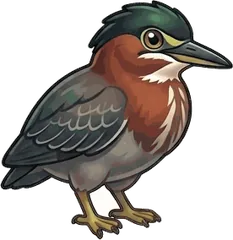 Green Heron
The smaller Green Heron's call is a sharp, raucous kyowk! or skyow! that falls in pitch. The night-heron's is a deep, guttural bark.
Where the Black-crowned Night-Heron card lives
In Warble the same bird can be an easy card in one state and a prized one in another, because each album ranks its birds by how often people really report them there. The Black-crowned Night-Heron appears in 5 state albums:
 Heard one? Open Warble, tap the green button while it sings, and the Black-crowned Night-Heron card flips into your album. Get the app free.
More about the Black-crowned Night-Heron on this site
Questions people ask
What bird says quok at night?
Most likely a Black-crowned Night-Heron. Its loud, barking quok or kwok is heard mostly at dusk and after dark, often from a bird flying overhead on its way to feed at a marsh, pond or river.
Why is it called a night heron?
Because it does most of its feeding from late evening through the night and spends the day resting in trees. Its scientific name, Nycticorax, goes further and calls it a night raven, after its croaking voice.
Where do Black-crowned Night-Herons sleep during the day?
In trees or dense bushes near water, usually sitting hunched and still. They become active at dusk, when they fly out to feeding areas, which is when you are most likely to hear the quok.
What city has the Black-crowned Night-Heron as its official bird?
Oakland, California. The heron is common around Lake Merritt and downtown Oakland, and there is a large rookery near San Francisco Bay.
Sources
- National Audubon Society, Guide to North American Birds: Black-crowned Night Heron. www.audubon.org/field-guide/bird/black-crowned-night-heron
- Wikipedia: Black-crowned night heron (name, calls, range, bait fishing, Oakland). en.wikipedia.org/wiki/Black-crowned_night_heron
- Missouri Department of Conservation, Field Guide: Black-crowned Night Heron. mdc.mo.gov/discover-nature/field-guide/black-crowned-night-heron
- National Audubon Society, Guide to North American Birds: Green Heron. www.audubon.org/field-guide/bird/green-heron