 Warble


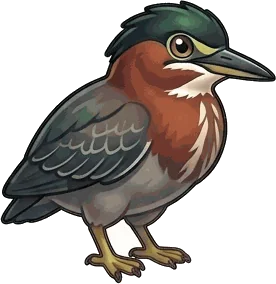
A Green Heron sounds like a pair of rusty scissors snapping shut. Its main call is one loud, sudden, harsh note that falls in pitch, written skyow!, kyowk! or skowp! (people also type it as skeow), given when the bird is disturbed or flying off. Often you hear it from a small, dark heron flushing ahead of you along a quiet, tree-lined creek or pond edge. It also makes softer kuk notes, and males have a set of odd courtship calls in spring.
What the skyow sounds like
The Green Heron's signature sound is a single explosive syllable. Audubon writes it kyowk! or skyow! and describes it as falling, flat, raucous and a little odd. Missouri's field guide spells it skowp! and offers the best description going: it sounds like closing a pair of rusty scissors. Wikipedia calls it loud and sudden. Put those together and you have the sound: one harsh, downward snap of a note.
A typical meeting goes like this. You are walking a creek or paddling along a wooded shore, a small dark bird you never noticed bursts from the bank, and it lets out one indignant skyow as it flies. Missouri's guide notes the call is given when the bird is disturbed or in flight, and Audubon notes that Green Herons often flush ahead of people along quiet creeks.
The other calls: kuk notes and courtship
Besides the main call, Green Herons give a series of quieter kuk notes. The more surprising sounds come in spring. A courting male calls raah-rahh with his bill wide open, makes noisy flights with his head and neck feathers puffed out, calls whoom-whoom-whoom in the air and sometimes roo-roo to the female before landing. While perched, he adds an aaroo-aaroo.
The male picks the territory and calls from a prominent perch. Audubon describes his displays: stretching the neck forward and snapping the bill, or pointing the bill up and swaying.
When and where you hear it
Green Herons are summer birds over most of the United States. They breed from southeastern Canada through the central and southern states east of the Rockies, with another population west of the Rockies down to northern Baja California. Northern birds arrive in March and April, start fall migration in September, and are gone by late October from places where they do not stay all year. In Missouri the heron is a common summer resident from mid-April through late October, with peak numbers from mid-May through August. Wikipedia notes they arrive at the same time they did a century ago.
Look and listen around small bodies of fresh water, especially ponds, creeks and marshes edged with trees, shrubs or tall marsh plants. In winter they withdraw to the southernmost tier of the country and south as far as Panama and northern South America. Audubon puts the population at about 1.2 million, describes it as apparently stable, and notes the bird may be pushing north in parts of the Northwest. In Warble it is a legendary card in the Missouri and New York albums.
The fishing trick
The Green Heron is one of the few birds known to use tools. It drops a feather, a twig, an insect or even a crust of bread onto the water, waits for a fish to come and investigate, and grabs it. Missouri's guide notes that this is part of why many people think of the bird as intelligent, and it raises a question nobody has settled: whether the skill is inherited, learned by watching others, or a mix of both.
What it looks like
A stocky, crow-sized heron that usually sits with its neck pulled in tight against its body. Adults have a chestnut neck with a white line down the front, a dark crown that can be raised into a bushy crest, and a back glossed green or blue that often looks just dark in poor light. The legs are short and yellow to orange. Young birds are duller and browner, with a streaked neck. On an exposed perch, a nervous Green Heron flicks its tail and raises and lowers its crest.
When it strikes, the folded neck shoots out surprisingly far. It eats mostly small fish, plus crayfish, frogs, tadpoles and aquatic insects. Pairs usually nest alone or in small groups, on a stick platform in a shrub or tree, often over water, and both parents incubate the three to five pale green eggs for 19 to 21 days. Old Ozark nicknames for the bird include fly-up-the-creek and shikepoke.
Birds that sound similar
- ?Yellow-crowned Night-Heron
Its call is a loud, flat, raucous quawk!, a croak rather than the Green Heron's falling, rusty-scissors snap. It feeds at dusk and at night as well as by day, around cypress swamps, bayous, mangroves and streams.
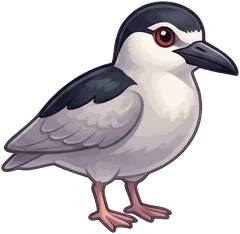 Black-crowned Night-Heron
Audubon describes the Yellow-crowned's quawk as higher than this bird's, so the Black-crowned gives a deeper version of the same croak. If you see it, it is larger and grayer than a Green Heron, with a thicker, shorter bill.
Where the Green Heron card lives
In Warble the same bird can be an easy card in one state and a prized one in another, because each album ranks its birds by how often people really report them there. The Green Heron appears in 26 state albums:
 Heard one? Open Warble, tap the green button while it sings, and the Green Heron card flips into your album. Get the app free.
Questions people ask
What bird makes a loud skeow sound by a creek?
Usually a Green Heron. Its call is a single harsh, falling note, written skyow, kyowk or skowp, given when it is disturbed or takes flight. Missouri's field guide compares it to closing a pair of rusty scissors.
Do Green Herons really use bait to fish?
Yes. Green Herons are one of the few tool-using birds. They drop feathers, twigs, insects or bread on the water to lure fish within reach, then grab whatever comes to look.
Why is the Green Heron called fly-up-the-creek?
It is an old Ozark nickname, recorded by Missouri's Department of Conservation along with shikepoke. It suits a bird that so often flushes ahead of you along a quiet creek, calling as it goes.
Where do Green Herons go in winter?
South. Northern birds leave by late October and winter from the southernmost United States to northern South America. They come back north in March and April.
Sources
- National Audubon Society, Guide to North American Birds: Green Heron. www.audubon.org/field-guide/bird/green-heron
- Wikipedia: Green heron (calls, courtship calls, range, migration, tool use). en.wikipedia.org/wiki/Green_heron
- Missouri Department of Conservation, Field Guide: Green Heron. mdc.mo.gov/discover-nature/field-guide/green-heron
- National Audubon Society, Guide to North American Birds: Yellow-crowned Night Heron. www.audubon.org/field-guide/bird/yellow-crowned-night-heron