 Warble
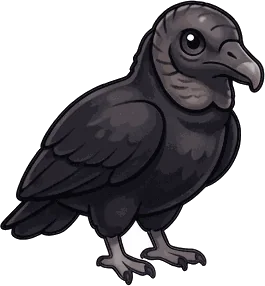
A Black Vulture has no song and almost no voice. Like the Turkey Vulture it lacks a syrinx, so all it can do is hiss and grunt, and even that is seldom heard: at a carcass, during courtship or when a bird feels cornered. Learn it by sight instead. It soars on flat wings, breaks its glides with a few quick, choppy flaps, and shows a short square tail and a pale patch near each wingtip. The bare head is gray-black at every age.
Does it sing? No: hisses and grunts
There is nothing to learn by ear here in the usual sense. The Black Vulture has no syrinx, the organ birds use to make calls and songs, and Wikipedia and the Missouri Department of Conservation both note that this leaves it with only grunts and hisses. Audubon adds that even these are seldom heard. Wikipedia places them when the bird is agitated or feeding.
The likeliest place to hear one, then, is a carcass crowded with Black Vultures. They forage in groups, they are aggressive at food, and a flock can push a Turkey Vulture off a meal even though the Turkey Vulture is slightly larger. The hissing is the sound of that shoving match.
Courtship hisses and other close-range sounds
The other time Black Vultures make noise is courtship. Audubon describes a male walking circles around a female on the ground, neck stretched out, hissing as he goes. Wikipedia adds that several males may circle one female at once, wings half open, strutting and bobbing their heads. Pairs then stay together year-round for the long term, according to Missouri's guide.
Get too close to a Black Vulture and the hiss may be followed by something else. A disturbed bird throws up, which drives off predators and makes it light enough to take off quickly.
When and where you see it
Black Vultures live from the mid-Atlantic states, the southern Midwest and the southern United States through Mexico and Central America to most of South America. Audubon calls them abundant in the Southeast and scarce in the Southwest. Most stay put all year. They like open lowland with woods nearby, such as coastal plains, because they hunt over open ground but roost and nest in forest. They also avoid crossing open water, which is why they are missing from the Florida Keys.
The range is moving north. Audubon notes the expansion in the Northeast and says more birds now winter there, usually in roosts with Turkey Vultures. In Missouri the Black Vulture is an uncommon year-round resident in the south and center and accidental in the north, and sightings are rising.
The diet is mostly carrion: deer, raccoons, opossums, armadillos, roadkill and landfill scraps. Its sense of smell is weaker than the Turkey Vulture's, so it flies high, watches for other vultures dropping down and follows them in. It also occasionally kills small or newborn animals, including young livestock.
No nest is built. Usually two eggs go on the ground in a dark spot such as a cave, a thicket or a hollow tree, and Florida birds can start as early as January. Young fly at 75 to 80 days, but parents keep feeding them for up to eight months, and the family stays together to find food. A Black Vulture can live 25 years.
How to know one overhead
- Flat wings. A Black Vulture glides with its wings held nearly level, with none of the Turkey Vulture's V or wobble.
- Flap, flap, flap, glide. Its shorter wings make soaring less efficient, so it breaks glides with bursts of quick flapping.
- White wingtip patches. The bases of the outer flight feathers are white, making a pale patch near each tip.
- A short, square tail and a stocky, big-headed look. It is about the same body size as a Turkey Vulture but looks smaller.
- Height. Black Vultures often soar higher than Turkey Vultures and follow them.
What it looks like
Glossy black, about 25 inches long with a wingspan near 58 inches, per Missouri's guide. The head and neck are bare, with wrinkled gray-black skin. The nostrils have no dividing wall, so from the side you can see right through the beak. The legs are grayish white and usually streaked whiter still, because vultures cool off by excreting on them. You will often see one standing with its wings spread open, a pose thought to dry the feathers, warm the body and bake off bacteria.
Birds that sound similar
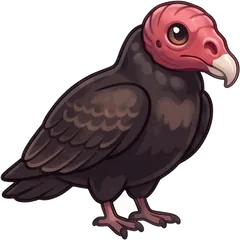 Turkey Vulture
The Turkey Vulture has the same hisses and grunts, so listening will not help. It soars with wings in a V, rocks side to side, shows a silvery trailing half to the wing, and adults have a red head.
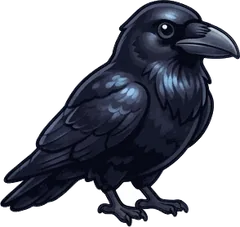 Common Raven
A Common Raven soaring high can look like a small black vulture, but it calls: a deep, guttural croak or a hollow wonk-wonk. Look for its wedge-shaped tail and thick bill.
Where the Black Vulture card lives
In Warble the same bird can be an easy card in one state and a prized one in another, because each album ranks its birds by how often people really report them there. The Black Vulture appears in 19 state albums:
 Heard one? Open Warble, tap the green button while it sings, and the Black Vulture card flips into your album. Get the app free.
More about the Black Vulture on this site
Questions people ask
Do black vultures make any noise?
Very little. Black Vultures have no syrinx, so they can only hiss and grunt, and they seldom do even that. You might hear hissing at a crowded carcass or from a courting male circling a female on the ground.
Do black vultures kill livestock?
Occasionally. Wikipedia calls it the only New World vulture known to prey on cattle, mostly newborn calves, lambs and piglets. But such attacks are rarely seen, and vultures gather fast at any carcass, so it is unclear how many reported deaths they actually cause.
Are black vultures moving north?
Yes. Audubon and Missouri's conservation department both describe a northward expansion, with more birds wintering in the Northeast and more sightings in Missouri. Abundant roadkill, climate change and changes in nesting habitat appear to be driving it.
How can you tell a black vulture from a turkey vulture?
By the wings. The Black Vulture holds them flat, flaps often and shows white only near the tips. The Turkey Vulture holds them in a V, rocks as it soars and rarely flaps.
Sources
- National Audubon Society, Guide to North American Birds: Black Vulture. www.audubon.org/field-guide/bird/black-vulture
- Wikipedia: Black vulture (syrinx, flight, diet, livestock, courtship, nesting, defense). en.wikipedia.org/wiki/Black_vulture
- Missouri Department of Conservation, Field Guide: Black Vulture. mdc.mo.gov/discover-nature/field-guide/black-vulture
- National Audubon Society, Guide to North American Birds: Common Raven (voice and shape). www.audubon.org/field-guide/bird/common-raven