 Warble


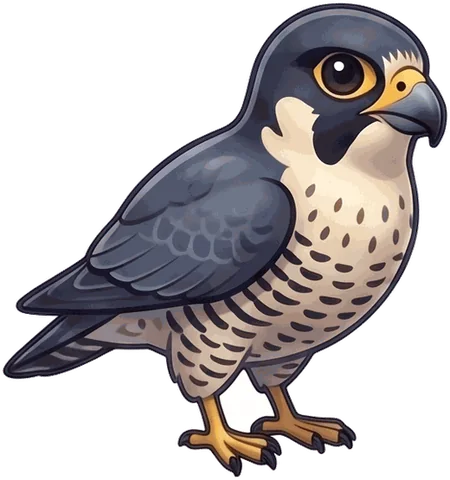
A Peregrine Falcon sounds like a harsh, rasping kack-kack-kack-kack, a fast run of grating notes that Audubon says is usually heard near the nest. Away from it the bird is mostly silent. Close to a nest you may also hear chicks begging with a screechy screea, screea and adults giving quick chitters and a kee-u-chip. So the place to hear a peregrine is under a nesting cliff, bridge or downtown ledge in spring, when the adults scold anything that comes too close.
The kack: a rasping alarm
Peregrines do not sing. Their best-known sound is the alarm, a series of harsh, rasping notes that Audubon writes as kack-kack-kack-kack and Animal Diversity Web as kaa-a-aack, kaa-a-ack. It is a scolding, ratcheting sound aimed at anything that comes too near the nest.
The call is also surprisingly personal. According to Animal Diversity Web, researchers could tell individual peregrines apart by their alarm calls in 72 to 90 percent of cases, which means each bird scolds with its own recognizable voice.
Most peregrine sounds belong to the breeding season. Calls pass between mates, between parents and young, and between rivals. Outside of that, a hunting peregrine may give a quick string of sharp kee, kee, kee notes, but for most of the year this is a quiet bird.
Chitters, chips and begging chicks
Near the nest the vocabulary gets bigger. The chitter is a rapid run of chi chi chi chi notes used in several situations. The kee-u-chip is a three-part call with most of its punch in the final chip. Chicks beg with a repeated, screechy screea, screea, screea, and young birds stay dependent on their parents for about six weeks after they leave the ledge. That is the time to listen, while parents drop prey in midair for the young to catch.
When and where you hear it
The peregrine lives on every continent except Antarctica, though it is uncommon in most places. In North America it nests on cliffs from mountains to the coast, often near water, and more and more on the ledges of tall buildings and bridges, which stand in for cliffs. In cities, feral pigeons can make up 80 percent or more of what it eats. Breeding runs from March to May depending on latitude. There is no nest, just a shallow scrape, usually with three or four eggs, and pairs often stay together for many seasons.
Some peregrines stay put all year, including those on the Pacific Northwest coast. Arctic breeders are long-distance migrants that winter in Central and South America, and migrants often follow coastlines and turn up well out at sea. The scientific name means wandering falcon, after those journeys.
The bird nearly vanished from the United States. In the middle of the 20th century DDT and similar pesticides built up in its prey and caused widespread breeding failure, and the peregrines of eastern North America died out. After DDT was banned in the early 1970s, nest protection and releases brought peregrines back, and the species came off the federal endangered list on August 25, 1999. A spring visit to a known nest ledge is the best chance to catch a peregrine in Warble, since the bird is so quiet the rest of the year.
The stoop
The peregrine's signature move is silent. It climbs high, then folds into a steep dive called a stoop and strikes a flying bird from above. Large prey is knocked down and eaten where it falls. It also chases birds in level flight or skims low over land and water to surprise them, and it takes prey from songbirds up to geese and large gulls.
How fast is the stoop? Sources disagree. Audubon says the bird may possibly reach about 200 mph, Animal Diversity Web says it has been clocked at over 180 mph, and Wikipedia reports a 242 mph stoop recorded by a falconer in 2005, while noting that radar has reliably measured 114 mph. Animal Diversity Web calls it perhaps the fastest animal on earth.
What it looks like
A crow-sized falcon, 14 to 19 inches long, with long pointed wings and strong, shallow wingbeats. Adults are blue-gray above and finely barred below, with a black crown and a thick black moustache on the cheek that gives a hooded look. Young birds are browner and streaked below rather than barred. Females are larger than males, by up to 30 percent according to Wikipedia. Arctic birds are paler overall.
Birds that sound similar
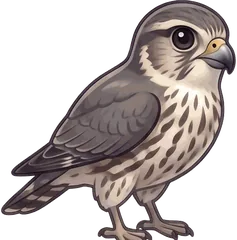 Merlin
The Merlin gives a high, loud cackle that can sound like a small peregrine alarm, and like the peregrine it is usually silent. It is much smaller, robin to crow size, and seldom dives from great height.
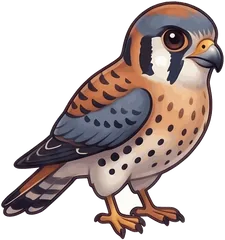 American Kestrel
Audubon writes the kestrel's call as klee-klee-klee, the same syllables it uses for the Merlin. A run of klee notes points to the small falcons; the peregrine's alarm is a rasping kack.
Where the Peregrine Falcon card lives
In Warble the same bird can be an easy card in one state and a prized one in another, because each album ranks its birds by how often people really report them there. The Peregrine Falcon appears in 1 state albums:
 Heard one? Open Warble, tap the green button while it sings, and the Peregrine Falcon card flips into your album. Get the app free.
Questions people ask
What does a baby peregrine falcon sound like?
A repeated, screechy screea, screea, screea. Chicks and fledglings beg with it whenever a parent appears, and they stay dependent for about six weeks after leaving the nest ledge, so the begging goes on well into summer.
How fast is a peregrine falcon?
Very fast, but figures vary. Audubon and Animal Diversity Web cite stoops of 180 to 200 mph, a falconer recorded 242 mph in 2005, and radar has reliably measured 114 mph.
Do peregrine falcons live in cities?
Yes. Tall buildings and bridges work like cliff ledges, so peregrines nest on them in many cities, and pigeons can make up 80 percent or more of the diet of urban birds. Listen for the rasping alarm near the nest in spring.
Is the peregrine falcon still endangered?
No. After DDT wiped it out of much of North America, the peregrine recovered with a pesticide ban, nest protection and releases. It was removed from the US endangered species list on August 25, 1999, and populations look stable or increasing.
Sources
- National Audubon Society, Guide to North American Birds: Peregrine Falcon. www.audubon.org/field-guide/bird/peregrine-falcon
- Animal Diversity Web, University of Michigan: Falco peregrinus (calls, breeding, speed). animaldiversity.org/accounts/Falco_peregrinus/
- Wikipedia: Peregrine falcon (urban diet, subspecies, DDT recovery, stoop speed, name). en.wikipedia.org/wiki/Peregrine_falcon
- National Audubon Society, Guide to North American Birds: Merlin (voice, size). www.audubon.org/field-guide/bird/merlin