 Warble


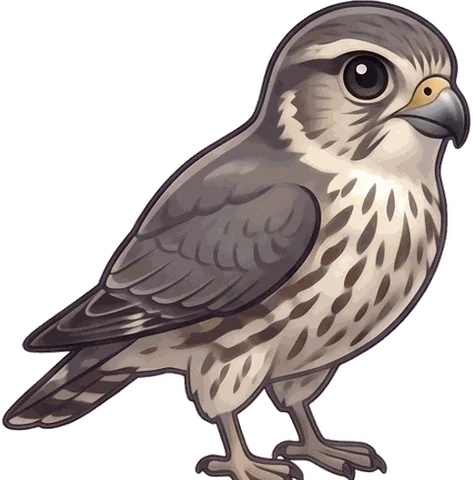
A Merlin sounds like a rapid, sharp chatter: a series of ki-ki-ki-ki-kee notes, or what Audubon calls a high, loud cackle, sometimes a klee-klee-klee much like an American Kestrel's. Away from the nest this small, powerful falcon is usually silent. Most calling Merlins are nesting birds in spring and early summer, and they are fierce about it, going after crows and other raptors that come near. In the northern prairie towns where Merlins now nest, that chatter comes from the trees in people's yards.
The chatter: ki-ki-ki-ki-kee
Merlins do not sing. Their main sound is a fast string of sharp, hard notes, written by Animal Diversity Web as ki-ki-ki-ki-kee. Audubon describes the same voice as a high, loud cackle and also gives a klee-klee-klee that resembles an American Kestrel's call. The effect is a quick, insistent chattering.
The catch is how rarely you hear it. Audubon notes the Merlin is usually silent, and outside the breeding season it lives alone and has little reason to call. The noise starts when a pair settles on a nest. Animal Diversity Web says nesting Merlins become highly aggressive toward other raptors and crows nearby, and much of the chattering you hear is aimed at them.
Between calls: a silent hunter
Most of what a Merlin does, it does quietly. It hunts by watching from a perch and then flying out after a bird, or by racing low over the ground, often less than about three feet up, using trees and shrubs as cover to surprise its prey. It catches most of its meals in the air, chasing a startled bird from behind, and it seldom dives steeply from above or soars. Pairs sometimes hunt together, one bird flushing prey toward the other. The food is mostly small birds, along with dragonflies and other large insects, bats and rodents, and a Merlin often specializes in whatever is locally plentiful: Horned Larks on the plains, small sandpipers on the coast, House Sparrows in town.
When and where you hear it
Merlins breed across the northern forests of North America and Eurasia, in semi-open country with trees to nest in and open ground to hunt over. In North America the eastern form breeds in Canada and the northernmost United States and winters from the southern part of the continent to northern South America. A pale form lives on the Great Plains, and a dark form stays on the Pacific Northwest coast all year. In winter they also use grasslands and coastal marshes.
Since about 1960 Merlins have moved into towns on the northern prairies, nesting and wintering there and living largely on House Sparrows, and Wikipedia notes that some city birds no longer bother to migrate. Numbers across North America have been rising, after a drop in the 1960s and 1970s caused by DDT and related pesticides.
Merlins do not build nests. They take over old nests of crows, magpies or hawks, usually 10 to 60 feet up, and lay four or five eggs. The female does most of the incubating, about four weeks, while the male brings food, and the young fly roughly a month after hatching. That nesting stretch is when you are most likely to hear the chatter, and the best time to catch a Merlin card in Warble.
Pigeon hawk, the lady's falcon, and an app
For much of the 20th century North Americans called this bird the pigeon hawk, because in flight it looks something like a pigeon. The name merlin comes from the Old French esmerillon and reached English after the Norman Conquest. In medieval falconry the Book of St. Albans called it the falcon for a lady, noted for its chases of skylarks. The bird also shares its name with Merlin Bird ID, the identification app from the Cornell Lab of Ornithology.
What it looks like
A small, compact falcon, between a robin and a crow in size, with pointed wings and a relatively short tail. Males average about 5.8 ounces and females about 8.1, so Wikipedia notes that a Merlin is only a little larger than an American Kestrel but a third to a half heavier. Males are blue-gray above, while females and young birds are brown above; all are streaked below, and the dark tail has narrow whitish bands. Prairie males can be almost sky blue on the back, and Pacific Northwest males are nearly black. Audubon points out that a Sharp-shinned Hawk looks similar but has rounded wingtips and no white bands on the tail.
Birds that sound similar
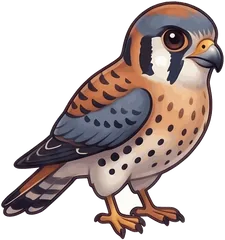 American Kestrel
Audubon compares the Merlin's klee-klee-klee directly to the American Kestrel's, so the two can sound alike. The Merlin is a third to a half heavier than the kestrel, and usually silent away from its nest.
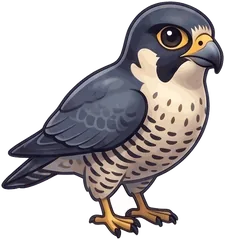 Peregrine Falcon
A Peregrine Falcon's alarm is a rasping kack-kack-kack-kack, also heard mostly near a nest, but from a crow-sized falcon on a cliff, bridge or building. The Merlin's high cackle comes from a much smaller bird.
Where the Merlin card lives
In Warble the same bird can be an easy card in one state and a prized one in another, because each album ranks its birds by how often people really report them there. The Merlin appears in 1 state albums:
 Heard one? Open Warble, tap the green button while it sings, and the Merlin card flips into your album. Get the app free.
Questions people ask
Why is a merlin chasing crows and hawks?
It is almost certainly protecting a nest. Nesting Merlins turn highly aggressive toward crows and other raptors, often with loud ki-ki-ki-ki-kee chattering. Merlins often raise their young in old crow nests.
Do merlins live in cities?
Some do. Since about 1960 Merlins have nested and wintered in towns on the northern prairies, feeding mainly on House Sparrows, and some urban birds have stopped migrating. North American populations have generally been increasing.
Why was the merlin called a pigeon hawk?
Because in flight it looks somewhat like a pigeon. Pigeon hawk was the common North American name well into the 20th century. The name merlin itself comes from the Old French word esmerillon.
How do you tell a merlin from a kestrel?
By build and behavior more than voice, since both can give a klee-klee-klee. The Merlin is heavier and more powerful, streaked below with a banded dark tail, and it hunts in fast, low chases.
Sources
- National Audubon Society, Guide to North American Birds: Merlin. www.audubon.org/field-guide/bird/merlin
- Animal Diversity Web, University of Michigan: Falco columbarius (call, nesting behavior). animaldiversity.org/accounts/Falco_columbarius/
- Wikipedia: Merlin (bird) (hunting, weights, subspecies, urban birds, name, falconry). en.wikipedia.org/wiki/Merlin_(bird)
- National Audubon Society, Guide to North American Birds: Peregrine Falcon (voice). www.audubon.org/field-guide/bird/peregrine-falcon