 Warble

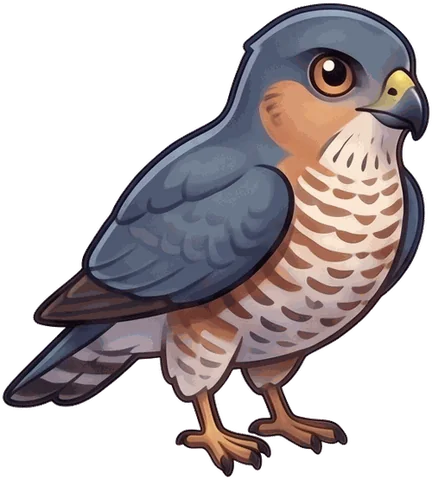
A Sharp-shinned Hawk sounds like a quick, sharp, scolding kek-kek-kek or kik-kik-kik, which is its alarm call. It is a quiet bird most of the year and calls mainly in the breeding season, near a nest hidden in the forest. Close to the nest you may also hear the male's kip or kew kew kew and the female's long keeeep in reply. Most people meet this small hawk in silence, though, when it shoots into a yard after the birds at a feeder.
The alarm: kek-kek-kek
Sharp-shinned Hawks have no song. Their signature sound is the alarm, a rapid series of hard, sharp notes that Animal Diversity Web writes as kek-kek-kek or kik-kik-kik. Think of a fast, sharp scold rather than a long scream.
You will rarely hear it outside the breeding season. Animal Diversity Web describes the species as usually quiet but more vocal while nesting, when a pair holds a territory and drives off intruders by calling, chasing and attacking. That means the alarm is mostly a spring and early summer sound of dense woods, especially stands of conifers, and an angry kek-kek-kek in the forest may mean you have walked too close to a nest.
Nest talk: kip, kew and keeeep
Around the nest the pair has a small private vocabulary. A male flying in gives a spaced kip, kip or a run of kew kew kew, and the female answers with a drawn-out keeeep. Females and nestlings also make a thin eee. The calls go with the routine of the nest: the male does the hunting and brings prey to the female, who plucks it and feeds the chicks. Wikipedia notes that she broods the young for 16 to 23 days while the male hunts and guards the territory.
When and where you hear it
Sharp-shinned Hawks breed across the forested parts of the United States and Canada. The breeding season runs from late March to June. The stick nest goes in a large conifer or a dense clump of deciduous trees, usually 8 to 62 feet up, and holds four or five eggs. Young fly at about a month old and depend on their parents for roughly another month.
Northern birds migrate south, some more than 900 miles, and winter as far as Panama, with a few in the Greater Antilles. They leave the breeding grounds in August and return in March. At hawk watches across the country, migrating sharp-shins are among the most numerous raptors counted, usually passing alone but sometimes in small groups. For Warble players, late spring in a stand of dense conifers is the best chance to catch one by ear.
At the bird feeder
The sharp-shin is an ambush hunter. It waits on a hidden perch and darts out, or flies fast and low through dense vegetation, steering with its tail, to catch small birds by surprise. Backyard feeders concentrate exactly what it eats, and Wikipedia notes that it often hunts at them. The usual victims are sparrows, warblers, finches, wrens, nuthatches, chickadees, titmice and thrushes. Males, being much smaller, take smaller birds; females can handle robins and flickers. Recorded prey ranges from an Anna's Hummingbird weighing about a sixth of an ounce to a Ruffed Grouse.
The species lost ground to DDT and other pesticides in the 1960s and 1970s. Since then it has rebounded, possibly above historical levels, and Wikipedia credits both the DDT ban and the spread of backyard feeders.
What it looks like
A small hawk with rounded wingtips and a long tail. Females are much bigger than males, averaging about 30 percent longer and often more than half again as heavy: a male is roughly 9 to 12 inches long, a female 11 to 14.5. Adults have a dark cap, blue-gray back and white underparts barred with rufous, and red to dark orange eyes. Young birds are brown above, streaked below, with yellowish eyes. The long, very slender yellow legs give the bird its name. The similar Cooper's Hawk is larger, with a bigger head, thicker legs and a more rounded tail with a wider white tip.
Birds that sound similar
- ?Cooper's Hawk
The closest match by ear. Audubon writes the Cooper's call as a loud cack-cack-cack-cack, very like the sharp-shin's alarm. Check the bird: the Cooper's is crow-sized, bigger-headed and thicker-legged, with a rounder tail.
 Merlin
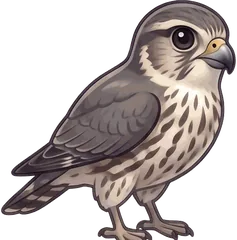
A Merlin's high, loud cackle or klee-klee-klee can pass for a sharp-shin's scold. The Merlin is a falcon with whitish bands on its dark tail; Audubon notes the sharp-shin has rounded wingtips and no white tail bands.
Where the Sharp-shinned Hawk card lives
In Warble the same bird can be an easy card in one state and a prized one in another, because each album ranks its birds by how often people really report them there. The Sharp-shinned Hawk appears in 3 state albums:
 Heard one? Open Warble, tap the green button while it sings, and the Sharp-shinned Hawk card flips into your album. Get the app free.
Questions people ask
Why is there a hawk at my bird feeder?
Because feeders gather small birds in one place, and that is exactly what a Sharp-shinned Hawk hunts. Wikipedia notes the species often hunts at backyard feeders, ambushing sparrows, finches and other songbirds from cover.
How do you tell a sharp-shinned hawk from a Cooper's hawk?
Not by voice, since both give a fast kek or cack series. Look at size and build: the Cooper's is larger, about crow-sized, with a bigger head, thicker legs and a more rounded tail tipped with wider white.
Why is it called a sharp-shinned hawk?
For its legs. The Sharp-shinned Hawk has long, very slender yellow legs, which is where the common name comes from.
Are female sharp-shinned hawks bigger than males?
Yes, by a lot. Females average about 30 percent longer and often weigh more than half again as much. The difference shows in what they catch: males take small songbirds, while females can take birds as big as robins and flickers.
Sources
- Animal Diversity Web, University of Michigan: Accipiter striatus (calls, breeding, migration). animaldiversity.org/accounts/Accipiter_striatus/
- Wikipedia: Sharp-shinned hawk (measurements, plumage, feeders, diet, nesting, range, name). en.wikipedia.org/wiki/Sharp-shinned_hawk
- National Audubon Society, Guide to North American Birds: Cooper's Hawk (voice, comparison). www.audubon.org/field-guide/bird/coopers-hawk
- National Audubon Society, Guide to North American Birds: Merlin (comparison with Sharp-shinned Hawk). www.audubon.org/field-guide/bird/merlin