 Warble
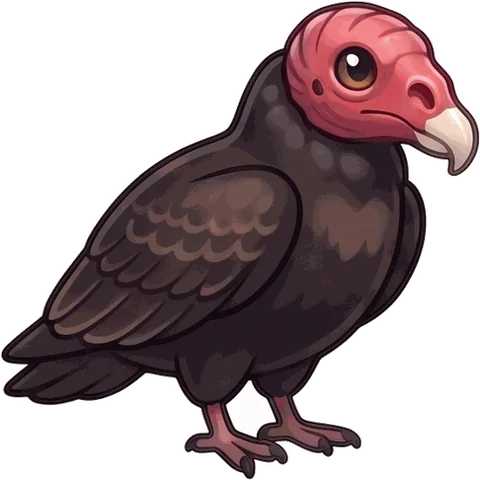
A Turkey Vulture makes almost no sound at all. It lacks a syrinx, the voice organ other birds sing with, so the most it can manage is a hiss or a low grunt, usually at a carcass or at the nest. You will nearly always meet it in silence: a big dark bird soaring with its wings raised in a shallow V, tipping from side to side, the flight feathers flashing silvery gray from below. If a large bird circling overhead is calling, it is not this one.
Does it sing? No: hisses and grunts
There is no Turkey Vulture song, and no call in the usual sense either. Birds make their sounds with a syrinx, and the Turkey Vulture does not have one. Wikipedia and the Missouri Department of Conservation agree on the result: the bird can only hiss and grunt. Audubon adds when you might hear even that, which is while it feeds and around the nest. So a vulture you can hear is a vulture you are standing close to.
That silence is itself a field mark. A large, dark bird that circles a field for a long time without a single scream or whistle is very likely a vulture. Because Warble works by ear, this is a card you earn beside a roost or a carcass, not from a glance at the sky.
The hiss, up close
The noisiest Turkey Vultures are the young ones. Audubon notes that chicks approached at the nest hiss and throw up in self-defense. Adults do much the same: Wikipedia says a threatened bird may flee, vomit on the intruder or play dead, and that the half-digested carrion it brings up deters most nest raiders. If a vulture hisses at you, step back. What comes next is worse than the noise.
When and where you see it
Turkey Vultures range from southern Canada to the southern tip of South America and stay all year across much of the southern United States. Northern birds migrate in flocks, some as far as South America. The western population makes the long trips, while eastern birds rarely go beyond the United States. In Missouri the vulture is a common migrant and summer resident statewide, and it is becoming locally common in winter in the south.
Look over farmland, grassland, foothills, desert and roadsides, and over towns and landfills too. They roost together at night, often by the hundreds, in big dead trees or on towers, sometimes with Black Vultures. At dawn they move to sunny perches and wait for the ground to warm, then lift off and spend the day searching alone. The two eggs go on the bare floor of a cave, a cliff crevice, a hollow log or an old building, and the young fly at nine to ten weeks.
Unlike most birds, this one finds food partly by smell. It flies low to catch ethyl mercaptan, a gas released early in decay, and Black Vultures often follow it to the meal.
How to know one overhead
Since you will rarely hear it, learn the shape:
- Wings in a shallow V, raised above the body rather than held flat.
- A rocking, unsteady glide. The bird tips from side to side and almost never flaps once it is up.
- Two-toned underwings: black linings in front, silvery gray flight feathers behind.
- A head that looks too small for the body, and a fairly long tail.
- Deep, heavy wingbeats on takeoff, then soaring as soon as there is lift.
Missouri's guide gives the comparison that matters most. The Black Vulture holds its wings nearly flat, flaps three or four times between glides, has a shorter tail and shows a white patch near each wingtip.
What it looks like
A very large bird, 25 to 32 inches long with a wingspan of about six feet. The body is brownish black, the head small, bare and red, the hooked beak short and ivory. The pink legs are usually streaked white, because the bird cools itself by excreting onto them. Young birds have a gray head. On damp mornings one may perch with its wings spread wide, a pose thought to dry the feathers and warm the body. The name comes from the red head and dark plumage, which recall a male Wild Turkey.
Birds that sound similar
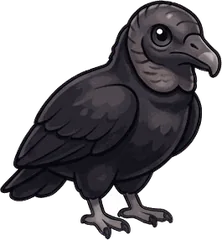 Black Vulture
The Black Vulture is just as quiet, with the same hisses and grunts, so sound will not separate them. Look instead: flat wings, quick bursts of flapping, a short tail and white wingtip patches.
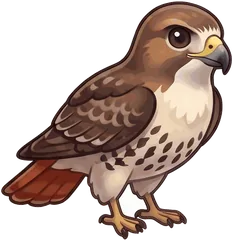 Red-tailed Hawk
A soaring Red-tailed Hawk often calls, a hoarse, falling keeeeer. A vulture never screams. The hawk is also smaller and stockier, with a feathered head and, on most adults, a reddish tail.
Where the Turkey Vulture card lives
In Warble the same bird can be an easy card in one state and a prized one in another, because each album ranks its birds by how often people really report them there. The Turkey Vulture appears in 49 state albums:
 Heard one? Open Warble, tap the green button while it sings, and the Turkey Vulture card flips into your album. Get the app free.
More about the Turkey Vulture on this site
Questions people ask
Do turkey vultures make any noise?
Barely. Turkey Vultures have no syrinx, the organ birds use to sing and call, so they can only hiss and grunt. You hear it at a carcass or near a nest, where chicks hiss at anything that comes close.
Why is it called a turkey vulture?
Because the adult's bare red head and dark body look like a male Wild Turkey's. In much of the United States it is also called a buzzard, though in Europe that word means a kind of hawk.
How do you tell a turkey vulture from a black vulture?
Watch the wings. A Turkey Vulture soars with its wings in a V, rocks from side to side and shows a silvery back half to the wing. A Black Vulture holds its wings flat, flaps often and shows white only near the tips.
Are turkey vultures dangerous to pets or livestock?
No. Missouri's conservation department says they pose no danger to livestock, and they rarely kill anything. They eat carrion, and they can safely eat carcasses carrying anthrax or rabies, which helps limit the spread of disease.
Sources
- National Audubon Society, Guide to North American Birds: Turkey Vulture. www.audubon.org/field-guide/bird/turkey-vulture
- Wikipedia: Turkey vulture (syrinx, flight, smell, roosting, defense, nesting, name). en.wikipedia.org/wiki/Turkey_vulture
- Missouri Department of Conservation, Field Guide: Turkey Vulture. mdc.mo.gov/discover-nature/field-guide/turkey-vulture
- National Audubon Society, Guide to North American Birds: Red-tailed Hawk (voice). www.audubon.org/field-guide/bird/red-tailed-hawk