 Warble
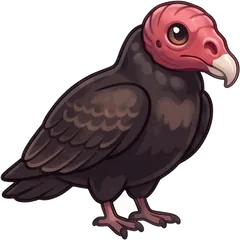
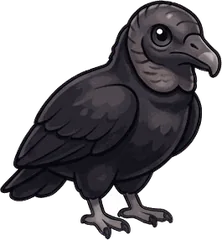
You will not tell these two apart by ear: vultures have no voice box, and all either one manages is a hiss or a grunt near a carcass or a nest. Watch the flight instead. A Turkey Vulture soars on long wings raised in a shallow V and tilts from side to side, and from below the trailing half of each wing looks silvery. A Black Vulture holds shorter wings nearly flat, breaks its glides with three or four quick flaps, and shows a white patch near each wingtip.
Side by side
| Turkey Vulture | Black Vulture | |
|---|---|---|
| Voice | No voice box; hisses or grunts when feeding or at the nest | No voice box; hisses or grunts, seldom heard |
| Soaring | Wings in a shallow V, tilting side to side | Wings held nearly flat |
| Flapping | Deep, ponderous wingbeats when taking off | Three or four quick flaps, then a flat glide |
| Underwing | Black in front, gray or silvery on the trailing half | Black, with a whitish patch near each wingtip |
| Head | Small, bare and red on adults; gray on young birds | Bare and grayish black at every age |
| Build | Long wings, long tail, small head | Stocky; shorter wings, short square tail, bigger head |
| Size | 25 to 32 inches; wings about 6 feet | About 2 feet long; wings under 5 feet |
| Finding food | Smells carrion as well as spotting it | Watches other vultures from above and follows them in |
| Where and when | Open and semi-open country across much of the US; northern birds migrate | Southeastern lowlands and coastal plains, spreading north; mostly resident |
By ear: a hiss is all you get
On a site about bird sounds, vultures are the honest exception. Neither species has a syrinx, the voice box songbirds use, so as Missouri's field guide puts it, they can only hiss and grunt. Audubon calls the Turkey Vulture usually silent, hissing or grunting when it feeds or at the nest; nestlings that are approached defend themselves by hissing and regurgitating. The Black Vulture makes the same hisses and grunts and is seldom heard, though courting males hiss as they walk in circles around a female.
So if you hear a vulture at all, you are standing near a carcass, a roost or a nest, and the sound will not tell you which species it is. The silence is useful in its own way: a big dark bird that whistles or screams as it circles is not a vulture, and it is worth checking the hawks and eagles instead.
By sight: watch the wings first
Both are big, dark birds with bare heads, and at a distance the flight gives them away long before you can see a face. A soaring Turkey Vulture holds its wings in a shallow V, not flat, and tilts from side to side as if it cannot quite keep its balance. When it takes off, it flaps with deep, ponderous beats. A Black Vulture holds its wings nearly horizontal and alternates a series of three or four quick flaps with stretches of soaring, a choppier rhythm than the Turkey Vulture's.
Then look underneath. The Turkey Vulture's wings are two-toned, black linings in front of gray or silvery flight feathers along the whole trailing half. The Black Vulture's wings are black except for a whitish patch near the tip of each one, which shows clearly in flight. Its tail is short, rounded and square-tipped, and the whole bird looks stocky, with shorter wings and a bigger head. Audubon notes that the two have about the same body size, but the Black Vulture looks smaller.
Perched, the head helps. An adult Turkey Vulture has a small, featherless red head; a Black Vulture's head is bare and grayish black. The trap is the young Turkey Vulture, whose head is gray, not red. For that bird, Audubon points to the plumage, which has a browner tinge on a perched Turkey Vulture, and to the different shape of the head and bill.
Where you will meet each one
The Turkey Vulture is the one most people know. It soars over open and semi-open country, farmland, grassland, woods and foothills, as well as roadsides and landfills, and it is especially fond of bluffs where warm air rises. It lives all year across much of the southern United States, while northern birds migrate in flocks, some as far as South America. Large groups share a roost at night, then split up to forage alone, often sitting in the sun at dawn until the ground warms enough to make thermals.
The Black Vulture prefers flat lowlands and coastal plains, avoids high mountains and rarely crosses open water, which keeps it off the Florida Keys. It forages over open ground but roosts and nests in forest. It has spread north in the Northeast, and more birds now stay north for the winter, often sharing roosts with Turkey Vultures. In Missouri it is an uncommon year-round resident in the south and center, while Turkey Vultures are much more common statewide.
The two also find food differently. A Turkey Vulture can smell carrion, unusual among birds. A Black Vulture often flies higher, watching other vultures from above, then follows them down to the carcass and frequently drives them off it. So a lone, wobbling bird is likely a Turkey Vulture, and a flock of flat-winged birds crowding a roadkill is likely Black Vultures.
 Still not sure which one is outside? Warble listens while it sings and tells you, then adds the card to your album. Get the app free.
Questions people ask
Do vultures make any sound?
Barely. Turkey and Black Vultures have no syrinx, the bird voice box, so they can only hiss and grunt, usually when feeding, at the nest, or, for Black Vultures, during courtship.
Which vulture has a red head?
The adult Turkey Vulture. Young Turkey Vultures have gray heads, and Black Vultures have bare, grayish-black heads at every age, so a dark-headed vulture still needs a look at its wings.
Why do black vultures follow turkey vultures?
Because the Turkey Vulture has the better nose. Black Vultures often fly higher, watch Turkey Vultures from above, follow them to a carcass and then frequently chase them away from it.
Sources
- National Audubon Society, Guide to North American Birds: Turkey Vulture. www.audubon.org/field-guide/bird/turkey-vulture
- National Audubon Society, Guide to North American Birds: Black Vulture. www.audubon.org/field-guide/bird/black-vulture
- Missouri Department of Conservation, Field Guide: Turkey Vulture. mdc.mo.gov/discover-nature/field-guide/turkey-vulture
- Missouri Department of Conservation, Field Guide: Black Vulture. mdc.mo.gov/discover-nature/field-guide/black-vulture