 Warble

A Golden Eagle sounds nothing like its size. Its call is a high-pitched kee-kee-kee or a thin scream or squeal, and Wikipedia notes that observers have called the voice weak, shrill and even puppy-like. Most of the time it says nothing at all. Golden Eagles are quiet even in the breeding season, when most of their few calls are made, and they defend their territory with flight displays rather than sound. If you hear one, you are probably near a nest in the open country of the West.
What it sounds like: a small voice in a big bird
Golden Eagles do not sing, and they call much less than people expect. Audubon describes the voice as a high-pitched kee-kee-kee, along with a high scream or squeal, and adds that the bird is usually silent. Wikipedia goes further: the voice is weak, high and shrill, and some writers have called it quite pathetic or puppy-like for such a powerful animal. Do not expect a fierce cry from the cliff.
When the eagle does call, it is mostly around the nest. Animal Diversity Web says Golden Eagles are largely silent outside the breeding season, and most of their calls have to do with feeding and with nestlings begging. Wikipedia adds that the species is often quiet even while breeding, and that most calls serve as contact between eagles, occasionally as a warning to an intruder and only rarely between the members of a pair.
Nine calls, rarely heard
Researchers in western Montana sorted the Golden Eagle's vocabulary into nine distinct calls, with names such as chirp, cluck, wonk, honk and hiss. In practice few people hear more than one or two of them. The likeliest is a nestling begging at a cliff nest.
When and where you hear it
Golden Eagles live across North America, Europe and Asia, mostly in remote country. In North America they breed through most of Alaska, western Canada, the western United States and Mexico. As a breeder the species is absent east of a line running from North Dakota through western Nebraska and Oklahoma to West Texas; a pair nested in Maine until 1999, but the eagle is now believed gone as a breeder from the eastern United States. Most pairs in the western states stay put all year. Birds from northern and central Alaska and northern Canada migrate south, and about 4,000 may pass Mount Lorette in Alberta each autumn, the largest Golden Eagle migration on record.
Look for open mountains, foothills, plains, rangeland, tundra and desert. The eagle hunts by soaring high, gliding low along slopes or watching from a perch, then dives to seize prey in its talons. Pairs sometimes hunt as a team. The menu is mostly ground squirrels, prairie dogs, marmots and jackrabbits, with grouse and other gamebirds, and occasionally prey as large as a fox or a young deer.
Nests are bulky stick platforms, usually on cliff ledges, added to every year until they become huge, and a pair may rotate between two or more sites. Usually two eggs are laid and incubated for about six weeks, mostly by the female, and the older chick often kills the younger. In the western states Warble players are more likely to see this eagle than to hear it.
Territory without a sound
Instead of calling, a Golden Eagle draws its borders in the air. Animal Diversity Web notes that pairs defend territory with an undulating flight rather than with sound. Audubon describes repeated high climbs followed by steep dives, loops and rolls, and Wikipedia adds exaggerated, aggressive downstrokes, mostly at the edge of the home range when another eagle shows up. Very rarely, two rivals lock talons and tumble through the air.
What it looks like
A very large, dark brown eagle, about the size of a Bald Eagle, with a wingspan of about six and a half feet according to Audubon. Adults are solid brown with golden feathers on the back of the head and neck, which give the bird its name, and faint pale bands on the tail. Young birds show a white patch in the middle of the wing and a white tail base ending in a broad dark band; full adult plumage takes five and a half to six and a half years. Compared with a young Bald Eagle, a Golden Eagle has a longer tail, a smaller head and bill, and no white mottling on the body. Females are larger than males.
Birds that sound similar
 Bald Eagle
The Bald Eagle is weak-voiced too, with squeaky cackling, thin squeals and gull-like calls. The Golden Eagle gives a high kee-kee-kee or squeal, and most of the time stays silent.
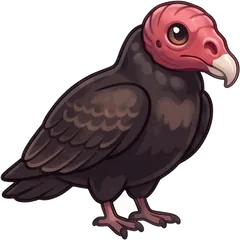 Turkey Vulture
From a great distance a Turkey Vulture can pass for a Golden Eagle, and sound will not settle it, since the eagle so rarely calls. The vulture flies in a looser, less controlled way and shows silvery flight feathers.
Where the Golden Eagle card lives
In Warble the same bird can be an easy card in one state and a prized one in another, because each album ranks its birds by how often people really report them there. The Golden Eagle appears in 3 state albums:
 Heard one? Open Warble, tap the green button while it sings, and the Golden Eagle card flips into your album. Get the app free.
More about the Golden Eagle on this site
Questions people ask
Do golden eagles screech?
Not much. Their call is a high, thin kee-kee-kee or a squeal, described as weak and even puppy-like, and they are usually silent. Most calls are made around the nest during the breeding season.
Where do golden eagles live in the United States?
Mostly in the West: Alaska and the western states, over open mountains, foothills, plains, rangeland and desert. They are believed gone as breeders from the eastern states, though winter visitors hunt over marshes and rivers there.
How do you tell a golden eagle from a young bald eagle?
Look at the white. A young Golden Eagle has clean white patches in the wing and at the base of the tail, while a young Bald Eagle is blotched with white on the body and underwing. The Golden also has a longer tail and a smaller head and bill.
Are golden eagles protected?
Yes. Golden Eagles have been federally protected under the Bald Eagle Protection Act since 1962. Before that, roughly 20,000 were killed, mostly shot from aircraft, on the mistaken belief that they preyed on sheep and goats.
Sources
- National Audubon Society, Guide to North American Birds: Golden Eagle. www.audubon.org/field-guide/bird/golden-eagle
- Wikipedia: Golden eagle (vocalizations, range, migration, plumage, displays). en.wikipedia.org/wiki/Golden_eagle
- Animal Diversity Web, University of Michigan: Aquila chrysaetos (calls, breeding, protection). animaldiversity.org/accounts/Aquila_chrysaetos/
- National Audubon Society, Guide to North American Birds: Bald Eagle (voice). www.audubon.org/field-guide/bird/bald-eagle