 Warble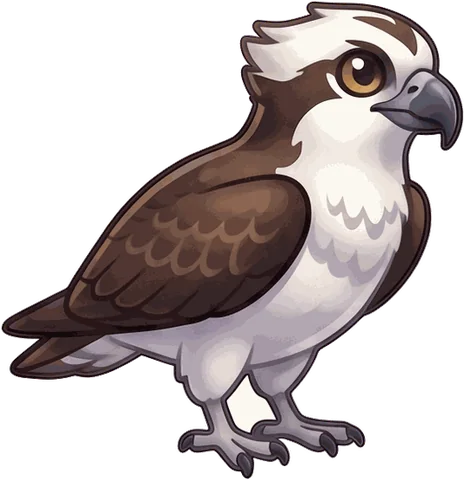
An Osprey sounds far too small for a bird with a five- to six-foot wingspan: a series of loud, clear, chirping whistles, cheep, cheep or yewk, yewk, slow and even when the bird is calm and speeding into a frantic, rising cheereek when something bothers it near the nest. Audubon calls the sound loud musical chirping. You hear it over lakes, rivers and coasts from spring through early fall, often from a bird hovering over the water or sitting on a nest platform.
What the call sounds like
The Osprey's voice is a set of high, clear whistles, chirped rather than screamed. The basic call is a series of sharp notes, cheep, cheep or yewk, yewk, each one short and slightly rising. Missouri's field guide describes descending chirps, rising squeals and a loud, clear whistle given in series, sometimes in answer to another osprey. From a hawk-sized bird it is unexpectedly thin, closer to a squeaky toy than to a raptor.
Researchers recognize up to five different calls, used for begging, alarm, courtship and nest defense. The one most people hear is the alarm: when a person, a boat or a Bald Eagle comes close to the nest, the whistles speed up and climb into a frenzied cheereek, usually with the bird sitting bolt upright or diving at the intruder. In spring the male adds a screaming call to his sky-dance, an undulating courtship flight with hovering pauses, performed while carrying a fish or a stick.
Begging at the nest
Nestlings and fledglings whine for food, and since the male delivers three to ten fish a day during the nestling period, a nest with young is rarely quiet. By late summer the fledged young call whenever an adult flies past, which makes an osprey colony on a marsh one of the noisiest places on the water.
When and where you hear it
Ospreys live on every continent except Antarctica, and the North American population breeds from Alaska and Canada south through the United States wherever there is shallow water with fish: coastal estuaries and salt marshes above all, but also big lakes, reservoirs and rivers. Nearly all of them migrate, traveling alone rather than in flocks, and most North American birds winter in South America; a few stay in Florida and California. In Missouri they are uncommon migrants, and the state guide notes that a bird still around in late May is probably nesting.
The diet is fish, 99 percent of it, typically 5 to 10 ounces and about a foot long. An Osprey flies slowly 50 to 200 feet above the water, hovers when it spots a fish, then plunges feet first, swinging its legs forward at the last instant. It succeeds on roughly a quarter to three quarters of its dives, best in calm weather. The toolkit is specialized: a reversible outer toe, spiny pads on the soles, nostrils that close underwater and dense, oily plumage. Once airborne it turns the fish head forward, one foot in front of the other, for less drag. Bald Eagles have noticed all this and routinely rob Ospreys of their catch.
Pairs use the same nest for years, a heap of sticks that can reach six feet across and weigh nearly 300 pounds, on a treetop, a channel marker, a utility pole or a platform built for the purpose. Nests on artificial structures are more stable and fledge more young than natural ones. Two to four eggs are incubated for five to six weeks, and the young fledge at seven to ten weeks. DDT, by thinning eggshells, crashed the population in the 1950s and 1960s; since the 1972 ban Ospreys have recovered well. In Warble the Osprey is a summer card, best caught near a marina or a reservoir dam.
What it looks like
A large, slender raptor, 21 to 24 inches long with a wingspan of five to six feet, dark brown above and white below with a white head crossed by a dark stripe through the eye. Females usually show a necklace of dark streaks across the breast; males are cleaner white. In flight the long wings are held with a sharp bend at the wrist, so from below the bird looks like a shallow M, with a black patch at each wrist. Old names were fish hawk, sea hawk and river hawk, and all three fit.
Birds that sound similar
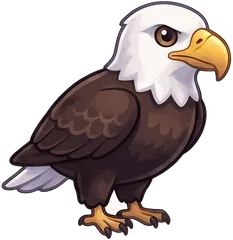 Bald Eagle
The Bald Eagle's chatter is weaker and more stuttering, a run of short chirps. An Osprey's whistles are louder and clearer, each note slides up, and the frantic cheereek usually means an eagle has arrived.
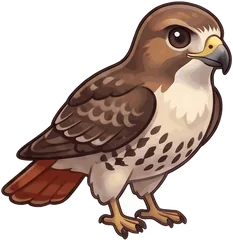 Red-tailed Hawk
A Red-tailed Hawk screams one long, hoarse, falling note. The Osprey never rasps; its notes are short, clean whistles in a series.
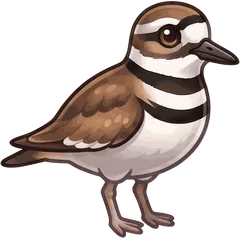 Killdeer
Both give piercing, repeated high notes near water. The Killdeer's kill-deer is a two-syllable shriek from the ground or low over a field; Osprey whistles come from high up, over open water.
Where the Osprey card lives
In Warble the same bird can be an easy card in one state and a prized one in another, because each album ranks its birds by how often people really report them there. The Osprey appears in 34 state albums:
 Heard one? Open Warble, tap the green button while it sings, and the Osprey card flips into your album. Get the app free.
Questions people ask
What does an osprey sound like?
A series of loud, clear chirping whistles, written cheep, cheep or yewk, yewk, that speed up and rise into a frantic cheereek when the bird is alarmed near its nest. It is thin and high for such a big bird, nothing like the scream of a Red-tailed Hawk.
Why does an osprey carry a fish head first?
For aerodynamics. After the catch the bird shifts the fish in its feet so that one foot is in front of the other and the fish faces forward, which cuts drag on the flight back to the nest. A reversible outer toe and spiny foot pads make the grip possible.
Do ospreys mate for life?
Usually. Missouri's field guide says they typically mate for life, and pairs return to the same nest year after year, repairing and adding to it each spring.
Why do bald eagles chase ospreys?
To steal fish. Bald Eagles routinely pirate food from Ospreys, chasing a bird carrying a catch until it drops it. The Osprey's frantic whistling as the eagle closes in is often the first sign of the encounter.
Sources
- National Audubon Society, Guide to North American Birds: Osprey. www.audubon.org/field-guide/bird/osprey
- Wikipedia: Osprey (calls, fishing adaptations, nest, DDT, lifespan, old names). en.wikipedia.org/wiki/Osprey
- Missouri Department of Conservation, Field Guide: Osprey. mdc.mo.gov/discover-nature/field-guide/osprey
- Animal Diversity Web: Pandion haliaetus (call types, sky-dance, dive success, nest platforms). animaldiversity.org/accounts/Pandion_haliaetus/