 Warble
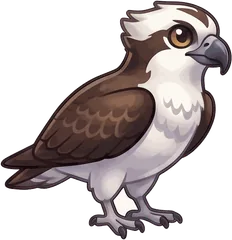
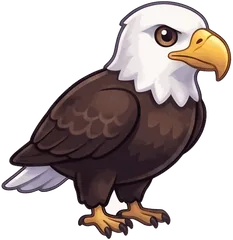
Listen to the quality of the whistle. Both birds chirp rather than scream, but an Osprey's call is loud, clear and musical, a series of sharp cheep, cheep or yewk, yewk notes that become a frenzied cheereek when something disturbs the nest. A Bald Eagle sounds weaker and squeakier, a staccato kleek kik ik ik ik with a gull-like edge. Then check the belly: an Osprey is white underneath, with a dark mask and crooked, M-shaped wings, while an adult eagle is dark below with a white head and tail.
Side by side
| Osprey | Bald Eagle | |
|---|---|---|
| Call | Loud, clear, musical whistles: cheep, cheep, rising to a frenzied cheereek near the nest | Weak, staccato, chirping whistles, kleek kik ik ik ik, somewhat gull-like |
| Size | About 2 feet long; wings 5 to 6 feet | 28 to 40 inches; wings about 6 to 7.5 feet |
| Head | White, with a dark stripe through the eye | Adult pure white with a yellow bill; young birds dark |
| Underparts | White; females often streaked across the breast | Dark brown; young birds blotched with white |
| Wings in flight | Long and narrow, bent into an M, with black wrist patches | Dark from tip to tip |
| Hunting | Hovers, then plunges feet first; fish are 99 percent of the diet | Fish first, plus birds, mammals and carrion; steals from Ospreys |
| Nest | Open treetop, utility pole, tower or a platform built for it | Big mature tree, usually close to open water |
| When | Spring to fall in most of the US; winters mainly in South America | All year in the south; northern birds move to open water in winter |
By ear: clear whistle or squeaky chatter
Neither bird sounds the way people expect. The scream of movie eagles belongs to the Red-tailed Hawk, whose call, Wikipedia notes, is often substituted for the Bald Eagle's because it is much louder. Both of these fish hunters chirp and whistle instead, which is one reason they get mixed up.
The Osprey is the one with the clear voice. Audubon sums it up as loud, musical chirping. Wikipedia writes the basic call as a series of sharp whistles, cheep, cheep or yewk, yewk, and Missouri's field guide adds descending chirps, rising squeals and a loud, clear whistle given in series, sometimes in answer to another Osprey. When the bird is disturbed near its nest, the call turns into a frenzied cheereek.
The Bald Eagle's call is the same idea done badly: weak, staccato, chirping whistles, written kleek kik ik ik ik, that sound a bit like a gull. Young eagles sound harsher and shriller. So listen for clarity and carry. Loud, clear whistles that can climb into a frantic cheereek point to an Osprey; thin, stuttering squeaks point to the eagle.
By sight: the belly and the bend in the wing
Both have white heads, which is where the confusion starts. An Osprey's head is white with a dark mask running through the yellow eye; an adult Bald Eagle's head is pure white, with no stripe, above a yellow bill. The Osprey is deep glossy brown above and pure white underneath, and females often wear a band of brown streaks across the breast. The adult eagle is evenly dark brown with a white tail. A young eagle has no white head at all, just dark brown with messy white streaking until about its fifth year.
In flight, look at the wing shape. An Osprey's wings are long, narrow and arched: head-on, the wrists sit higher than the tips, and from below the wings form an M with a black patch at each wrist. Audubon says a soaring Osprey at a distance suggests a large gull more than a hawk. In size it falls midway between a large hawk and an eagle: about two feet long with a wingspan of five to six feet, against 28 to 40 inches and up to seven and a half feet for the eagle.
Behavior is the clincher. An Osprey patrols 50 to 200 feet above the water, hovers when it spots a fish, then dives feet first and may go almost completely under. Fish make up 99 percent of its diet. A Bald Eagle eats plenty of fish too, 56 percent of the diet in a review of 20 nesting studies, but also birds and mammals, and Wikipedia notes it gets a good share of its food from carrion and from stealing.
Where you will meet each one
Both live by water. Ospreys fish rivers, lakes and coasts, fresh or salt, and are most common around big coastal estuaries and salt marshes, though large lakes, reservoirs and rivers work too. They nest on open treetops, often dead or broken ones, and readily take to utility poles, cell towers, duck blinds and platforms people build for them. Bald Eagles nest in big mature trees, most often close to open water.
The calendar helps more than the map. North American Ospreys mostly spend the winter in South America, with some staying in the southernmost states such as Florida and California. Bald Eagles in the south hold their territories all year, while northern birds whose water freezes move south or to the coast and gather at open lakes and rivers. So a white-headed raptor over an icy river in January, away from the southernmost states, is almost certainly an eagle.
In summer the two meet on the same water, and not always politely. Bald Eagles are known to chase Ospreys and force them to drop their catch. Missouri's guide notes one thing they do share: both generally mate for life.
 Still not sure which one is outside? Warble listens while it sings and tells you, then adds the card to your album. Get the app free.
Questions people ask
Do ospreys and bald eagles sound alike?
A little, since both chirp instead of screaming. The Osprey's whistles are loud, clear and musical; the eagle's are weaker and squeakier, a staccato kleek kik ik ik ik with a gull-like edge.
Why do bald eagles chase ospreys?
To steal their fish. Bald Eagles get part of their food by theft, and they sometimes chase an Osprey carrying a catch until it drops it.
Do ospreys stay for the winter?
Mostly not. North American Ospreys generally winter in South America, though some stay in the southernmost states, such as Florida and California. Bald Eagles, by contrast, gather in winter at open rivers and lakes in the northern states.
Sources
- National Audubon Society, Guide to North American Birds: Osprey. www.audubon.org/field-guide/bird/osprey
- Missouri Department of Conservation, Field Guide: Osprey. mdc.mo.gov/discover-nature/field-guide/osprey
- Wikipedia: Osprey (calls, plumage, fishing, diet, wintering range). en.wikipedia.org/wiki/Osprey
- Wikipedia: Bald eagle (call, plumage, diet studies, habitat, migration). en.wikipedia.org/wiki/Bald_eagle