 Warble
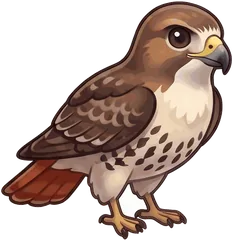
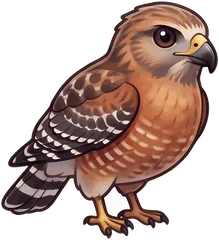
Listen to the texture and count the notes. A Red-tailed Hawk gives one long, hoarse, rasping cry of two to three seconds that starts high and slides down, kree-eee-ar, usually from a bird soaring over open country. A Red-shouldered Hawk gives a clearer, whistled kee-yeeear and usually repeats it three or four times in a row, from wet woods, most of all in spring. One catch: in the East, Blue Jays often copy the red-shoulder's call almost perfectly, so find the bird before you decide.
Side by side
| Red-tailed Hawk | Red-shouldered Hawk | |
|---|---|---|
| Call | One drawn-out, hoarse, rasping scream, kree-eee-ar, sliding down over two to three seconds | A clear, whistled kee-yeeear that falls in pitch, usually three or four in a row |
| When it calls | Mostly while hunting or soaring; loudest at rivals and predators | Mostly in courtship and territory defense; loudest in spring |
| Copied by | Sound editors, who use its scream as the generic raptor cry on TV | Blue Jays in the East, Steller's Jays in the West |
| Adult marks | Reddish-brown tail; in the East, a white chest and dark belly band | Reddish shoulders and chest; tail and wings banded black and white |
| In flight | Bulky and broad-winged; wingspan 45 to 52 inches | Pale crescent near each wingtip; quick flaps and a glide; wingspan about 40 inches |
| Where | Open country with high perches, nearly everywhere | Wet woods in the East; riverside and oak woods on the California coast |
By ear: one rasp or a string of whistles
The Red-tailed Hawk's cry is one most people know without knowing it. It is a drawn-out scream of two to three seconds, hoarse and rasping rather than clean, starting high and slurring downward: Audubon writes it keeeeer, Wikipedia kree-eee-ar, and the usual comparison is a steam whistle. It is often used as the generic raptor sound on television and in other media, even when the bird on screen is something else. Red-tails call most while hunting or soaring, and loudest when a predator or a rival hawk enters the territory.
The Red-shouldered Hawk sounds cleaner and more insistent. Its scream, kee-yeeear in Audubon's spelling and kee-aah in Wikipedia's, is shrill and whistled and falls in pitch, and it usually comes in a run of three or four. The calling is heaviest in courtship and territory defense, so spring is when it stands out: males fly upward calling and then dive steeply, and pairs circle high over the nesting woods, calling as they go. Audubon notes that the bird is often heard before it is seen.
So the test is texture and count. A long, raspy scream sliding downward, from a bird turning circles over a field, is a red-tail. A clear, whistled phrase repeated again and again from the trees along a creek or a swamp is a red-shoulder, or a jay.
The Blue Jay problem
In the East, Blue Jays often imitate the Red-shouldered Hawk's call almost perfectly, and in the West Steller's Jays do it too. Wikipedia notes that the jays and the hawk can be hard to tell apart by voice alone, so the voice may not settle this one. The bird can. Red-shouldered Hawks call in flight during courtship, circling over their woods, so look up. If the scream comes from inside a leafy tree and no hawk ever shows itself, look for something blue.
By sight: tail, shoulders and wingtips
An adult Red-tailed Hawk has a reddish-brown tail, reddish above and whitish below, and the color shows even from underneath when the bird flies over. Most eastern red-tails have a white chest crossed by a dark band of streaks on the belly, and from below the leading edge of the inner wing looks dark. An adult Red-shouldered Hawk has reddish shoulders and a reddish chest, and its tail and flight feathers are banded in narrow black and white. West Coast birds are redder, Florida birds paler.
The red-tail is the bulkier hawk, broad-winged and built for soaring, with a wingspan Audubon puts at 45 to 52 inches against about 40 for the red-shoulder. The red-shoulder often flies with several quick flaps and a glide, a rhythm that can suggest an accipiter, and at every age it shows a pale crescent near each wingtip in flight.
Young birds are harder. A young red-tail has a brown tail with dark bars instead of a red one, and young eastern red-shoulders are brown too, with narrow tail bars. Check the wingtips for the red-shoulder's crescent and the belly for the red-tail's band.
Where you will meet each one
Audubon calls the Red-tailed Hawk the most widespread and familiar large hawk in North America. It needs open ground for hunting and high places to sit: woodland with clearings, prairie groves, plains, mountains, desert with a few trees, and the utility poles along a road. It is absent from unbroken forest and the high Arctic. Many central and southern birds, adults especially, stay all year, while northern birds may migrate far south.
The Red-shouldered Hawk lives in the woods, usually wet ones. In the East look for it in tall deciduous and mixed forest with an open understory, often along rivers and swamps, and in Florida in pine woods and mangroves; in winter it may use more open places. In the West it breeds along the California coast in riverside forest, oak woodland, eucalyptus groves and some neighborhoods. Most stay all year; only northern birds migrate.
 Still not sure which one is outside? Warble listens while it sings and tells you, then adds the card to your album. Get the app free.
Questions people ask
What is the difference between a red-tailed hawk and a red-shouldered hawk call?
Texture and count. The Red-tailed Hawk gives one long, hoarse, rasping scream of two to three seconds that slides downward. The Red-shouldered Hawk gives a clear, whistled kee-yeeear that also falls in pitch but usually comes three or four times in a row.
Can a Blue Jay sound like a Red-shouldered Hawk?
Yes. In the East, Blue Jays often imitate the Red-shouldered Hawk's scream almost perfectly. The voices can be hard to tell apart, so look for the bird: a hawk calling as it circles over the woods is the real thing.
Is the hawk scream on TV a red-tailed hawk?
Very often. The Red-tailed Hawk's hoarse scream is widely used as a generic raptor sound effect on television and in other media, even when the bird shown is a different species.
Sources
- National Audubon Society, Guide to North American Birds: Red-tailed Hawk. www.audubon.org/field-guide/bird/red-tailed-hawk
- National Audubon Society, Guide to North American Birds: Red-shouldered Hawk. www.audubon.org/field-guide/bird/red-shouldered-hawk
- Wikipedia: Red-tailed hawk (the scream, when it calls, use in media, habitat). en.wikipedia.org/wiki/Red-tailed_hawk
- Wikipedia: Red-shouldered hawk (call, imitation by jays, range, residency). en.wikipedia.org/wiki/Red-shouldered_hawk