 Warble
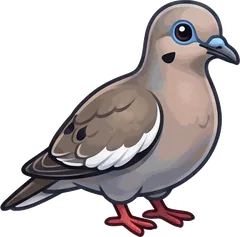
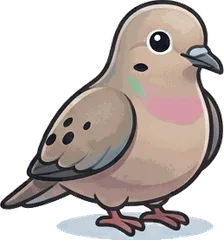
Listen to the rhythm. A White-winged Dove crows a drawn-out, rhythmic hooo-hooo-ho-hooo that many people hear as who cooks for you. A Mourning Dove's song is a low, mournful coo-ah, coo, coo, coo: a two-part opening note, then three plain coos. If you can see the bird, look at the folded wing. A White-winged Dove shows a bright white stripe along the edge of the wing, plus a red eye in a patch of blue skin and a short, squarish tail. A Mourning Dove has black spots on the wing and a long, pointed tail.
Side by side
| White-winged Dove | Mourning Dove | |
|---|---|---|
| Song | A drawn-out, rhythmic hooo-hooo-ho-hooo, or who cooks for you | A low, mournful coo-ah, coo, coo, coo |
| Wings | Big white patch, a stripe along the edge of the folded wing; no black spots | Plain gray-brown with black spots |
| Tail | Shorter, rounded or squarish, with white tips on the outer feathers | Long, pointed and wedge-shaped, edged with white spots |
| Face | Bright red eye in bare blue skin; dark mark on the lower face | Dark eye, plain face |
| Size | 11 to 12.6 inches, 4.9 to 5.6 ounces; bulky | 9 to 13 inches, 3 to 6 ounces; slender |
| Where and when | Southwest, Texas and Florida, spreading north and east; southwestern birds mostly arrive by March, leave by September | Open country from southern Canada to central Mexico; some stay all winter over most of the range |
By ear: a chant or a lament
The White-winged Dove's song has a beat you can tap your foot to. Audubon writes it as a drawn-out hooo-hooo-ho-hooo and also gives the familiar phrase, who cooks for you. It is a crowing, hooting phrase, and on spring mornings the males can fill a desert wash or a streamside grove with it. Males call from favorite perches, mostly at dawn and in late afternoon, and the calling peaks in May and June. Females give a softer, more slurred version.
The Mourning Dove does not chant. Its song is the low, sad coo the bird is named for, which Audubon writes as coo-ah, coo, coo, coo: a two-part opening note, then three single coos. Missouri hears it as soft, rising and falling. It sounds unhurried and a little sorrowful, a phrase that drifts away rather than marching to a finish.
So the question is cadence. If you can fit the words who cooks for you to what you hear, with a clear, almost spoken rhythm, think White-winged Dove, especially in the Southwest, Texas or Florida. If the coo opens with a two-part note and then settles into three single coos, it is a Mourning Dove.
By sight: the white stripe, the eye and the tail
Wikipedia notes that the two are easily confused, which is fair: both are brownish doves of about the same length. The best single mark is on the wing. A White-winged Dove has a big white patch that shows as a bold white crescent when it flies and, as the Missouri Department of Conservation puts it, as a clear white stripe along the front edge of the folded wing when it sits. A Mourning Dove has no white on the wing at all, only a scattering of black spots, which the White-winged Dove lacks.
The tail is the next tell. The Mourning Dove's tail is long, pointed and wedge-shaped, edged with white spots that show in flight. The White-winged Dove's is shorter and rounded or square at the tip, with white tips on the outer feathers. In courtship a perched male White-winged Dove fans his tail open and shut to flash its black and white pattern.
Up close, check the face. An adult White-winged Dove has bright red eyes set in bare blue skin, with a dark mark on the lower face; young birds are grayer with brown eyes. A Mourning Dove has dark eyes in a plain face, a slender body and a rounded head, while the White-winged Dove is larger and bulkier.
Where you will meet each one
The Mourning Dove is everywhere. It lives from southern Canada to central Mexico in almost any open or semi-open country: farms, towns, suburbs, roadsides, grasslands, prairies, deserts and forest clearings, avoiding only unbroken forest. Some stay through winter over most of the breeding range, while many northern birds move south in fall. It visits feeders, often eating on the ground beneath them.
The White-winged Dove is a bird of the Southwest and the South. It uses river woods, mesquite, saguaro stands, groves and towns, plus Texas brushland, chaparral, farmland, suburbs and citrus groves. In the desert it is often seen on top of giant saguaros, eating the fruit and flowers, and Audubon calls it an important pollinator of the cactus. Most birds nesting in the southwestern United States go south for the winter; they arrive early, mostly by March, and leave early, mostly by September. A few stay the winter, mainly in towns and suburbs, and Florida birds are mostly resident.
Its range is on the move. The species has spread north and east into Texas, Oklahoma, Louisiana, coastal Mississippi, Kansas, Arkansas and northern New Mexico, helped by farm crops and backyard feeders, and a growing share of Texas birds now stay all year. In Missouri it is still only a rare visitor. Outside the South and Southwest, the Mourning Dove is by far the likelier of the two.
 Still not sure which one is outside? Warble listens while it sings and tells you, then adds the card to your album. Get the app free.
Questions people ask
What dove says who cooks for you?
The White-winged Dove. Its drawn-out, rhythmic hooo-hooo-ho-hooo is often written as who cooks for you. Males call mostly at dawn and in late afternoon, and calling peaks in May and June. Listen for it in the Southwest, Texas and Florida.
How do you tell a White-winged Dove from a Mourning Dove?
Look at the folded wing. A White-winged Dove shows a white stripe along the wing's front edge and has a red eye in blue skin and a short, squarish tail. A Mourning Dove has black wing spots, dark eyes and a long, pointed tail. By ear, who cooks for you against coo-ah, coo, coo, coo.
Is a White-winged Dove bigger than a Mourning Dove?
Yes, heavier and bulkier, though not much longer. Audubon gives 4.9 to 5.6 ounces for the White-winged Dove against 3 to 6 for the Mourning Dove, and the White-winged has the shorter tail.
Sources
- National Audubon Society, Guide to North American Birds: White-winged Dove. www.audubon.org/field-guide/bird/white-winged-dove
- National Audubon Society, Guide to North American Birds: Mourning Dove. www.audubon.org/field-guide/bird/mourning-dove
- Wikipedia: White-winged dove (description, calls, range expansion, diet). en.wikipedia.org/wiki/White-winged_dove
- Missouri Department of Conservation, Field Guide: Mourning Dove (similar species). mdc.mo.gov/discover-nature/field-guide/mourning-dove