 Warble


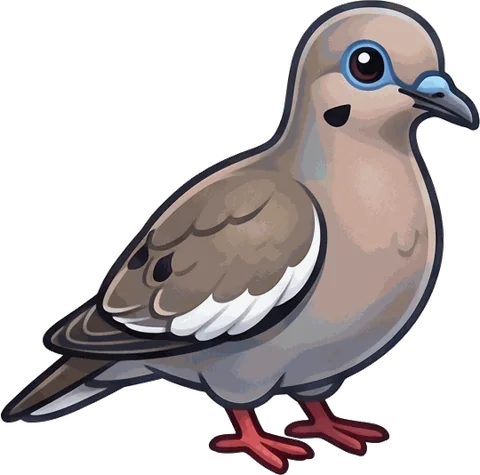
A White-winged Dove sounds like a dove doing an owl impression. The main call is a drawn-out, hooting hooo-hooo-ho-hooo that many people hear as who cooks for you, delivered by a male from a favorite perch, mostly just before dawn and again in the late afternoon. It also has a longer, rolling coo that repeats its last two notes over and over. In Texas, Arizona and the rest of the Southwest it is one of the defining sounds of a summer morning, in towns as much as in the desert.
The birder's mnemonic
“who cooks for you” The Barred Owl is known for the same words, so time of day helps: the dove calls mostly around dawn and late afternoon, the owl mostly at night.
What the song sounds like
The song is a set of hollow, owl-like coos with a clear rhythm. Audubon writes it as a drawn-out hooo-hooo-ho-hooo and offers who-cooks-for-you as the familiar version. David Sibley, quoted on Wikipedia, transcribes it as hhhHEPEP pou poooo, with a breathy start, a couple of quick accented notes in the middle and a long note to finish. The pitch drops or stays level through the phrase rather than rising.
There is a second song that sounds like the first one got stuck. Sibley writes it as pep pair pooa paair pooa paair pooa: an opening note, then the last two syllables repeated again and again, so it can run on for a long time.
Calling is done by males from dedicated perches, and it peaks in May and June, mostly just before sunrise and again in the late afternoon. Audubon describes the males crowing on spring mornings in streamside groves and desert washes.
The other calls
Not every White-winged Dove sound is a song. Both sexes give a muted, trumpeting errUah when they claim a preening branch or a spot at the feeder, a much quieter sound than the cooing. Nestlings start making noise when they are two days old and can whistle a thin sur-ee begging call by day five.
Courtship adds a show. Males flap upward and then glide down in a wide circle, and when perched they fan the tail to flash its black and white pattern, while pairs go through a ritual of nodding and preening.
When and where you hear it
The White-winged Dove is native to the southwestern United States, Mexico, Central America and the Caribbean, and it is mainly a summer bird in the Southwest: in Arizona the first arrivals turn up in March. It lives year-round in Texas, and about a third of Texas birds now stay through the winter. Florida's birds, introduced, are mostly permanent residents.
It is also spreading. The doves have pushed out of Texas into Oklahoma, Louisiana and coastal Mississippi, helped by cities and backyard feeders, and are expanding into Kansas, Arkansas and northern New Mexico, with strays reported as far as Canada and Alaska. San Antonio alone held more than a million year-round birds in 2001. They use river woods, mesquite, groves, farmland, citrus and suburbs.
In the Sonoran Desert the bird has a special relationship with the giant saguaro. Western birds arrive to breed in the hottest part of the year, when the cactus is in flower and fruit, and they perch on top of saguaros to eat the flowers and fruit. Audubon calls the dove an important pollinator of the saguaro, and the fruit can supply all the water the bird needs. In Warble the card is common in the Texas, Arizona and New Mexico albums and a legendary find in Florida.
What it looks like
A heavy dove, about 11 to 12.6 inches long and 4.9 to 5.6 ounces, bulkier than a Mourning Dove and with a shorter tail. The best mark is a white stripe on the folded wing, which becomes a bright white crescent on each wing in flight, along with white tips on the outer tail feathers. Up close, adults have a ring of bare blue skin around a startling crimson eye, and bright pinkish-red legs. Males and females look alike in the field, though males carry a little more purple gloss on the crown and neck. Young birds are duller and grayer, with brown eyes.
Birds that sound similar
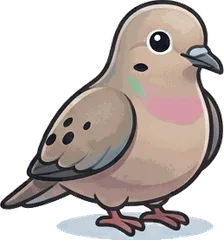 Mourning Dove
The Mourning Dove's coo is low and mournful, coo-ah, coo, coo, coo, a long two-part note and then plain coos. The White-winged Dove's is more rhythmic and owl-like, with quick accented notes in the middle: who cooks for you.
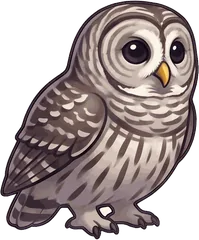 Barred Owl
The Barred Owl's call is remembered as who cooks for you, who cooks for you all, the same words used for this dove. The owl calls mostly at night; the dove calls mostly at dawn and late afternoon, often in town.
Where the White-winged Dove card lives
In Warble the same bird can be an easy card in one state and a prized one in another, because each album ranks its birds by how often people really report them there. The White-winged Dove appears in 7 state albums:
 Heard one? Open Warble, tap the green button while it sings, and the White-winged Dove card flips into your album. Get the app free.
More about the White-winged Dove on this site
Questions people ask
What bird says who cooks for you?
Two very different birds. In the Southwest and Texas, a daytime who cooks for you from a perch in town is usually a White-winged Dove, calling mostly around dawn and in the late afternoon. The same phrase is the classic memory aid for the Barred Owl, which calls mostly at night.
Why do white-winged doves coo so early in the morning?
Because that is when the males do most of their calling. Cooing peaks in May and June, mostly just before dawn and again in the late afternoon, and each male calls from his own favorite perch.
Why are there so many white-winged doves in my neighborhood?
Because towns suit them. The species has spread across Texas and into neighboring states with the help of cities and backyard feeders, and in winter the birds north of Mexico live mostly in towns. San Antonio had more than a million of them year-round in 2001.
Do white-winged doves migrate?
Many do. Most birds nesting in the southwestern United States go south in fall and return in spring. More of them are staying, though: about a third of Texas birds now spend the winter there, and Florida's introduced birds are mostly permanent residents.
Sources
- National Audubon Society, Guide to North American Birds: White-winged Dove. www.audubon.org/field-guide/bird/white-winged-dove
- Wikipedia: White-winged dove (calls, range expansion, migration, saguaro, description). en.wikipedia.org/wiki/White-winged_dove
- National Audubon Society, Guide to North American Birds: Mourning Dove. www.audubon.org/field-guide/bird/mourning-dove
- Wikipedia: Barred owl (call mnemonic and calling times). en.wikipedia.org/wiki/Barred_owl