 Warble


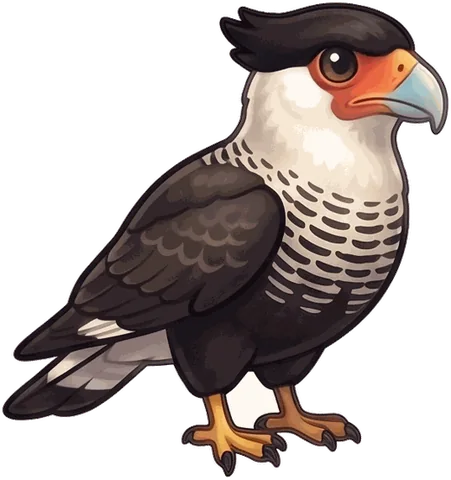
A Crested Caracara sounds like a dry, harsh rattle: a run of clacking notes that HawkWatch International writes as klak, klak, klak, sometimes ending in a drawn-out greeaaaaa. Audubon calls it a harsh cackle, and HawkWatch compares part of it to a raven's croak. The famous detail is the posture: the bird often throws its head back, nearly to its shoulders, while it rattles. In the United States you hear it only near the Mexican border, mostly in south and central Texas, and in the prairies of south-central Florida.
What the rattle sounds like
The caracara has no song in the songbird sense, but its rattle is one of the strangest sounds in ranch country. It is a dry series of clacks, klak, klak, klak, which can stretch into a long, grating greeaaaaa. Texas Parks and Wildlife magazine calls it static-like, which is a good description: it sounds less like a voice than like interference on a radio. Audubon lists both rattles and screams among its calls and describes the voice as a harsh cackle. HawkWatch hears a raven-like croak in it.
Even the name is a sound. Audubon traces "caracara" to an Indigenous South American name that imitates the call, and Wikipedia follows it back to the Old Tupi word karakará. Say it fast and dry, with a click on each k, and you have the idea.
The head-throw
What makes the caracara unforgettable is how it calls. While giving the rattle, it often tips its head straight back until the crown nearly touches its shoulders. Texas Parks and Wildlife magazine links the display to courtship and to claiming territory or food.
Pairs do it together. Audubon describes courting birds that toss their heads back again and again while giving a guttural call, then preen each other's feathers. Pairs mate for life and share the work of raising two or three young a year.
When and where you hear it
The caracara is a bird of the American tropics that reaches the United States in only a few places. In Texas it is common in the south and has become more common in central and north Texas, in cattle country, mesquite savanna and the coastal plain. Arizona has caracaras in the desert around Pima County. Florida's birds are a relict population left from the last ice age, when the Gulf Coast was oak savanna; today they live in the wet prairies of the south-central part of the state, in counties such as Okeechobee, Highlands, Glades and DeSoto, and prefer cabbage palms for nesting.
Adults stay on their territories all year, while young birds can wander a long way, and strays have turned up as far as California, Michigan and Vermont. Caracaras are comfortable around people as long as there is open ground, so ranch roads, highway shoulders and landfills are good places to look and listen. In Warble the caracara is a card in the Texas album.
The bully at the roadkill
Caracaras are falcons that act like vultures with attitude. They eat mostly carrion and often cruise highways early in the morning looking for road kill. At a carcass they dominate Black and Turkey Vultures and will chase them away. They also rob other birds, harassing vultures, hawks, pelicans, ibises and spoonbills until the victim drops or even coughs up its meal.
They hunt too. A caracara walks about as much as it flies, striding through grass to catch insects, snakes, lizards, frogs, small mammals and birds, scratching the ground for insects and digging up turtle eggs. Wildfires, cattle and farm machinery all flush prey, and caracaras turn up to take advantage. Texas Parks and Wildlife magazine adds pecans to the menu.
What it looks like
A big, long-legged bird, roughly two feet long with a wingspan of about four feet, and by weight the second-largest falcon after the Gyrfalcon. Adults wear a black cap with a shaggy crest, a white neck and cheeks, a black belly and bare facial skin, yellow to reddish orange, that changes color with the bird's mood. In flight the dark body shows four pale patches: the chest, the base of the tail and a window near each wingtip. Young birds are browner and streaked. Caracaras perch on poles and fence posts and usually fly low, rarely soaring.
Birds that sound similar
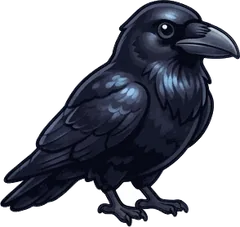 Common Raven
HawkWatch compares part of the caracara's call to a raven's croak. In Texas or Florida ranch country, a croak that runs into a dry klak-klak-klak rattle, especially from a bird with its head tipped back, is the caracara.
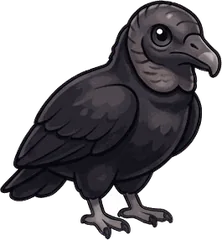 Black Vulture
Caracaras feed beside Black and Turkey Vultures and push them off carcasses. At a roadkill, the bird giving a harsh rattle or cackle is the caracara; look for the black cap and orange face.
Where the Crested Caracara card lives
In Warble the same bird can be an easy card in one state and a prized one in another, because each album ranks its birds by how often people really report them there. The Crested Caracara appears in 1 state albums:
 Heard one? Open Warble, tap the green button while it sings, and the Crested Caracara card flips into your album. Get the app free.
Questions people ask
What bird throws its head back and rattles?
The Crested Caracara. While giving its dry, static-like rattle it often tips its head back nearly to its shoulders. Pairs do it together in courtship, and single birds do it when claiming territory or food. In the US, look for it in south and central Texas, southern Arizona and south-central Florida.
Is a crested caracara a falcon or an eagle?
A falcon. It belongs to the falcon family, though it differs from typical falcons in shape and habits, and it is the second-largest falcon by weight. Some people call it the Mexican eagle, but it is not an eagle at all.
Is the crested caracara the national bird of Mexico?
No. The Golden Eagle is Mexico's national bird and appears on its flag. The idea that the bird in the Aztec founding legend was really a caracara comes from a 1960 proposal by Rafael Martín del Campo, and it gave the caracara the name Mexican eagle.
Sources
- National Audubon Society, Guide to North American Birds: Crested Caracara. www.audubon.org/field-guide/bird/crested-caracara
- HawkWatch International, Raptor ID fact sheet: Crested Caracara (call, behavior). hawkwatch.org/raptor-id/raptor-id-fact-sheets/crested-caracara/
- Texas Parks & Wildlife magazine: Wild Thing, What's for Dinner? Anything! (head-throw call, diet). tpwmagazine.com/archive/2010/nov/scout3/
- Wikipedia: Crested caracara (name, range in Texas and Florida, feeding, Mexican eagle). en.wikipedia.org/wiki/Crested_caracara