 Warble


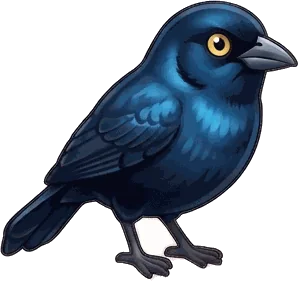
A Boat-tailed Grackle sounds harsh and slightly unhinged. The male's song is a run of rough jeeb-jeeb-jeeb-jeeb notes mixed with chatters, squeaks, buzzes and gargling shrieks, often shouted from a dock, a bridge or a causeway at the edge of a salt marsh. Females are much quieter, with short barks and squawks. What you will not hear is a clean whistle or a cluck: those belong to the Great-tailed Grackle. Listen for it along the coast from the Mid-Atlantic to Texas, and across Florida.
What the song sounds like
The song is built on one harsh, rasping note, jeeb, repeated in a series that holds steady or slides down in pitch rather than climbing. Around that core the male packs in whatever rough material he has on hand: chatters, squeaks, rattles and buzzes. A naturalist writing for a land trust on Edisto Island, South Carolina, summed it up as a chain of shrieks, gargles and painfully loud buzzes that earns the bird attention rather than admiration. That is fair. Nobody keeps a Boat-tailed Grackle around for the melody.
The performance is visual too. In the nesting colony a male stands in the open, fluffs out his body feathers, spreads his tail and flutters his wings rapidly while giving harsh, rattling calls. Several males may do this side by side, and a male threatening a rival points his bill straight up at the sky. All of this is aimed at a harem: males compete to defend and mate with a cluster of females nesting close together, which is why the colonies are such noisy places.
Females are much quieter. You mostly hear short barks and squawks from them, so in a mixed flock the long, harsh songs come from the males.
The calls: rattles, chatters and chips
Outside the full song, the everyday sounds are short and rough: buzzes, chatters, chip notes and rattles. None of them is sweet. The useful thing to remember is what is missing. Both Audubon and Wikipedia note that the Boat-tailed lacks the whistles and clucks of its close relative, the Great-tailed Grackle. On the Texas and Louisiana coast, where both birds live, a whistle points to the Great-tailed, and a string of harsh jeeb notes from the marsh points to this one.
When and where you hear it
Boat-tailed Grackles live year-round along the coasts of the Southeast and the Mid-Atlantic and across the Florida peninsula. Outside Florida they are rarely found far from tidewater; in Florida they also live well inland, usually around marshes and lakes. Over recent decades they have pushed their breeding range north along the Atlantic coast. Most birds stay put through the winter, although a few of the northernmost breeders move south in fall.
The classic setting is a salt marsh, but they are almost always near some kind of water: marshes, flooded fields, mudflats and beaches. They have also settled into coastal towns, including several Gulf Coast cities, where they work parking lots, wharves and outdoor restaurant patios and use the people around them as cover from predators. On Edisto Island, colonies gather on docks, bridges and causeways, using them as stages for calling and lookouts for food.
They eat almost anything they can catch near the water, from crabs, snails, shrimp and small fish to frogs and insects, plus grain in some seasons. They steal food from larger birds and from people, and they raid heron colonies for unguarded eggs. In Warble the card is common in the Florida album and a legendary find in Mississippi.
What it looks like
A big, long-legged blackbird with a long, dagger-like bill, a rounded, domed head and a long, keel-shaped tail. The male is glossy black with an iridescent sheen, often showing indigo tones, and measures 15 inches or more, a good part of it tail. The female is far smaller, roughly 10 to 13 inches, tawny to cinnamon brown with darker wings and tail. Eye color depends on where you are: Atlantic birds have pale, yellowish eyes, while birds on the Gulf Coast and inland have dark eyes. Young males are black without the gloss, and young females are duller than adults, with spotted breasts.
Birds that sound similar
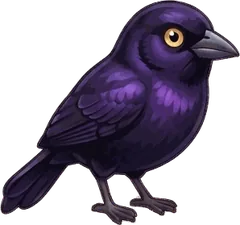 Great-tailed Grackle
The Great-tailed whistles and clucks; the Boat-tailed does not, sticking to harsh jeeb notes, chatters and rattles. They share the Texas and Louisiana coast, where Boat-tailed adults have dark eyes. Young Great-tailed are dark-eyed too, so trust the voice.
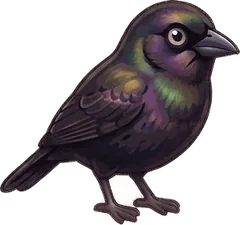 Common Grackle
A Common Grackle's voice is clucks and a sharp, harsh squeak like a rusty hinge, and the bird is only 11 to 13 inches long. Both have yellow eyes on the Atlantic coast, so listen for the Boat-tailed's runs of jeeb notes.
Where the Boat-tailed Grackle card lives
In Warble the same bird can be an easy card in one state and a prized one in another, because each album ranks its birds by how often people really report them there. The Boat-tailed Grackle appears in 6 state albums:
 Heard one? Open Warble, tap the green button while it sings, and the Boat-tailed Grackle card flips into your album. Get the app free.
Questions people ask
What does a female boat-tailed grackle sound like?
Quiet, by grackle standards. Females mostly give short barks and squawks, while the males handle the long, harsh songs full of jeeb notes, rattles and buzzes. If a flock on a dock is screeching, the noise is mostly coming from the glossy black males.
Is a boat-tailed grackle the same as a great-tailed grackle?
No, although they were treated as one species until the 1970s. They overlap on the Texas and Louisiana coast without interbreeding. The Boat-tailed is the marsh bird, rarely far from tidewater outside Florida, and it lacks the whistles and clucks that the Great-tailed uses all the time.
Why do boat-tailed grackles hang around parking lots?
Because that is where the food is. In Gulf Coast towns they scavenge trash, search parking lots and outdoor restaurant patios and steal food straight from people. Living close to humans also seems to protect them from predators, which is a good deal for a bird that already eats almost anything.
Do boat-tailed grackles migrate?
Mostly not. They are permanent residents along the Southeast and Mid-Atlantic coasts and across Florida, and the colonies on Edisto Island in South Carolina stay all year. A few of the northernmost breeders move south in fall.
Sources
- National Audubon Society, Guide to North American Birds: Boat-tailed Grackle. www.audubon.org/field-guide/bird/boat-tailed-grackle
- Wikipedia: Boat-tailed grackle (song, range, urban birds, eye color by region). en.wikipedia.org/wiki/Boat-tailed_grackle
- Edisto Island Open Land Trust: Boat-tailed Grackle. edisto.org/boat-tailed-grackle/
- National Audubon Society, Guide to North American Birds: Common Grackle. www.audubon.org/field-guide/bird/common-grackle