 Warble


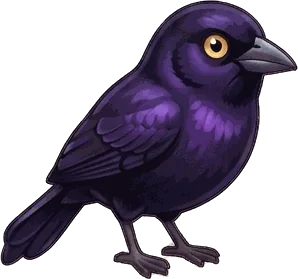
A Great-tailed Grackle sounds like a one-bird junkyard band. The everyday call is a low chut, males add a louder clack, and in the eastern population, which reaches west to central Texas, males also give a striking whistle that climbs in pitch. Around those sits an unusually large vocabulary used all year, from sweet, tinkling notes to a squeal like a rusty gate hinge. If a long-tailed black bird is making that racket in a Texas grocery store parking lot, you have found it.
What the song sounds like
The full song of the eastern birds comes in four parts. It opens with a run of harsh, dry notes that sound like twigs being snapped, softens into a stretch of gentle, rolling notes, goes back to snapping twigs, and finishes with several loud calls of two syllables each.
That song is only the core of a much larger collection. Great-tailed Grackles have an unusually big repertoire, and they use it in every season, winter included. The range runs from sweet, tinkling notes all the way to a grinding squeal like a gate that needs oil. Males use more kinds of sounds than females, which mostly chatter, although there is at least one report of a female singing the territorial song.
Grackles in the West have their own dialect. Birds of the smaller western race, found in California and western Arizona, sing a series of repeated notes that ends on one accented note, often mixed with other repeated phrases, so a grackle in San Diego does not sound quite like one in Houston. In Arizona, where the two western races meet, the birds appear to mix often.
The calls: chut, clack and that whistle
The sound you hear most is the plain call, a low, short chut. Males also give a louder, harder clack. In the eastern population they add a clean, rising whistle, loud and deliberate enough to pass for a person whistling.
Whistles and clucks are the signature of this species, and they are exactly what the closely related Boat-tailed Grackle lacks. All that volume costs the grackle some goodwill: the loud calls are a big part of why some people treat it as a pest.
When and where you hear it
Great-tailed Grackles began in the tropical lowlands of Central and South America and for more than a century they have been moving north. Today they range from Venezuela, Colombia and Ecuador up to Minnesota, west to Oregon, Idaho and California and east to Florida, with strays reaching southern Canada. Between 1880 and 2000 their breeding range grew by more than 5,500 percent, following farms and cities.
They live year-round in open country with scattered trees, from farmland to downtown, and they feed on the ground in pastures, wetlands and anywhere else that is clear. Cities suit them very well. In Austin they crowd around food trucks and grocery store parking lots and the bird has become an icon of the University of Texas campus. They will even pick dead insects off the license plates of parked cars. At night they gather in shared roosts in trees or in reeds.
The calls go on all year. Courtship and nesting pick up in spring, with the mating season usually starting in early or mid-April. In Warble the card is common in the Texas, Arizona and Nevada albums and a legendary find in Kansas.
What it looks like
A big, lanky blackbird, larger than a starling and smaller than a crow, about 15 to 18 inches long. The male is black all over with a violet-blue gloss, a bright yellow eye, a heavy, nearly straight bill, a flat crown and a very long tail that he can fold into a deep vertical keel, like the hull of a boat seen from behind. The female is much smaller, brown above and buffy below, with dark stripes at the sides of the throat, the same yellow eye and a shorter tail without the keel. Young birds look like females but have brown eyes and streaked breasts, and young males carry shorter tails and often dark eyes.
Birds that sound similar
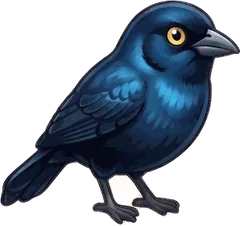 Boat-tailed Grackle
Listen for whistles. Audubon gives the Boat-tailed's call as a harsh jeeb-jeeb-jeeb-jeeb, without the whistles and clucks of the Great-tailed. The two overlap on the Texas and Louisiana coast, where Boat-tailed adults have dark eyes.
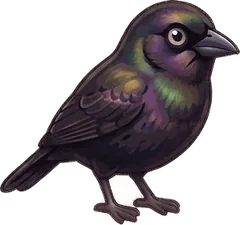 Common Grackle
Audubon sums up the Common Grackle's voice as clucks and a sharp, harsh call like a rusty hinge. A Great-tailed does those too, then adds the loud clack and the rising whistle. A Common Grackle also tops out around 13 inches.
Where the Great-tailed Grackle card lives
In Warble the same bird can be an easy card in one state and a prized one in another, because each album ranks its birds by how often people really report them there. The Great-tailed Grackle appears in 7 state albums:
 Heard one? Open Warble, tap the green button while it sings, and the Great-tailed Grackle card flips into your album. Get the app free.
Questions people ask
Why are there so many grackles in parking lots?
Because parking lots feed them. In Austin, Great-tailed Grackles gather around food trucks and grocery stores, and they will pick dead insects off the license plates of parked cars. They also roost together in trees at night, so the trees beside a busy lot can hold a noisy crowd.
Do female great-tailed grackles sing?
Mostly they chatter. Males use a much wider range of sounds, including the song and the whistles, while females stick largely to chatter calls. There is at least one report of a female singing the territorial song, so the rule is not absolute.
What is the difference between a great-tailed grackle and a boat-tailed grackle?
The voice is the quickest tell: the Great-tailed whistles and clucks, the Boat-tailed gives a harsh jeeb-jeeb-jeeb. They were treated as one species until the 1970s, and they share the Texas and Louisiana coast without interbreeding.
Where did great-tailed grackles come from?
From the tropical lowlands of Central and South America. The Aztecs brought them to the Valley of Mexico under the emperor Ahuitzotl, between 1486 and 1502, the earliest documented case of people moving a bird to a new range in the Americas. Since about 1880 they have spread north along farms and cities.
Sources
- Wikipedia: Great-tailed grackle (vocal repertoire, range expansion, Austin, description). en.wikipedia.org/wiki/Great-tailed_grackle
- National Geographic: Great-tailed Grackle (calls, regional songs, subspecies, identification). www.nationalgeographic.com/animals/birds/facts/great-tailed-grackle
- National Audubon Society, Guide to North American Birds: Boat-tailed Grackle. www.audubon.org/field-guide/bird/boat-tailed-grackle
- National Audubon Society, Guide to North American Birds: Common Grackle. www.audubon.org/field-guide/bird/common-grackle