 Warble


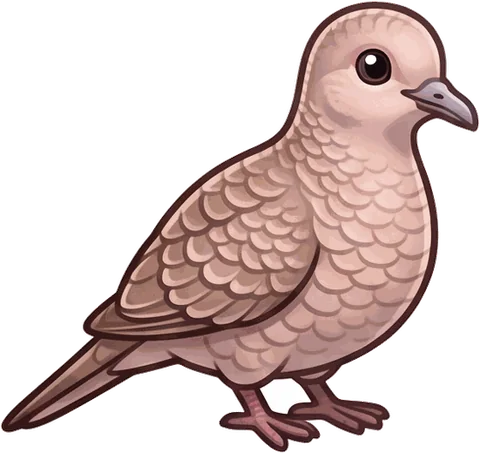
An Inca Dove sounds like a small, gloomy voice repeating itself: a soft, two-note coo that birders write as no-hope, or simply coo-coo, given over and over in a town yard. When the bird flushes from a lawn, its wings make a dry rattle. Inca Doves live year-round in towns of the Southwest and Texas, so this is a backyard sound in places like Austin and San Antonio rather than a wilderness one.
The birder's mnemonic
“no hope” The phrase has two notes and comes again and again, so the repetition is as useful a clue as the words.
What the song sounds like
The song is about as simple as bird song gets. Audubon describes it as a soft coo-coo or no-hope, often repeated, and repetition is the real signature. The bird delivers the same two-part phrase again and again. Because it is soft, it is easy to miss at first, and hard to ignore once you have tuned in.
Because the bird is so tied to people, the song comes from human places: yards with lawns and shade trees, parks, farmyards and, in desert towns, any block with a reliable supply of water. In Texas the doves nest on cedar elms, live oaks and hackberries but also on palms, cacti, vines, building beams, utility poles and hanging baskets, so the nest may be on your porch.
Calls and the wing rattle
Besides the song, Audubon lists a flat, undulating hoot. The sound people notice most, though, is not vocal at all. Inca Doves feed on the ground with small, dainty steps, and when something startles them they flutter up with a dry rattle of the wings. If a little brown bird bursts off a sidewalk with a papery whirr and a flash of rust, you have flushed an Inca Dove.
Spring brings more going on. Males defend breeding territories and will fight over them, and in courtship a male bobs his head and fans his tail to show off its black and white pattern. Pairs often abandon a nearly finished nest and start over, sometimes after building one or two practice nests.
When and where you hear it
The Inca Dove probably did not live north of Mexico originally. It moved north as towns grew across the Southwest, and the Texas record shows how. The first specimen was collected at Laredo in 1866, the next record came from Austin in 1889, and by the early 1900s the doves were breeding in San Antonio, New Braunfels, Austin and Waco. Sightings reached Oklahoma and Kansas in the 1950s, and since the mid-1970s breeding has been confirmed from far west Texas to Amarillo, East Texas and the upper coast. Birds that wander north in fall and winter and then stay to breed keep pushing the edge outward.
Today it is a permanent resident across most of Texas and the rest of the Southwest, including Arizona, and into California. Courtship and nest-building usually start in late February, and nesting may happen in any month somewhere in Texas, so the activity is not limited to spring. Inca Doves seldom live in natural habitat away from towns and farms, probably because people supply water. In Warble the card is a rare find in the Texas and Arizona albums.
Cold nights and dove pyramids
For a desert dove living at the northern edge of its range, winter is the hard part. Inca Doves get through cold nights by letting their body temperature drop, and by roosting in tight clusters, sometimes stacked into a small pyramid of birds, to hold in heat. Both habits help explain how such a small bird has settled as far north as it has.
What it looks like
A small, slim dove, about 7 to 9 inches long and only 1.1 to 2.1 ounces, with a long tail. The whole body is covered in dark, scaly edging, as if drawn in fine scallops. In flight it shows rusty wing feathers and white outer tail feathers. Males and females look alike. The nest is a compact twig platform with a shallow cup, and a good one can be used for years: one Texas nest held 11 broods over four years.
Birds that sound similar
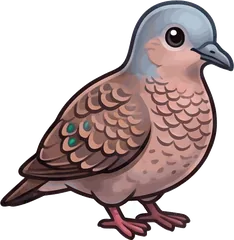 Common Ground Dove
The Common Ground Dove also repeats soft coos, but Audubon describes each one as rising at the end, coo-oo, coo-oo, unlike the two-note no-hope. In flight both show rusty wings; the ground dove has a short black tail.
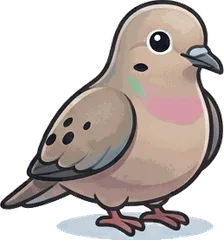 Mourning Dove
The Mourning Dove gives a low, mournful coo-ah, coo, coo, coo, a longer phrase. An Inca Dove's has just two notes, repeated many times. Scaly young Mourning Doves can also fool you by sight.
Where the Inca Dove card lives
In Warble the same bird can be an easy card in one state and a prized one in another, because each album ranks its birds by how often people really report them there. The Inca Dove appears in 2 state albums:
 Heard one? Open Warble, tap the green button while it sings, and the Inca Dove card flips into your album. Get the app free.
Questions people ask
What bird says no hope?
The Inca Dove. Its soft two-note coo is written as no-hope in the Audubon field guide, and the bird repeats it many times in a row from a perch in a town yard across the Southwest and Texas.
What makes a rattling sound when a small dove flies up?
The wings. Inca Doves take off with a dry rattle, and the Common Ground Dove makes a similar soft rattle when it flushes. Watch the tail as it goes: long with white edges for the Inca, short and black for the ground dove.
Why do Inca doves sit in a pyramid?
To stay warm. On cold nights Inca Doves roost in tight groups, sometimes stacked into a pyramid, to conserve heat, and they also let their body temperature drop overnight. Together these habits help a small desert dove survive at the cold northern edge of its range.
Are Inca doves native to Texas?
Probably not originally. Audubon says the species likely did not occur north of Mexico before people built towns in the Southwest. In Texas it was first collected at Laredo in 1866 and spread north and east from there, breeding in Austin, San Antonio and Waco by the early 1900s.
Sources
- National Audubon Society, Guide to North American Birds: Inca Dove. www.audubon.org/field-guide/bird/inca-dove
- Texas Breeding Bird Atlas (Texas A&M University): Inca Dove. txtbba.tamu.edu/species-accounts/inca-dove/
- National Audubon Society, Guide to North American Birds: Common Ground Dove. www.audubon.org/field-guide/bird/common-ground-dove
- National Audubon Society, Guide to North American Birds: Mourning Dove. www.audubon.org/field-guide/bird/mourning-dove