 Warble


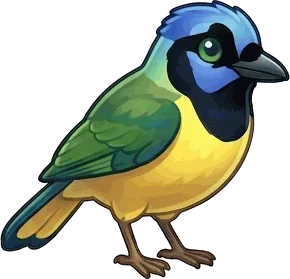
A Green Jay sounds like a jay with an oversized vocabulary. The calls you hear most in South Texas are a cheh-cheh-cheh-cheh, a rasping rassh-rassh-rassh and a dry, throaty rattle, plus a repeated shink, shink, shink and one call that sounds remarkably like an alarm bell. There is no tidy song, just a steady stream of buzzes, chatters, rattles and screams from family groups moving through dense brush. In the United States you hear it only in far southern Texas, where it lives year-round.
What it sounds like
Field guides describe Green Jay calls, not a song, and what the calls have is range. Wikipedia describes the repertoire as very extensive and full of unusual notes, and Audubon lists buzzes, chatters, chips, rattles, raucous cries and screams. The calls run flat or rise in pitch, and many come in repeated series.
The standout is a call that sounds like an alarm bell going off in the brush. Around it come the everyday sounds: a rasping rassh-rassh-rassh, which Wikipedia gives as the most common call, and the cheh-cheh-cheh-cheh that birders in South Texas learn quickly because they hear it so often. Audubon adds a variety of rattling calls and a repeated shink, shink, shink.
The Texas Breeding Bird Atlas sums the bird up as boisterous, and that fits. Green Jays live in pairs or family groups all year. Near some parks and refuges they are very tame and easy to watch; elsewhere they stay hidden in the thickets despite their colors and are far easier to hear than to see.
The rattle
Of all the Green Jay's calls, the dry, throaty rattle is the one most likely to fool an experienced listener, because it is very much like the rattle of a Blue Jay and of the western scrub-jays. On its own, a rattle from a thicket is not proof of a Green Jay. What settles it is the rest of the vocabulary: the cheh-cheh-cheh, the rasping rassh notes and that bell-like call.
When and where you hear it
The Green Jay is a tropical bird that reaches the United States only in southern Texas, where it is known locally as the Rio Grande Jay. Its range runs from there south through Mexico to Honduras. It is a permanent resident that rarely wanders far from where it nests. In Texas it is most common in dense native lowland woods of acacia, ebony and hackberry, usually near rivers, and it also uses mesquite brush, stands of short oaks and suburbs that still have native vegetation nearby.
It has been moving north. In 1974 its northern limit ran roughly from Laredo to Falfurrias. Later surveys found it breeding north to Kleberg and Jim Wells counties, with probable breeding in Dimmit and Bee counties. At Lake Corpus Christi the local checklist upgraded it from accidental in 1976 to uncommon permanent resident by 1988, and at Falcon State Recreation Area it went from uncommon to a resident seen on most visits. By the early 2000s it was common to uncommon north to Live Oak, Bee and Maverick counties.
Nesting runs from late March to mid-July. The nest is a bulky cup of thorny twigs hidden in a dense tree or thicket, the female alone incubates three to five eggs, and the young stay on their parents' territory until the following nesting season, when they are driven off. In some tropical areas yearlings help feed the next brood, but apparently not in Texas. In Warble the card is a rare find in the Texas album.
What it looks like
A robin-sized jay, about 10.6 to 11.8 inches long, rich green above, paler and yellowish green below, with a head patterned in black and blue-violet and bright yellow outer tail feathers. The wings are short and rounded and the tail long. Eye color varies with geography: birds in the north of the range, including Texas, have dark brownish eyes, while birds farther south have bright yellow ones. Green Jays eat insects, spiders, lizards, seeds, acorns and fruit, crack hard seeds by hammering them with the bill, cache acorns, and have even been seen using sticks to pry insects out of tree bark.
Birds that sound similar
 Blue Jay
The Blue Jay's dry, throaty rattle is very close to the Green Jay's, so do not decide on the rattle alone. Wait for the Green Jay's cheh-cheh-cheh, rasping rassh notes or bell-like call, and remember that in Texas Green Jays breed almost only in the far south.
- ?Woodhouse's Scrub-Jay
Formerly lumped as the Western Scrub-Jay, it has a harsh, scratchy voice and a rattle much like the Green Jay's. In Texas it lives in the west and on the Edwards Plateau, away from the Green Jay's brush country near the Rio Grande.
Where the Green Jay card lives
In Warble the same bird can be an easy card in one state and a prized one in another, because each album ranks its birds by how often people really report them there. The Green Jay appears in 1 state albums:
 Heard one? Open Warble, tap the green button while it sings, and the Green Jay card flips into your album. Get the app free.
Questions people ask
What bird sounds like an alarm bell in South Texas?
Very likely a Green Jay. One of its most distinctive calls sounds like an alarm bell, and it comes from dense brush and woods in far southern Texas, often mixed with rattles, rasping rassh-rassh-rassh notes and a fast cheh-cheh-cheh-cheh.
Where can I hear green jays in Texas?
In the far south of the state, especially the Rio Grande Valley, where they live year-round in native woods and brush, usually near water. They are tame around some parks and refuges. In recent decades they have spread north to Live Oak, Bee and Maverick counties.
Are green jays rare in Texas?
Not in the right place. Audubon calls them common in the native woods and mesquite brush of southern Texas, and the Texas Breeding Bird Atlas describes their status as improving, with a clear trend north. They are still rather uncommon at the northern edge of their range.
Are green jays found anywhere else in the United States?
No. Green Jays enter the United States only in southern Texas, and they rarely wander far from their nesting areas, so a Green Jay heard outside South Texas would be a real surprise.
Sources
- National Audubon Society, Guide to North American Birds: Green Jay. www.audubon.org/field-guide/bird/green-jay
- Wikipedia: Green jay (calls, range, description, tool use). en.wikipedia.org/wiki/Green_jay
- Texas Breeding Bird Atlas (Texas A&M University): Green Jay. txtbba.tamu.edu/species-accounts/green-jay/
- Wikipedia: Woodhouse's scrub jay (relationship to the Western Scrub-Jay, Texas range, voice). en.wikipedia.org/wiki/Woodhouse%27s_scrub_jay