 Warble


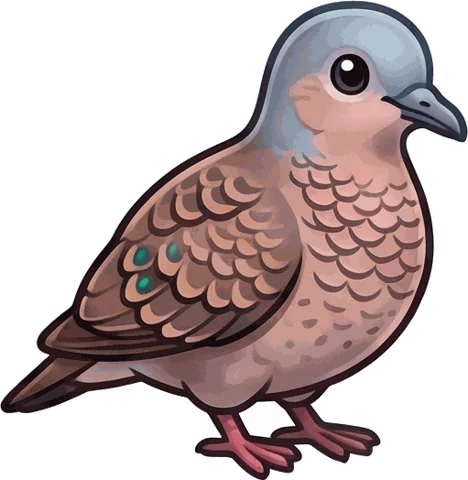
A Common Ground Dove sounds like a soft question asked over and over. Each note is a short coo that lifts at the end, coo-oo, given singly with a pause before the next, at a slow, steady pace of a few per minute. The singer is a sparrow-sized dove, usually on or near the ground in brushy fields, open pine woods, orchards or ranch yards across the southern United States, and it may keep calling through the heat of the day. When flushed it flutters off with a soft wing rattle and a flash of rusty red.
What the song sounds like
The song is a single soft coo with a rising inflection, repeated: coo-oo, coo-oo, coo-oo. Audubon writes it that way; Animal Diversity Web hears it as woot, woot, woot or wroo, and notes that the calls come about four or five times a minute. That slow tempo is the giveaway: one small note, a wait, then another, like someone knocking gently to see if anyone is home.
Timing is not much help, because ground doves coo at all hours of the day. Audubon notes that a male may repeat his short song often, even in the heat of the day. The cooing mostly serves as a courtship advertisement or as a signal when the pair trades places on the nest.
Courtship brings out the showmanship. A male struts with stiff steps, chest puffed out and head bowed, cooing as he goes, and several males may compete for the same female. During this bowing display he gives a guttural squawk, a rough note that sounds nothing like the gentle coo, and before mating he bows, flicks his wings and calls again.
Calls and the wing rattle
Ground doves have a small set of other sounds. A short wut-wut answers a threat from another ground dove, and calls given in flight work as warnings. When a male defends food or a mate, he coos, raises his wings and shows the chestnut patches in them. A bird flushed from its nest gives the usual calls but more quietly, and nestlings make a soft cheep when hungry and a louder peep when upset.
The sound you are most likely to notice, though, comes from the wings. A startled ground dove bursts up from the ground and into the brush with a soft, fluttering rattle, showing its short black tail and a flash of rusty red. These birds mostly make short, low, direct flights.
When and where you hear it
Common Ground Doves live across the southernmost tier of the United States, from California to Florida, and on through the West Indies, Mexico, Central America and the northern third of South America. In most areas they stay all year. In the Southeast look for them in brushy fields, the open understory of pine woods and forest edges; in Florida, in dry oak scrub, flatwoods and coastal strands. In the Southwest they use orchards, ranch yards and mesquite thickets along streams. They walk the ground in pairs or small flocks, tails slightly raised and heads bobbing, and in the Southeast they will visit feeders. Where their habitats overlap they may mix with Inca Doves.
Breeding runs from February to October, with two or three broods a year and sometimes four, so the cooing season is long. The nest is a flimsy platform on the ground or in a shrub or low tree, usually 3 to 12 feet up. Pairs keep long bonds and often perch close together, preening each other. Audubon reports that the species has declined seriously in many areas in recent decades, especially in the southeastern United States, for reasons that are not well understood. In Warble the card is an uncommon find in the Florida album.
What it looks like
The smallest dove in North America, about the size of a sparrow: 6 to 7 inches long and a little over an ounce. It is chunky, with short, rounded wings, a short tail and short legs. The body is sandy brown with dark spots on the wings and a scaly pattern on the head and breast, and the thin bill is pinkish at the base with a dark tip. Males have a bluish crown and pinkish tones on the head and chest; females are duller. In flight the wings flash bright rusty red, and the short black tail shows pale corners.
Birds that sound similar
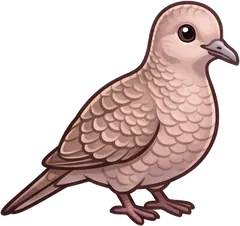 Inca Dove
The Inca Dove's song is a two-note no-hope, repeated often, while the ground dove gives single coos that rise at the end. Both flash rusty wings; the Inca has a long tail with white edges, the ground dove a short black one.
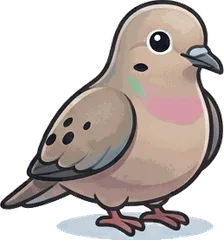 Mourning Dove
The Mourning Dove's song is a low, mournful phrase, coo-ah, coo, coo, coo, several notes in one go. A ground dove gives one rising note at a time with long pauses. Scaly young Mourning Doves can look short-tailed at first.
Where the Common Ground Dove card lives
In Warble the same bird can be an easy card in one state and a prized one in another, because each album ranks its birds by how often people really report them there. The Common Ground Dove appears in 1 state albums:
 Heard one? Open Warble, tap the green button while it sings, and the Common Ground Dove card flips into your album. Get the app free.
Questions people ask
What is the smallest dove in the United States?
The Common Ground Dove, the smallest dove in North America. It is about the size of a sparrow, roughly 6 to 7 inches long, and lives across the southern edge of the country from California to Florida.
What bird makes a soft coo that rises at the end?
In the southern United States, a single soft coo-oo with an upward lift, repeated slowly, is very likely a Common Ground Dove. The Inca Dove gives a two-note no-hope and the Mourning Dove a longer, mournful phrase.
Do ground doves coo all day?
Yes. Common Ground Doves coo at all hours of the day, and males may keep repeating the song even in the midday heat. The cooing advertises for a mate and signals when the pair swaps places on the nest.
Are common ground doves declining?
In many places, yes. Audubon reports serious declines over recent decades, especially in the southeastern United States, and the causes are not well understood. The species is still widespread overall and is listed as Least Concern.
Sources
- National Audubon Society, Guide to North American Birds: Common Ground Dove. www.audubon.org/field-guide/bird/common-ground-dove
- Animal Diversity Web (University of Michigan): Columbina passerina. animaldiversity.org/accounts/Columbina_passerina/
- National Audubon Society, Guide to North American Birds: Inca Dove. www.audubon.org/field-guide/bird/inca-dove
- National Audubon Society, Guide to North American Birds: Mourning Dove. www.audubon.org/field-guide/bird/mourning-dove