 Warble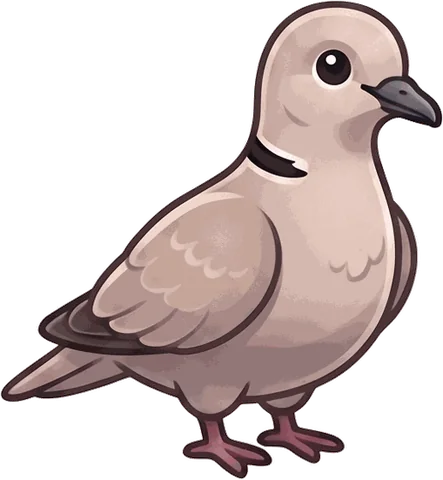
A Eurasian Collared-Dove sounds like a dove that has learned to count to three: a deep, hollow kuk-kooooo-kuk with the weight on the long middle note, repeated over and over from a rooftop, a pole or a power line, often for minutes on end. The other sound is nothing like a coo: a harsh, nasal, mewing hrrreeew given as the bird lands or flies, closer to a catbird's whine than to anything you expect from a dove.
What the song sounds like
The song is a three-syllable coo, written kuk-kooooo-kuk, goo-GOO-goo or coo-COO-cook depending on the guide. However you spell it, the shape is the same: a short note, a longer stressed note, and a short closing note, then a pause and the whole thing again. It is deeper and more hollow than a Mourning Dove's, and it does not trail off. In Europe, where the bird spread across the continent in the twentieth century, early-spring collared-doves have been reported as cuckoos by people who heard the hollow rhythm before they saw the bird.
Repetition is the defining trait. A male will deliver the phrase dozens of times without a break from an exposed perch, and once you learn it you realize how much of the background noise of a suburb or a farm town is this one bird. The scientific name records the sound: decaocto is Greek for eighteen, and in the old story a poorly paid servant complained to Zeus, who created the collared-dove to repeat her grievance. The bird has been calling out eighteen ever since.
The call: a harsh nasal mew
When a collared-dove lands, and sometimes in flight, it gives a harsh, drawn-out, nasal hrrreeew that falls in pitch and lasts a second or two. Audubon compares it to the mewing call of a Gray Catbird, and the first time you hear it from a bird you took for a Mourning Dove it is a jolt. This screech is a good confirmation when the coo is ambiguous: Mourning Doves have nothing like it.
When and where you hear it
This bird did not exist in North America before the 1970s. Fewer than 50 escaped from captivity in Nassau, in the Bahamas, in 1974. Their descendants reached the Florida mainland, and from the 1980s the species pushed north and west at a remarkable pace, roughly 60 miles a year through Arkansas, more than twice the speed of its earlier spread across Europe. It now lives across most of the country, north to Oregon and Washington and even Alaska, though the Northeast has been slow to fill in beyond scattered wanderers.
Collared-doves stay all year and breed through most of it, three or four broods being normal and up to six recorded, so the coo is a sound of nearly every month, loudest in spring. Almost every nest is within a kilometer of an occupied building. Listen in small towns, suburbs and farmyards with a mix of trees and open ground, from Florida, where the American population began, across the Plains to the West Coast; Audubon notes the bird does better in small towns than in big cities. Look up: the singer is usually on a pole, a wire or a rooftop.
In Missouri, where it became the 398th species on the state checklist, it is now a permanent resident that crowds feeders and pushes smaller birds aside. It is an easy card for Warble players anywhere the bird has settled, because it repeats itself so obligingly.
What it looks like
A big, pale, stout dove, 11 to 13 inches long, noticeably larger and heavier than a Mourning Dove. The body is chalky grayish tan, a little paler below, with a narrow black half-collar edged in white on the back of the neck, dark wingtips that contrast with the pale wing, and broad white patches in the outer tail that show when it fans to land. The tail is squared, not pointed. Mourning Doves are slimmer and browner, with black spots on the wings and a long tapering tail, and they are the ones with the sad voice.
Birds that sound similar
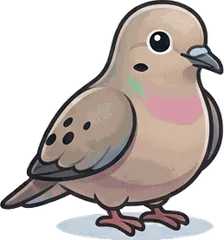 Mourning Dove
The Mourning Dove's coo is softer and sadder: a rising coo-ah followed by three lower, even coo notes. The collared-dove's is three parts, deeper, with the stress in the middle, and it never sounds mournful.
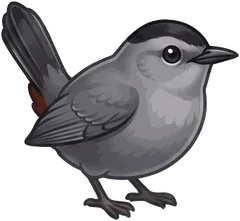 Gray Catbird
The catbird's nasal, cat-like mew is the closest match for the collared-dove's harsh landing call. A catbird calls from inside a thicket and follows with a long jumble of mimicry; the dove calls once as it drops onto a wire.
Where the Eurasian Collared-Dove card lives
In Warble the same bird can be an easy card in one state and a prized one in another, because each album ranks its birds by how often people really report them there. The Eurasian Collared-Dove appears in 24 state albums:
 Heard one? Open Warble, tap the green button while it sings, and the Eurasian Collared-Dove card flips into your album. Get the app free.
Questions people ask
How is a Eurasian Collared-Dove's call different from a Mourning Dove's?
Count the notes. The collared-dove gives three, kuk-KOOO-kuk, with the middle one longest and loudest, and repeats the set without pause. The Mourning Dove gives a soft rising coo-ah followed by three lower coos, slower and sadder. The collared-dove also has a harsh nasal screech that the Mourning Dove never makes.
Are Eurasian Collared-Doves invasive?
They are not native: the whole North American population descends from fewer than 50 birds that escaped in the Bahamas in 1974. Missouri lists the species as invasive and gives it no hunting protection. At feeders they crowd in and push smaller birds aside.
Why does the collared-dove coo all day?
Because it breeds nearly all year. Pairs commonly raise three or four broods, and up to six have been recorded, so a male is almost always advertising a territory. The song carries well from the poles and rooftops the bird favors, which makes it feel constant.
Where does the name decaocto come from?
It is Greek for eighteen, and it is meant to imitate the three-syllable coo. In the old story a poorly paid servant girl complained to Zeus, who created the collared-dove to repeat her grievance, and the bird has been calling out eighteen ever since.
Sources
- National Audubon Society, Guide to North American Birds: Eurasian Collared-Dove. www.audubon.org/field-guide/bird/eurasian-collared-dove
- Wikipedia: Eurasian collared dove (voice, name, introduction and spread). en.wikipedia.org/wiki/Eurasian_collared_dove
- Missouri Department of Conservation, Field Guide: Eurasian Collared-Dove. mdc.mo.gov/discover-nature/field-guide/eurasian-collared-dove
- National Audubon Society, Guide to North American Birds: Mourning Dove (lookalike voice). www.audubon.org/field-guide/bird/mourning-dove