 Warble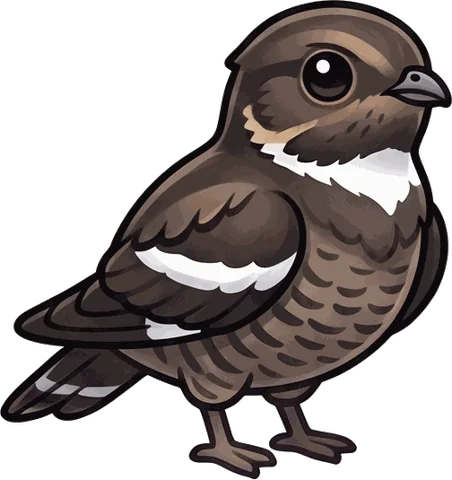
A Common Nighthawk sounds like a nasal, buzzy peent coming from somewhere high overhead at dusk, repeated every few seconds as the bird flies in loose, bounding circles over a ballfield, a parking lot or a stretch of prairie. In spring and early summer the male adds a second sound: he climbs, folds into a steep dive and, at the bottom, air rushing through his wing feathers makes a deep hollow boom or vroom. Both peak in the half hour after sunset from late April to September, though nighthawks also fly at dawn and sometimes in daylight.
What the peent sounds like
The nighthawk has no song. What it has is a call, given on the wing: a loud, harsh, nasal peent, sometimes written beernt or pee-yah, a single buzzy note like a tiny electric horn. Both sexes make it, and a hunting bird calls over and over for as long as it is flying. Most people hear the peent long before they connect it to the long-winged shape against the dimming sky, white wing bars flashing as it twists after insects.
The other sound gave the bird its country name of bull-bat. In courtship the male climbs high, plunges toward the ground and pulls out with a quick downward flex of the wings, and air rushing through the stiff outer wing feathers makes a deep, hollow boom, more like a truck passing on a distant highway than any voice. The dive is often given in daylight. Males also clap their wings together and give a croaking auk auk auk.
The other calls: rasps and hisses at the nest
Away from the sky the nighthawk is quiet. A female defending eggs gives a rasping sound, and she may flutter away feigning injury to lead a predator off. Threatened chicks spread their wings and hiss.
When and where you hear it
The nighthawk is not a hawk, and it is more a bird of dusk and dawn than of full night. It forages most actively in the half-light, and peak calling comes 30 to 45 minutes after sunset. It also hunts in daylight and on moonlit nights, and in towns it works the streetlights well after dark.
It is a summer bird with one of the longest migrations of any bird in the Americas, wintering in South America east of the Andes as far south as Argentina. Northbound birds start at the end of February and the last reach the far north in mid-June; in Missouri they arrive in late April. The southbound movement runs from mid-July to early October, and on late August and September evenings loose flocks, sometimes hundreds strong, drift south overhead. There is no nest; the female lays two speckled eggs on bare ground, gravel, a stump or a flat roof, incubates them for about 19 days, and the young first fly at around three weeks.
Nighthawks want open ground and open sky: prairie, glades, beaches, logged or burned forest, farmland, and cities, where flat gravel roofs stand in for bare ground and streetlights stand in for the moon. That is why a bird named for the night is a summer sound over downtowns in Texas, Nebraska and North Dakota. It is also in trouble: Audubon puts the population near 23 million but calls the decline serious across much of North America, blaming pesticides, the loss of gravel roofs and habitat. Record one peenting over the block with Warble and you have caught a bird that used to be far commoner.
What it looks like
In the air it is a slim, long-winged bird about nine inches long with a wingspan near two feet, weighing two to three and a half ounces, flying with erratic, bounding wingbeats on angled, sharply pointed wings. The field mark is the bold white bar across the outer wing; males also have a white throat and a white band near the tip of the forked tail, while females have a buff throat and a plain tail. Perched, it is a mottled gray, black and brown lump with heavily barred underparts. It eats flying insects, favoring beetles and flying ants along with moths and grasshoppers. Old names include goatsucker and bugeater.
Birds that sound similar
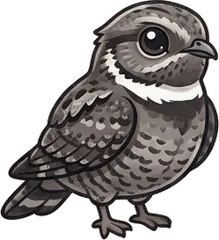 Eastern Whip-poor-will
The Eastern Whip-poor-will sings a whistled three-note phrase over and over from the forest floor at night. The nighthawk never repeats a phrase; it gives one nasal peent at a time, in the air, usually in the open and usually before full dark.
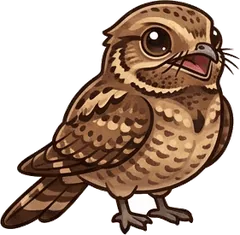 Chuck-will's-widow
The Chuck-will's-widow is a southern woodland bird singing a slow, low four-syllable phrase from a perch. Its wings are rounded and plain; the nighthawk's are long, pointed and barred with white, and its only voice is the buzzy peent.
Where the Common Nighthawk card lives
In Warble the same bird can be an easy card in one state and a prized one in another, because each album ranks its birds by how often people really report them there. The Common Nighthawk appears in 3 state albums:
 Heard one? Open Warble, tap the green button while it sings, and the Common Nighthawk card flips into your album. Get the app free.
Questions people ask
What is the buzzing peent sound in the sky at dusk?
Very likely a Common Nighthawk. Its call is a loud, nasal peent given in flight while the bird hunts insects overhead, most of all in the half hour after sunset. Look for a long-winged shape with a white bar on each wing.
What makes the booming sound when a nighthawk dives?
Air rushing through the stiff outer wing feathers. The male climbs, dives steeply and flexes his wings downward at the bottom of the dive, and the rush of air through the primaries produces a deep hollow boom. It is a courtship display, not a voice.
Why do nighthawks nest on roofs?
Because a flat gravel roof looks like the bare, open ground they nest on naturally. They build no nest and lay two camouflaged eggs directly on gravel, sand or rock, and city roofs put them next to the streetlights that draw their insect prey. The loss of gravel roofs is one reason their numbers are falling.
When do nighthawks migrate?
They leave for South America between mid-July and early October, with the biggest flights in late August and September, when flocks, sometimes of hundreds, pass over in the evening. They return from late April in the middle of the country to mid-June in the far north.
Sources
- National Audubon Society, Guide to North American Birds: Common Nighthawk. www.audubon.org/field-guide/bird/common-nighthawk
- Wikipedia: Common nighthawk (calls, boom display, size, migration dates, nicknames, decline). en.wikipedia.org/wiki/Common_nighthawk
- Missouri Department of Conservation, Field Guide: Common Nighthawk. mdc.mo.gov/discover-nature/field-guide/common-nighthawk
- Animal Diversity Web: Chordeiles minor, common nighthawk (calls, habitat, breeding, diet). animaldiversity.org/accounts/Chordeiles_minor/