 Warble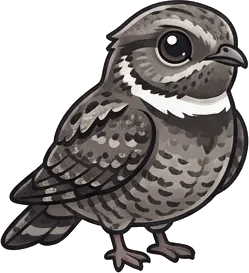
An Eastern Whip-poor-will sounds exactly like its name, sung as a loud, rolling three-note whistle: whip-poor-WILL, with a quick low whip, a softer poor and a rising, emphatic will. The phrase is repeated without a break, often hundreds of times, at a steady pace that can go on for many minutes. It is a night sound, starting at dusk and picking up again before dawn, loudest on moonlit nights from April to September in eastern woods. Only the Chuck-will's-widow, which is lower and slower, sounds much like it.
The birder's mnemonic
“whip-poor-will” The bird says its own name; put the weight on the last syllable and repeat it at a walking pace, and you have the song.
What the song sounds like
The song is a three-part whistle, whip-poor-WILL, loud, rhythmic and slightly rolling, with the emphasis on the last note. What makes it unforgettable is the repetition. The phrase is given over and over with almost no gap, at a steady tempo, and a bird in full voice keeps it up for a very long time: Audubon records one that sang 1,088 times without stopping, and the Missouri Department of Conservation notes that the song may be repeated hundreds of times a night.
The singer is a male, defending a patch of woods and calling for a mate. The song is higher and faster than the Chuck-will's-widow's, the only other bird likely to be confused with it, and the two overlap across much of the South.
The other calls: quirt, growl and hiss
Away from the song there are quieter calls most people never hear. A soft quirt is given by birds on territory, growing more insistent as the bird gets worked up. Two rivals meeting at a boundary produce a fluttering growl. A repeated loud hiss answers a predator near the nest, and a low guttural chuckle, written as cur, passes between a pair during courtship and when one adult relieves the other on the eggs.
When and where you hear it
The whip-poor-will sings at night and sleeps by day, and it is most active in the evening and again toward dawn. Bright nights are best. The birds hunt flying insects by sight, so they are especially active under a moon, and their whole breeding schedule is built around it: egg-laying is timed so the young hatch about ten days before a full moon, and the adults feed them mostly on nights when the moon is more than half full. A moon calendar is a better guide to hearing this bird than a thermometer.
It is a summer bird. Whip-poor-wills arrive in the East from late March through May and leave in September and October, so in Missouri they are present roughly April to September; they winter in the southeastern states, eastern Mexico and Central America. Nesting runs from May into June, and many pairs raise two broods. The two eggs, whitish with brown and gray marks, go straight onto the leaf litter with no nest built, in a shady spot in deciduous or mixed woods, and both parents incubate them for about three weeks. Listen in woodlands with an open understory; the birds avoid pure conifer stands. There are far fewer than there were: the population fell by more than 60 percent between 1970 and 2014, and the species is listed as Near Threatened, with fewer big moths and beetles, lost young forest and cats among the suspected causes. If you hear one, that is a good night, and one worth recording in Warble.
What it looks like
You will hear a hundred before you see one. The whip-poor-will is about the size of a robin, 8.7 to 10.6 inches long with a wingspan of 17.5 to 19.5 inches, and it weighs under two and a half ounces. Its plumage is a mottled mix of gray, brown and black that looks exactly like dry leaves, and it spends the day crouched motionless on the forest floor, sitting tight until it is nearly stepped on. It has a big flat head, large eyes, a tiny bill, an enormous mouth for scooping up moths and beetles in flight, and short, rounded wings with no white in them. The male shows a white band across the lower throat and white corners on the tail; on the female those parts are buff. The Chuck-will's-widow is bigger, about 12 inches, with browner, less gray plumage.
Birds that sound similar
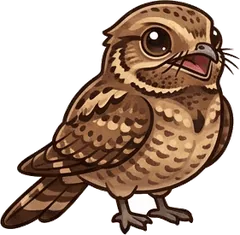 Chuck-will's-widow
The Chuck-will's-widow also says its name, but in four syllables, chuck-will's-WID-ow, and its song is lower and slower than the whip-poor-will's quick three-note phrase.
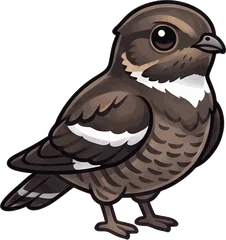 Common Nighthawk
A Common Nighthawk never repeats a whistled phrase. Its call is a single nasal, buzzy peent given in flight over rooftops and fields at dusk, and its wings are long and pointed with a white bar, not short and rounded.
Where the Eastern Whip-poor-will card lives
The Eastern Whip-poor-will is not in the top 100 of any single state album, so it lives in the national album of all 800 birds, where it counts as uncommon. Catching one anywhere in the country adds it there.
 Heard one? Open Warble, tap the green button while it sings, and the Eastern Whip-poor-will card flips into your album. Get the app free.
Questions people ask
What time of night does the whip-poor-will sing?
Mostly at dusk and before dawn, and more on bright moonlit nights than on dark ones. The bird is active all night when the moon is up, since it hunts insects by sight, so a clear night near the full moon in May or June is the best time to listen.
How many times does a whip-poor-will repeat its call?
Hundreds of times in a row is normal. One bird was recorded singing its phrase 1,088 times without a pause, at a steady pace with almost no gap between phrases, which is why it can feel endless from a tent.
Why don't I hear whip-poor-wills anymore?
Because there are far fewer of them. The population dropped by more than 60 percent between 1970 and 2014, and the species is listed as Near Threatened. Fewer large moths and beetles, the loss of young open forest, pesticides and predation by cats and dogs are the main suspects.
What months can I hear a whip-poor-will?
Roughly April through September in most of the East. Birds arrive from late March into May, sing most during nesting in May and June, and leave for the Southeast, Mexico and Central America in September and October.
Sources
- National Audubon Society, Guide to North American Birds: Eastern Whip-poor-will. www.audubon.org/field-guide/bird/eastern-whip-poor-will
- Wikipedia: Eastern whip-poor-will (size, plumage, winter range, population decline). en.wikipedia.org/wiki/Eastern_whip-poor-will
- Missouri Department of Conservation, Field Guide: Eastern Whip-poor-will. mdc.mo.gov/discover-nature/field-guide/eastern-whip-poor-will
- Animal Diversity Web: Caprimulgus vociferus, whip-poor-will (calls, migration dates, breeding). animaldiversity.org/accounts/Caprimulgus_vociferus/