 Warble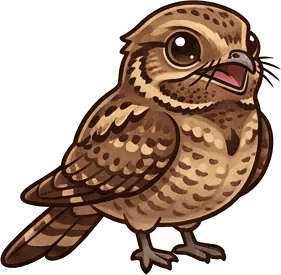
A Chuck-will's-widow sounds like its name said slowly in a low, mellow voice: a deep, quiet chuck, then a whistled will's-WID-ow with a vibrating middle note and the weight on the second and third syllables. The phrase is repeated over and over from a perch, 16 to 30 times a minute, on warm nights from spring into summer across the Southeast. It is slower, lower and less piercing than the Eastern Whip-poor-will, the bird it is most often confused with. Listen at dusk and on moonlit nights in oak and pine woods from Florida and Texas north to Long Island.
The birder's mnemonic
“chuck-will's-widow” The first syllable is deep and low, so from a distance you may hear mostly will's-widow; old country names for the bird include chip-fell-out-of-a-oak.
What the song sounds like
The song is the name, delivered at a walking pace. Audubon describes it as a mellow chuck-will's-widow repeated over and over, with the chuck deep and low and the rest whistled. The middle of the phrase has a distinct vibrato, a quavering note set between two shorter ones, and the accent falls on the second and third syllables, so what carries across a field on a June night is will's-WID-ow, will's-WID-ow, will's-WID-ow. The opening chuck is the quietest part, and the first to drop out as the bird gets farther away.
Only males sing, from a perch rather than the ground, and they sing at a steady clip of 16 to 30 phrases a minute, which works out to one every two to four seconds. Compared with the whip-poor-will, the Chuck-will's-widow is slower, lower-pitched and less piercing, a baritone next to a tenor, and where both sing you can pick them apart by tempo alone.
The other calls: clucks and hisses
Away from the song the bird is nearly silent. A Chuck-will's-widow flushed from its daytime roost or its eggs gives low clucking notes in protest, and a threatened bird hisses. Males on the nest give muted versions of the song. A female with eggs nearby may walk away dragging her wings along the ground and hissing, the classic broken-wing act meant to pull a predator after her. Females themselves do not sing.
When and where you hear it
The Chuck-will's-widow sings at dusk and when the moon is out, and more on warm nights than on cool ones. Like other nightjars it hunts at night, most actively at dusk and dawn and under moonlight, snapping big beetles and moths out of the air with a gape wide enough that it also swallows the occasional warbler, sparrow, hummingbird or bat whole. Birds arrive on the breeding grounds between February and May depending on latitude, nest from April through June, and slip away between late August and October, though some birds in southern Florida stay all year. The rest winter in the West Indies, Mexico, Central America and northern South America. The first warm, still, moonlit evening of spring is the night to stand at the edge of the pines.
Its range covers the southeastern United States, from Florida and eastern Texas north to Kansas, Oklahoma and Long Island, with a few outposts as far as Cape Cod and Ontario. It lives in open oak and pine woodlands, oak-hickory forest, the edges of swamps and clearings, and it tolerates suburbs with enough woods around them. The two eggs, blotched with brown, are laid directly on dead leaves or pine needles with no nest at all, and the female incubates them for about three weeks; the young can fly at around 17 days. In Florida, Georgia and Texas it is the default night voice of the pinewoods, and one that Warble can catch from a screened porch.
What it looks like
This is the largest nightjar in North America, 11 to 13 inches long with a wingspan of 23 to 26 inches, noticeably bigger and bulkier than a whip-poor-will. It is a rich buffy brown all over, mottled with cinnamon, cream and black, browner and less gray than the whip-poor-will, with a buff throat and a chest that often looks darker than the throat. The head is large and flat, the bill tiny, the mouth enormous, and the tail long. Males show white on the outer three tail feathers and a pale collar under the throat; females have no white in the tail. The oldest banded bird lived nearly 15 years.
Birds that sound similar
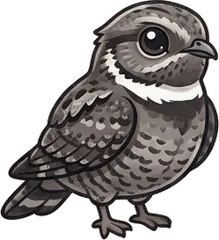 Eastern Whip-poor-will
The Eastern Whip-poor-will sings a quicker, higher, sharper three-note phrase, whip-poor-WILL. The Chuck-will's-widow has four syllables, a lower voice and a slower beat. Where both sing, the slower, deeper one is the Chuck.
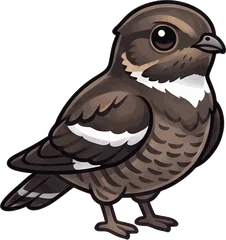 Common Nighthawk
A Common Nighthawk does not repeat a whistled phrase at all. It gives a single nasal peent while flying overhead at dusk, often over towns, and its long pointed wings carry a white bar. The Chuck-will's-widow sings from a perch in the woods.
Where the Chuck-will's-widow card lives
The Chuck-will's-widow is not in the top 100 of any single state album, so it lives in the national album of all 800 birds, where it counts as uncommon. Catching one anywhere in the country adds it there.
 Heard one? Open Warble, tap the green button while it sings, and the Chuck-will's-widow card flips into your album. Get the app free.
Questions people ask
How do I tell a Chuck-will's-widow from a whip-poor-will by sound?
Count syllables and feel the tempo. The Chuck-will's-widow sings four syllables, slowly and low, with a quivering middle note. The whip-poor-will sings three, faster, higher and more piercing.
What time of year do Chuck-will's-widows sing?
Mostly April through early summer. Birds arrive in the Southeast between February and May, nest from April into June, and leave between late August and October for the West Indies, Mexico and Central America. A few stay in south Florida all year.
Why can I only hear "will's-widow" and not the "chuck"?
Because the opening chuck is a deep, low note while the rest is whistled, so the whistled will's-widow is what carries. People once heard the song as chuckwuts-widow or chip-fell-out-of-a-oak.
Do Chuck-will's-widows really eat birds?
Occasionally, yes. Their main food is large night-flying insects, especially beetles and moths, but they have been recorded swallowing small birds such as warblers, sparrows and hummingbirds, and even bats, whole.
Sources
- National Audubon Society, Guide to North American Birds: Chuck-will's-widow. www.audubon.org/field-guide/bird/chuck-wills-widow
- Wikipedia: Chuck-will's-widow (song, size, range, diet, names). en.wikipedia.org/wiki/Chuck-will%27s-widow
- Animal Diversity Web: Caprimulgus carolinensis, chuck-will's-widow (singing rate and timing, migration, breeding). animaldiversity.org/accounts/Caprimulgus_carolinensis/
- Missouri Department of Conservation, Field Guide: Eastern Whip-poor-will (comparison with Chuck-will's-widow). mdc.mo.gov/discover-nature/field-guide/eastern-whip-poor-will