 Warble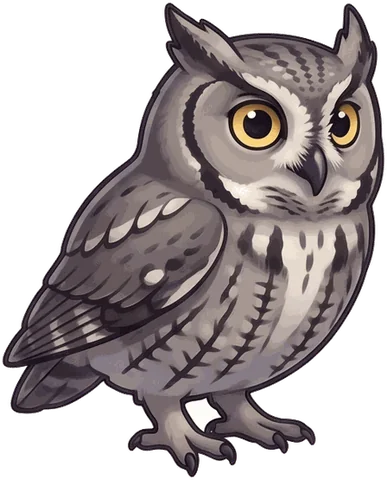
A Western Screech-Owl sounds like a ball dropped on a hard floor: a series of five to fifteen soft, hollow whistled hoots, all on about one pitch, that start slow and speed up toward the end, often sagging slightly in pitch as they run together. Its second song is a double trill, a short burst followed by a longer one. It does not whinny like the Eastern Screech-Owl. You hear it at dusk and through the night, in every month but most in late winter and spring, from wooded canyons and desert washes to suburban yards across the West.
What the bouncing-ball song sounds like
The main song is the bounce. Audubon describes it as an accelerating series of six to eight low whistles, often dropping in pitch toward the end; Animal Diversity Web counts five to fifteen hollow whistled hoots on a single pitch that speed up like a bouncing ball. The count varies, the effect does not: hoo, hoo, hoo-hoo-hoo-hoohoohoo, evenly spaced at first, then piling up until the notes blur and stop. It is soft, low and a little mournful. The rhythm, not the tone, is the giveaway.
The second song is the double trill: a short run of notes on one pitch, a tiny pause, then a longer run, falling slightly at the end. Both sexes sing, and a male's bounce song runs roughly 30 percent lower in pitch than a female's. Pairs sing duets, and a courting male brings food and makes clicking sounds.
Where both screech-owls occur, and their ranges now overlap in parts of Texas after the Western spread east over the last few decades, the songs settle the question. The Eastern gives a descending whinny and a trill at one tempo; the Western never whinnies, and its bounce song accelerates. Audubon puts it plainly: these two are best identified by sound.
The other calls: barks, chuckles and bill snaps
Away from the songs the Western Screech-Owl barks and chuckles much like its eastern cousin, and it snaps its bill when a predator is too close to the nest hole. There is a high-pitched screech in the repertoire, but it is an alarm, not a song.
When and where you hear it
Western Screech-Owls are permanent residents and defend their territory all year, so a bounce song can turn up on any night, though the birds answer each other less while incubating and raising young. The heaviest calling comes as pairs form in January and February and runs into the nesting season, with eggs laid in March and April. The female incubates two to five white eggs for about 26 days while the male brings food, and the young leave the cavity around four weeks after hatching. The owl forages at dusk and through the night, hunting from a perch by ear as much as by eye, and it will snatch flying insects out of the air.
This owl uses an odd mix of country: wooded canyons, oak and streamside groves, farm shelterbelts, mesquite and even saguaro forest, plus wooded suburbs, parks and gardens; it stays out of the open desert and the high mountains. In Arizona listen along mesquite-lined washes, in California in oak woodland and fan-palm oases, in Washington in mixed coastal forest, and in Colorado in cottonwoods around ranches and small towns. Nests go in tree cavities, old woodpecker holes, nest boxes and holes in giant cactus, 5 to 35 feet up. Because it is common in western neighborhoods and sings a slow, patterned song, it is one of the easier owls for Warble to pick out of an evening recording.
What it looks like
A small, stocky owl, 7.5 to 10 inches long with a wingspan of about two feet and a weight of three to eight ounces, females a little larger and northern birds larger than southern ones. It has a round head with short ear tufts, yellow eyes, a pale face with a dark border and streaked, barred underparts. Most birds are gray; those of the Pacific Northwest are browner, and there is no red morph, so a rufous screech-owl is an Eastern. The most useful mark in a good photo is the bill: its base is blackish, while the Eastern's is yellow-green. The menu is mice, voles and pocket gophers, plus beetles, moths, scorpions, small birds, lizards, frogs and crayfish. Great Horned, Spotted and Barred Owls eat it, and crows and jays raid its nests.
Birds that sound similar
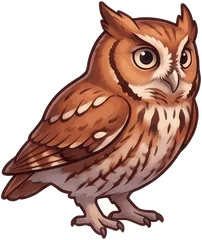 Eastern Screech-Owl
The Eastern Screech-Owl gives a descending whinny like a small horse and a trill that holds one steady tempo. The Western's bounce song speeds up, and it never whinnies. Where the two meet in Texas, voice is the only reliable way to separate them.
- ?Northern Saw-whet Owl
The saw-whet's late winter and spring song is a monotonous series of tooting whistles at one steady pace, sometimes continuing for hours. The screech-owl's whistles accelerate and stop within a few seconds, then start over.
Where the Western Screech-Owl card lives
The Western Screech-Owl is not in the top 100 of any single state album, so it lives in the national album of all 800 birds, where it counts as uncommon. Catching one anywhere in the country adds it there.
 Heard one? Open Warble, tap the green button while it sings, and the Western Screech-Owl card flips into your album. Get the app free.
Questions people ask
Why is it called a screech-owl if it does not screech?
The everyday songs are soft whistled hoots that speed up like a bouncing ball, and a double trill. A high screech exists but is only an alarm call given near the nest or at a predator.
How do I tell a Western Screech-Owl from an Eastern by sound?
Listen for the rhythm. The Western's series accelerates, evenly spaced hoots that pile up at the end. The Eastern's trill runs at one tempo, and the Eastern also gives a descending whinny the Western never makes. The two were once considered one species.
What time of year do Western Screech-Owls call?
All year, since they stay on territory year-round, but most in late winter and spring. Pairs form in January and February and eggs are laid in March and April, and singing drops off while the adults are incubating and raising young.
Do Western Screech-Owls live in cities?
Often, yes. They live in wooded suburbs, parks and gardens as long as there are trees with cavities or a nest box, and they nest in everything from oaks and cottonwoods to saguaro cactus.
Sources
- National Audubon Society, Guide to North American Birds: Western Screech-Owl. www.audubon.org/field-guide/bird/western-screech-owl
- Wikipedia: Western screech owl (songs, sex differences in pitch, size, morphs, habitat, nesting). en.wikipedia.org/wiki/Western_screech_owl
- Animal Diversity Web: Otus kennicottii, western screech owl (song, breeding timeline, habitat by state, predators). animaldiversity.org/accounts/Otus_kennicottii/
- National Audubon Society, Guide to North American Birds: Northern Saw-whet Owl. www.audubon.org/field-guide/bird/northern-saw-whet-owl