 Warble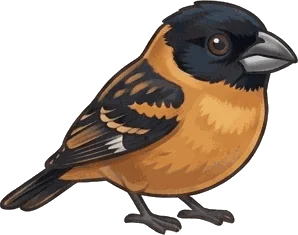
A Black-headed Grosbeak sounds like an American Robin that took singing lessons. The song is a long, rich warble of whistled phrases and short trills, rising and falling like a robin's but faster, softer, sweeter and more fluent. The call is a sharp, slightly metallic tick or ik. Both the orange-and-black male and the streaky brown female sing, sometimes while sitting on the eggs. Listen in oak woods and streamside cottonwoods across the West from late April into July.
What the song sounds like: a robin, improved
The song is a flowing warble built from whistled notes, quick trills and a back-and-forth rise and fall in pitch. The robin comparison is fair, because the phrases have the same caroling shape, but a grosbeak sings faster and smoother, with a mellow, almost liquid quality. Next to a Western Tanager, the grosbeak is the clear, rich voice and the tanager the hoarse one.
Both sexes sing, and their songs differ. The male sings from a perch to claim a territory and attract a mate, sometimes fluttering up into the air. The female sings while foraging, when dealing with other females and to keep in touch with her young. Most unusual of all, both birds sing from the nest while incubating, so a warble from inside a dense willow may be a bird sitting on eggs.
On the Great Plains, where this species meets the Rose-breasted Grosbeak, the songs are so alike that the birds themselves cannot tell them apart, and mixed pairs and hybrids result.
The call: a metallic tick
The call is a single sharp tick, emphatic and slightly metallic, also written ik or eek. It is the sound of a grosbeak moving through foliage or arriving at a feeder, and often the only clue to a female or young bird hidden in the leaves.
Grosbeaks are quarrelsome in the breeding season. Both sexes fight over territory, and a burst of ticks and chasing in an oak canopy in May usually means two neighbors have met at the boundary. Outside the breeding season they travel in small, loose flocks and go quiet.
When and where you hear it
The Black-headed Grosbeak breeds across western North America from the Pacific coast east to the middle of the Great Plains, and from British Columbia and Saskatchewan south into the mountains of Mexico. Birds from the United States and Canada winter in Mexico. They arrive late in spring, males about six days ahead of females, and leave early, with the first birds heading south as soon as mid-July.
The habitat is deciduous and mixed woodland with big trees and thick understory: oak woodland in California, streamside groves of cottonwood and willow across the interior, pine-oak forest and pinyon-juniper in the mountains of Arizona and New Mexico, and patches of broadleaf trees inside conifer forest farther north. Nests go in thickets at the edges of streams, ponds and openings. They come readily to feeders and campgrounds.
The diet mixes insects and spiders, seeds and fruit, with insects dominating in summer, including pests like codling moth caterpillars and cankerworms, plus cherries, berries and mistletoe fruit. The species is one of very few birds that can eat monarch butterflies, which store heart poisons from milkweed; genetic changes make the grosbeak resistant, and at the wintering colonies in Mexico the birds may take more than a million monarchs a year. The female builds a loose saucer of twigs and rootlets 3 to 35 feet up in outer foliage, often in a willow or live oak, and lays two to five spotted eggs. Both parents incubate for 12 to 14 days and feed the young, which leave the nest at 11 or 12 days but cannot fly for another two weeks. One brood a year. In Warble the song is an easy catch in riverside parks through June.
What it looks like
A chunky songbird, 7.1 to 7.9 inches long with a wingspan of about 12 inches, built around a huge, pale, conical bill. The male has a black head, black wings and tail with bold white patches, a cinnamon to tawny orange breast and collar and a yellow belly. The female is brown and streaky with a striped head, two white wing bars and a tan to buff-orange breast with little streaking; she is more orange and less streaked than a female Rose-breasted Grosbeak. Both sexes flash yellow wing linings in flight, and the population, around 15 million, is stable.
Birds that sound similar
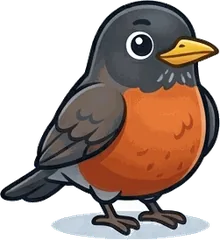 American Robin
The robin's cheer-up, cheerily is slower and simpler, with clear pauses between phrases. The grosbeak sings a faster, richer, sweeter warble with trills mixed in.
 Western Tanager
The Western Tanager also sings robin-like phrases but sounds hoarse and burry, and its call is a dry pit-er-ick. The grosbeak is clear and fluent, and its call is a single sharp tick.
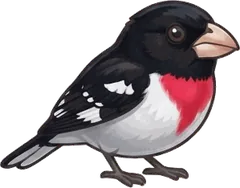 Rose-breasted Grosbeak
The Rose-breasted Grosbeak of the East sings a nearly identical soft, melodious robin-like song and gives a penetrating metallic eek. Where the two meet on the Great Plains, sound alone will not separate them.
Where the Black-headed Grosbeak card lives
In Warble the same bird can be an easy card in one state and a prized one in another, because each album ranks its birds by how often people really report them there. The Black-headed Grosbeak appears in 12 state albums:
 Heard one? Open Warble, tap the green button while it sings, and the Black-headed Grosbeak card flips into your album. Get the app free.
Questions people ask
How do I tell a Black-headed Grosbeak from a robin by sound?
Speed and sweetness. A robin sings short caroling phrases with pauses between them; a grosbeak sings a faster, smoother, richer warble with trills mixed in. If a "robin" sounds too good, look for a grosbeak.
Do female Black-headed Grosbeaks sing?
Yes. Females sing their own songs while foraging and to stay in contact with their young, and both sexes sing from the nest while incubating. After the male heads south, the female keeps singing to her fledglings.
Can Black-headed Grosbeaks really eat monarch butterflies?
Yes. Monarchs carry heart poisons from milkweed that sicken most birds, but the grosbeak has genetic changes that let it tolerate them. At the Mexican wintering colonies the birds may eat over a million monarchs a year.
When do Black-headed Grosbeaks arrive in spring?
Late. They come north in flocks late in spring, males about six days ahead of females, breed from April through July, and start leaving as early as mid-July for Mexico.
Sources
- National Audubon Society, Guide to North American Birds: Black-headed Grosbeak. www.audubon.org/field-guide/bird/black-headed-grosbeak
- Wikipedia: Black-headed grosbeak (song, call, monarch diet, nesting, hybridization). en.wikipedia.org/wiki/Black-headed_grosbeak
- Animal Diversity Web: Pheucticus melanocephalus. animaldiversity.org/accounts/Pheucticus_melanocephalus/
- National Audubon Society, Guide to North American Birds: Rose-breasted Grosbeak. www.audubon.org/field-guide/bird/rose-breasted-grosbeak