 Warble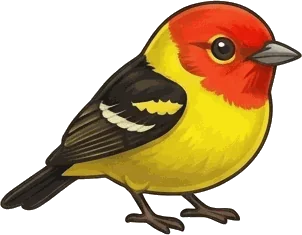
A Western Tanager sounds like an American Robin that has lost its voice. The song is a series of short, fluty phrases with a pause between each one, in the same rising and falling rhythm as a robin, but hoarser, burrier and more repetitive. The call is a dry, quick pit-er-ick, short and explosive, often the only sound a bird makes as it moves slowly through the treetops. Listen in open pine, fir and spruce forest across the West from May through July.
What the song sounds like: a hoarse robin
The song is built like a robin's: a handful of short, whistled phrases, each one rising or falling, separated by small pauses. The difference is the tone. Where a robin carols clearly, cheer-up, cheerily, the tanager sounds rough and burry, as if every note had a bit of gravel in it, and the phrases are more alike from one to the next, which makes the song a little monotonous. Most people's first reaction is "that robin sounds wrong," and that reaction is the identification.
Males sing four to seven phrases in a run, more sharply articulated and more often than females, who do sing, usually two to five more repetitive phrases. Singing peaks in the morning and tapers through the day, and neighboring males answer each other across their territories. Young birds, oddly, sound more musical than adults.
Because the bird forages slowly and deliberately high in the canopy, the song is usually your only way to find it. Follow the hoarse phrases to the top of a tall conifer and wait for a flash of yellow and black, with a red head if it is a male.
The call: pit-er-ick
The call is a dry, quick pit-er-ick, also written pit-r-ick. It is short and explosive, and both sexes and young birds use it. On migration, when tanagers pass through lowland parks, desert oases and orchards without singing, this call is how you notice them.
A female that senses danger near the nest gives a series of nervous calls, and the male answers with louder ones while flitting from branch to branch. Hear that exchange in a conifer stand in June and there is a nest nearby.
When and where you hear it
The Western Tanager breeds farther north than any other tanager, from southeastern Alaska and the Northwest Territories south through Washington, Oregon and California, through the Rocky Mountains to western Texas, and east to the western edge of the Dakotas and Nebraska. It winters from central Mexico to Costa Rica, with a few birds lingering in southern California.
Breeding habitat is open conifer or mixed forest of spruce, fir, pine and aspen, occasionally oak woodland, from about 330 feet up to 10,000 feet, higher in the south. The first birds reach the breeding grounds in April and most arrive by early May, though stragglers are still moving in mid-June. Departure starts as early as mid-July and most birds leave in August. They travel at night, alone or in groups of up to about 30, and immatures leave later than adults.
The diet is roughly four-fifths insects and one-fifth fruit. Tanagers glean wasps, bees, ants, beetles, grasshoppers, termites and cicadas from foliage, chase insects in mid-air, and visit flowers for nectar. They are fond of vespid wasps, which most migrant songbirds avoid, and they take berries such as mulberries and elderberries. The female builds a shallow cup of twigs, grass and rootlets lined with hair, usually 15 to 65 feet up in a conifer, lays three to five pale blue eggs blotched with brown, and incubates for about 13 days. Both parents feed the young, which fledge in roughly two weeks. For Warble players in the West, June is the easiest month to catch this card.
What it looks like
About 6.3 to 7.5 inches long with an 11.5-inch wingspan. The breeding male is bright yellow with black wings, back and tail, two wing bars and a red head. The red comes from a pigment called rhodoxanthin, rare in birds, which the tanager gets from insects that got it from plants. Females and young birds are duller yellow with olive or gray backs, dark wings and two pale wing bars, like a female oriole with a thicker, pale bill. Despite the name, the species belongs to the cardinal family. Birds have lived more than 15 years in the wild.
Birds that sound similar
 American Robin
The American Robin's cheer-up, cheerily is clear and caroling. The tanager uses the same phrase-and-pause rhythm but sounds hoarse and burry, and it repeats itself more.
 Black-headed Grosbeak
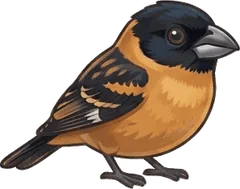
The Black-headed Grosbeak shares the western forests and also sings like a robin, but its warble is softer, sweeter, faster and more fluent, with no hoarseness. Its call is a sharp tick, not a pit-er-ick.
 Scarlet Tanager
The Scarlet Tanager of the East sings a similar hurried, burry, robin-like warble, but its call is a nasal chip-bang. The two rarely overlap, so range usually settles it.
Where the Western Tanager card lives
In Warble the same bird can be an easy card in one state and a prized one in another, because each album ranks its birds by how often people really report them there. The Western Tanager appears in 11 state albums:
 Heard one? Open Warble, tap the green button while it sings, and the Western Tanager card flips into your album. Get the app free.
Questions people ask
Why does a Western Tanager sound like a robin?
Its song uses the same pattern: short whistled phrases, each rising or falling, with pauses between them. The giveaway is tone. The tanager is much hoarser and more repetitive, so it sounds like a robin with a sore throat.
What does the Western Tanager call sound like?
A dry, quick pit-er-ick. It is short and explosive and is given by males, females and young birds, often while the bird is hidden high in a conifer or passing through on migration.
When do Western Tanagers arrive and leave?
They reach western breeding grounds in April and early May, with some still arriving in mid-June, and begin leaving as early as mid-July. Most are gone by the end of August, bound for Mexico and Central America.
Do female Western Tanagers sing?
Yes. Females sing shorter, more repetitive songs of two to five phrases, compared with four to seven for males, and they sing less often. Males will respond to a recording of a female's song.
Sources
- National Audubon Society, Guide to North American Birds: Western Tanager. www.audubon.org/field-guide/bird/western-tanager
- Wikipedia: Western tanager (measurements, range, song, diet, taxonomy). en.wikipedia.org/wiki/Western_tanager
- Animal Diversity Web: Piranga ludoviciana. animaldiversity.org/accounts/Piranga_ludoviciana/
- National Audubon Society, Guide to North American Birds: American Robin. www.audubon.org/field-guide/bird/american-robin