 Warble


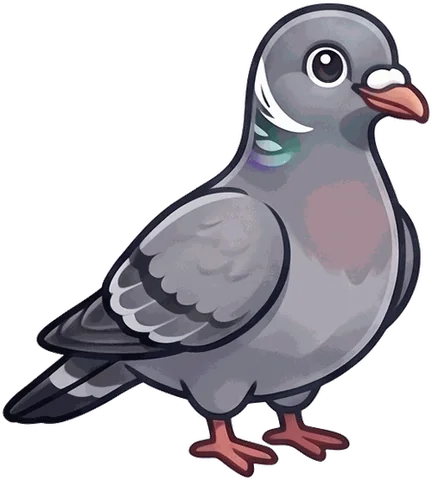
A Band-tailed Pigeon sounds like a mild-mannered owl: a low, hollow, two-note whoo-hoo, the first part rising and the second falling, repeated at an even pace from a tree in a western oak canyon or conifer forest. For a pigeon it is fairly quiet, and plenty of people who hear it are sure there is an owl in the yard. Flocks also give harsh squawks, and their wings whistle when they take off.
What the coo sounds like
The sound you will notice is a deep, two-syllable hoot, usually written whoo-hoo or huu-ooh. The first note slides up and the second slides down, so each phrase has a soft swell and fade, and the phrases come at a steady, unhurried tempo. Audubon describes the calls as flat and undulating. The pitch is low, the delivery gentle, and for a pigeon this is a fairly quiet bird.
That owl-like quality is the whole story for most listeners. A low whoo-hoo, whoo-hoo drifting out of a tall oak or fir at noon is a strong hint that you are hearing a pigeon, because a deep-voiced owl such as the Great Horned Owl hunts mostly at night and is heard hooting on midwinter nights.
In the breeding season the male adds a performance to the coo. He flies up, then sails in a wide circle while giving a wheezing call, and back on a branch he coos with his chest and neck puffed out. A big gray pigeon swelling up on a limb as it hoots is a courting male.
Other calls: squawks and a wing whistle
Flocks are not silent. Feeding and flying birds give harsh, grating squawks, the scream type of call that Audubon lists alongside the hoot. When a group bursts out of a tree, listen to the wings: the birds make a whistling sound in flight.
When and where you hear it
This is a bird of the West. In the United States it lives along the Pacific Coast in Washington, Oregon and California, and inland in the mountains of the Southwest, including southern Arizona. Beyond the border the range continues through Mexico and Central America and down the Andes to northern Argentina. On much of the Pacific Coast birds can be found all year, while in the interior Southwest they are mainly summer residents. Strays have reached the Atlantic Coast.
Listen in oak canyons, foothills, chaparral, pine-oak woods and fir forest. Acorns are the main food when the trees produce them, and the birds also eat elderberry, manzanita, juniper berries and wild grapes, climbing nimbly through thin branches and even hanging upside down to reach fruit. Flocks wander, following the acorn crop or moving downslope, and they may fly up to 5 kilometers, about 3 miles, from their nests to feed. They also gather at mineral springs to drink, a habit nobody has fully explained.
On the Pacific Coast the pigeon has become steadily more common in suburbs, and when wild food runs short it moves into parks, orchards and backyards. In Warble it is a rare card in the California album and a legendary one in Oregon and Washington.
What it looks like
A big, sleek gray pigeon about 14 to 16 inches long, roughly the size of a crow and one of the largest pigeons in the Americas. Look for a thin white collar across the back of the neck with a patch of iridescent green below it, a yellow bill, yellow feet, and a pinkish wash on the head and breast fading to a nearly white belly. The tail gives the bird its name: a darker band at the base and a broad pale gray band across the outer half. Young birds lack the white collar and look scaly from pale feather edges. Its genus, Patagioenas, is the closest living relative of the extinct Passenger Pigeon.
Pairs often nest a few trees apart in loose colonies. The nest is a flimsy stick platform, usually 15 to 40 feet up, holding a single white egg. Both parents incubate for 18 to 20 days, then feed the chick crop milk, a thick, fatty, protein-rich food they produce and bring back up. Young leave the nest at about four weeks, and a pair can raise two or even three broods in a year.
Birds that sound similar
 Great Horned Owl
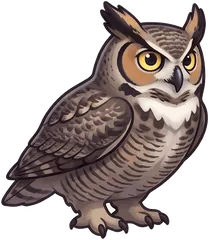
The Great Horned Owl gives a longer run of deep hoots, hoo, hoo-hoo, hoo, hoo, with the second and third notes clipped short, mostly at night. The pigeon repeats a simple two-note whoo-hoo at an even pace, often in broad daylight.
 Mourning Dove
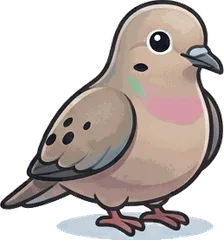
A Mourning Dove's coo is a four-part phrase, coo-ah, coo, coo, coo, given from farmland, suburbs and roadsides. The pigeon's phrase stops at two notes and usually comes from oak or conifer woods.
Where the Band-tailed Pigeon card lives
In Warble the same bird can be an easy card in one state and a prized one in another, because each album ranks its birds by how often people really report them there. The Band-tailed Pigeon appears in 3 state albums:
 Heard one? Open Warble, tap the green button while it sings, and the Band-tailed Pigeon card flips into your album. Get the app free.
More about the Band-tailed Pigeon on this site
Questions people ask
What bird sounds like an owl during the day in the West?
Often a Band-tailed Pigeon. Its low, two-note whoo-hoo is described as owl-like, and it calls by day from oaks and conifers along the Pacific Coast and in the mountains of the Southwest.
Is a Band-tailed Pigeon the same as a city pigeon?
No. It is a native wild pigeon of western forests, a separate species from the feral Rock Pigeons of towns. It has a white collar on the nape, a yellow bill and a banded tail, and it comes into suburbs mainly where they border its woods or when wild food runs short.
Why do Band-tailed Pigeons gather at mineral springs?
Nobody knows for certain. The birds commonly congregate at mineral springs to drink, but the reason has not been fully worked out.
Are Band-tailed Pigeons declining?
Yes, slowly. Breeding Bird Survey data show an average drop of about 2 percent a year since 1968, mostly blamed on forest loss. Overhunting seriously depleted them once before protection allowed a recovery, and a parasite disease, avian trichomonosis, has killed thousands in winter, especially in suburbs where they mix with feral pigeons.
Sources
- National Audubon Society, Guide to North American Birds: Band-tailed Pigeon. www.audubon.org/field-guide/bird/band-tailed-pigeon
- Wikipedia: Band-tailed pigeon (voice, range, diet, crop milk, population). en.wikipedia.org/wiki/Band-tailed_pigeon
- National Audubon Society, Guide to North American Birds: Great Horned Owl. www.audubon.org/field-guide/bird/great-horned-owl
- National Audubon Society, Guide to North American Birds: Mourning Dove. www.audubon.org/field-guide/bird/mourning-dove