 Warble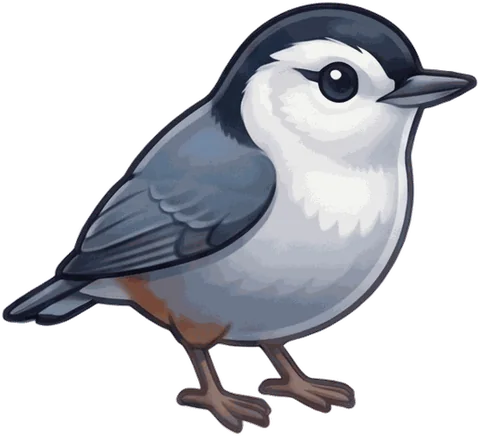
A White-breasted Nuthatch sounds like a small, slightly cranky horn: a low, nasal yank, yank given from a tree trunk, often while the bird is walking down it head first. In late winter and spring the male adds a song, a rapid run of low nasal whistles on one pitch, whe-whe-whe-whe-whe. Between those, pairs trade a thin, squeaky nit up to thirty times a minute, which is how you know one is nearby before you see it.
The birder's mnemonic
“yank-yank” Say it through your nose, low and flat; the Red-breasted's version is higher and thinner, like a toy horn.
What the song sounds like
The song is a series of low, nasal, whistled notes delivered fast and all on the same pitch, something like whe-whe-whe-whe-whe or qui-qui-qui-qui-qui. It has the same nasal tone as the call, just strung together and softened. It is not musical, and it does not carry very far, but it is unmistakable once you have matched it to the bird.
It is a mating song, so it belongs to the breeding season, when pairs that have been together all year start attending to their territory. The rest of the year the call does all the work.
In the West the vocabulary changes. Birds of the Rocky Mountains and Great Basin give a higher, faster yididitititit, and Pacific coast birds a more nasal beeerf.
The call: a nasal yank
The everyday call is a nasal yank or yank-yank, low-pitched and a little honking, given at intervals as the bird works over a trunk. Compared with the Red-breasted Nuthatch, it is lower, fuller and less tinny. You will also hear a thin, squeaky nit that pairs use to stay in contact, sometimes thirty times a minute, and a shrill kri repeated rapidly when the bird is worked up. This is a chatty bird; it mutters constantly.
In winter the yank is one of the signature sounds of a mixed feeding flock. Nuthatches travel with chickadees, titmice and woodpeckers, and their calls carry through bare woods.
When and where you hear it
The White-breasted Nuthatch lives across most of the United States wherever there are big deciduous or mixed trees, and it stays put all year. It prefers mature woodland and woodland edges along rivers, roads and clearings, and it is at home in suburbs and parks as long as the trees are large. It is rarely found in pure conifer forest, which is Red-breasted territory. Once in a while, in the West and North, numbers drift south in fall, but far less often than the Red-breasted.
You hear it most in fall and winter, when the leaves are down and the birds are busy hiding food. A nuthatch takes a sunflower seed from the feeder, wedges it into a bark crevice and hammers it open, or tucks it away for later; it does the same with acorns and hickory nuts. Seeds can make up more than half of its winter diet, while summer is mostly insects picked from bark. Across the East and Midwest it is a common Warble card, and the yank is usually what gives it away.
Why it walks down the tree
Nuthatches are the birds you see going down a trunk head first, or hanging upside down under a twig. They forage mainly on the trunk and the larger limbs, climbing about and exploring every surface in every direction, and sometimes drop to the ground. Most of what they eat in summer is insects picked from the bark.
At the nest, a natural cavity or old woodpecker hole usually 15 to 60 feet up, adults do something stranger: they spend minutes sweeping the inside and the rim of the hole with a crushed insect held in the bill, often a blister beetle. The chemicals are thought to discourage competitors for the hole. The female lays five to nine eggs and incubates for about two weeks; the young stay in the hole for two to nearly four weeks more.
What it looks like
A chunky, short-tailed bird about six inches long with a thin bill. The face and chest are clean white, and a beady black eye sits alone in that white face, framed by a narrow dark cap that is black on males and often gray on females. The back is blue-gray with a black band across the shoulders, and the lower belly usually shows some orange-brown. Pairs stay together year-round and defend the same stretch of woods against other nuthatches.
Birds that sound similar
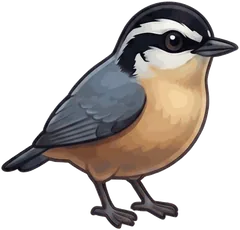 Red-breasted Nuthatch
The Red-breasted Nuthatch's yank is higher, thinner and more nasal, like a toy tin horn, and it comes from conifers. The White-breasted is lower and fuller and prefers oaks and other broadleaf trees.
- ?Brown-headed Nuthatch
In southern pine woods the Brown-headed Nuthatch gives high, piping, squeaky notes, nothing like the low honk of the White-breasted. It is smaller, with a brown cap that comes down to the eye.
- ?Pygmy Nuthatch
The western Pygmy Nuthatch keeps up a monotonous high peep, peep-peep from ponderosa and other pines, in noisy groups. The White-breasted is a lone, lower voice from bigger deciduous trees.
Where the White-breasted Nuthatch card lives
In Warble the same bird can be an easy card in one state and a prized one in another, because each album ranks its birds by how often people really report them there. The White-breasted Nuthatch appears in 42 state albums:
 Heard one? Open Warble, tap the green button while it sings, and the White-breasted Nuthatch card flips into your album. Get the app free.
Questions people ask
What bird makes a nasal yank yank sound?
Most likely a White-breasted Nuthatch. Its call is a low, nasal yank or yank-yank given from a tree trunk, often while the bird climbs down head first. If the sound is higher and tinnier and coming from a spruce or pine, it is a Red-breasted Nuthatch.
Why do nuthatches go down trees head first?
Nuthatches cling to bark with their feet and move over it in any direction, so descending a trunk is as natural to them as climbing it. They work the trunk and the larger limbs from every angle, and can hang upside down beneath twigs.
Do White-breasted Nuthatches migrate?
No. They are permanent residents, and pairs hold the same territory all year. In some years a few birds in the West and North move south in fall, but nothing like the big irruptions of the Red-breasted Nuthatch.
What is the difference between White-breasted and Red-breasted Nuthatch calls?
Both say yank, but the Red-breasted is higher, thinner and more nasal, often compared to a tin horn or a toy trumpet, and it lives in conifers. The White-breasted is lower and fuller and lives in deciduous trees.
Sources
- National Audubon Society, Guide to North American Birds: White-breasted Nuthatch. www.audubon.org/field-guide/bird/white-breasted-nuthatch
- Wikipedia: White-breasted nuthatch (vocalizations, regional calls, nesting, blister beetles). en.wikipedia.org/wiki/White-breasted_nuthatch
- Missouri Department of Conservation, Field Guide: White-breasted Nuthatch. mdc.mo.gov/discover-nature/field-guide/white-breasted-nuthatch
- National Audubon Society, Guide to North American Birds: Red-breasted Nuthatch. www.audubon.org/field-guide/bird/red-breasted-nuthatch