 Warble


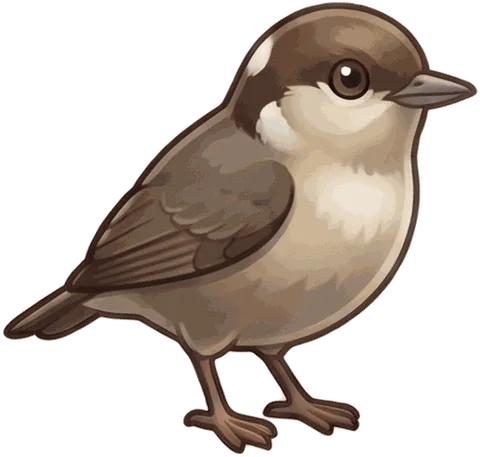
A Brown-headed Nuthatch sounds like someone squeezing a rubber duck up in the pines: a sharp, squeaky, two-note whee-hyah or squeaka! squeaka!, surprisingly loud for one of the smallest nuthatches in the world. These birds travel in pairs and family groups and call to each other constantly, so the usual sound is several squeaks overlapping, sometimes running together into a jumbled chitter. Listen in open pine woods across the Southeast, from Delaware to east Texas, in any month: the birds do not migrate.
What it sounds like: a rubber duck in the pines
The Missouri Department of Conservation writes the song as a high, two-note squeaka! squeaka! squeaka! and says it sounds like a rubber ducky or a squeak toy. Wikipedia spells the main call whee-hyah and makes the same comparison. Picture a bath toy squeezed in quick succession: a pinched, nasal squeak, loud enough to carry through a pine stand from a bird that weighs well under half an ounce.
Audubon describes the voice as high piping notes unlike those of any other eastern nuthatch, and that is the key. The other eastern nuthatches toot; this one squeaks. Pairs also duet, trading notes back and forth. It is one of the three birds on our kazoo page, and the only one closer to a toy duck than a toy horn.
The calls: a running conversation
Brown-headed Nuthatches are rarely silent. They call to each other constantly as they work through the branches, so you usually hear a group long before you see it. When a flock gets going, the squeaks speed up into a rapid, jumbled chittering that the Missouri guide says can be mistaken for hummingbirds. In flight they switch to a softer pit pit pit and assorted squeaks.
If you hear squeaking high in the pines and cannot pick out the birds against the needles, Warble can listen and tell you whether it is this nuthatch.
When and where you hear it
This is a bird of southeastern pine forests, found from Delaware to east Texas and Oklahoma, and from Tennessee and Arkansas down to the Gulf Coast and through Florida. Look in open pine woods, almost always with loblolly, longleaf, slash or pond pine, often mixed with sweetgum, oak or hickory, and especially in mature stands with an open understory. They are weak fliers that neither migrate nor wander far, so the squeaks are a year-round sound. In Missouri, where the species had vanished, birds from Arkansas were reintroduced in 2020 and 2021.
In winter, small groups join mixed flocks with Carolina Chickadees, woodpeckers and Pine Warblers. They creep along trunks and branches in any direction, upside down included, and are among the few birds known to use tools, prying off bark with a flake of bark held in the bill. Summer food is mostly insects and spiders; in winter it is mostly pine seeds, wedged into bark to crack them open or stored in crevices. They also visit feeders for sunflower seeds and suet.
What it looks like
Tiny, stocky and short-tailed: with the western Pygmy Nuthatch, this is one of the two smallest nuthatches in the world. It has a brown cap that comes down to the eye, a dark line through the eye, a small white spot on the back of the neck, a bluish-gray back and buffy white underparts. Males and females look alike.
Nesting is a group effort. Both members of a pair dig a cavity, usually in a dead pine and around 5 feet up, and they will also take nest boxes. Sometimes a helper male, often a son from an earlier year, brings food to the female and the young. The female incubates for about two weeks while her mate feeds her, and the chicks fledge about 18 days after hatching.
Audubon calls it probably the least numerous nuthatch in North America. It has lost ground where pine forest was cleared but stays common where southern pines remain, and it is listed as Least Concern.
Birds that sound similar
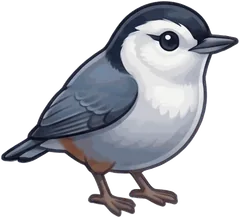 White-breasted Nuthatch
Where pines mix with big hardwoods you may hear both. The White-breasted Nuthatch gives a nasal, repeated yank-yank, a toot rather than a squeak. A squeaky two-note whee-hyah from a group in the pines is the Brown-headed.
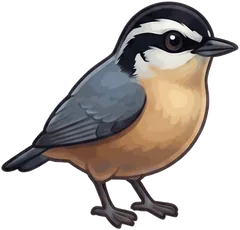 Red-breasted Nuthatch
Some winters the Red-breasted Nuthatch moves south into pine stands, a few as far as the Gulf Coast. Its high, nasal yank is compared to a small tin horn, not a rubber duck.
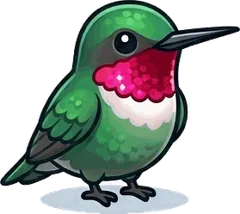 Ruby-throated Hummingbird
A busy flock of Brown-headed Nuthatches gives rapid, jumbled, chittery squeaks that can be mistaken for hummingbirds. If the chittering comes from small birds creeping along pine bark, often upside down, it is the nuthatches.
Where the Brown-headed Nuthatch card lives
In Warble the same bird can be an easy card in one state and a prized one in another, because each album ranks its birds by how often people really report them there. The Brown-headed Nuthatch appears in 6 state albums:
 Heard one? Open Warble, tap the green button while it sings, and the Brown-headed Nuthatch card flips into your album. Get the app free.
More about the Brown-headed Nuthatch on this site
Questions people ask
What bird sounds like a rubber duck?
In southern pine woods, the Brown-headed Nuthatch. Its high, two-note squeak, written squeaka or whee-hyah, is compared to a rubber duck or squeak toy, and family groups keep it up almost nonstop as they move through the pines.
Do Brown-headed Nuthatches use tools?
Yes. They are among the few birds known to use tools: a nuthatch will hold a flake of bark in its bill and use it to pry off other bark and reach insects. Juveniles have been seen doing it as well.
Do Brown-headed Nuthatches come to feeders?
Yes, often. They visit feeding stations and are especially fond of sunflower seeds and suet, and they are bold, inquisitive birds that are easy to approach.
Are Brown-headed Nuthatches in Missouri?
Again, possibly. They disappeared after the state's shortleaf pine forests were logged, then about 100 birds from Arkansas were released in the Mark Twain National Forest in 2020 and 2021. The reintroduction is being monitored.
Sources
- National Audubon Society, Guide to North American Birds: Brown-headed Nuthatch. www.audubon.org/field-guide/bird/brown-headed-nuthatch
- Wikipedia: Brown-headed nuthatch (calls, tool use, cooperative breeding). en.wikipedia.org/wiki/Brown-headed_nuthatch
- Missouri Department of Conservation, Field Guide: Brown-headed Nuthatch. mdc.mo.gov/discover-nature/field-guide/brown-headed-nuthatch
- National Audubon Society, Guide to North American Birds: White-breasted Nuthatch. www.audubon.org/field-guide/bird/white-breasted-nuthatch
- Missouri Department of Conservation, Field Guide: Red-breasted Nuthatch. mdc.mo.gov/discover-nature/field-guide/red-breasted-nuthatch