 Warble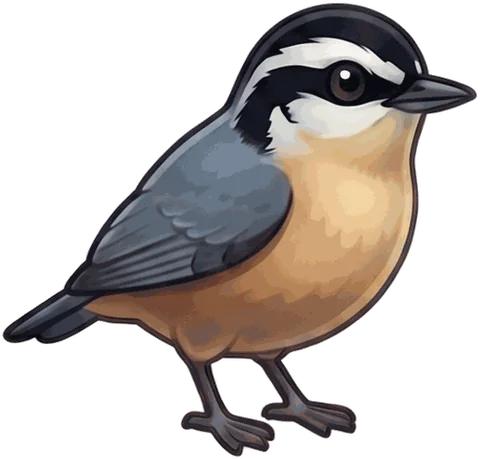
A Red-breasted Nuthatch sounds like a tiny tin horn or a child's noisemaker: a high, thin, nasal yank, yank or ink, ink, often repeated in a steady series from a spruce, pine or fir. It is higher and weaker than the honking yank of the White-breasted Nuthatch. The song is a slowly repeated run of the same nasal notes, each one rising a little. Soft tsit and tseep notes fill in between while the bird creeps up and down the trunk.
The birder's mnemonic
“yank-yank, like a toy tin horn” Think of a child blowing a party horn very softly, high and nasal; the White-breasted's version is deeper and fuller.
What the song sounds like
The song is a slow, even series of clear, nasal, rising notes, essentially the call repeated with a little more music in it. Males give a softer, sweeter version during courtship, when the male turns his back to the female, lifts his head, droops his wings and sways from side to side, and brings her food. It is a modest performance, and you will usually hear the call long before you hear the song.
Once you know the tone, it is one of the easiest sounds in a northern conifer forest to pick out. The Red-breasted also shows little fear of people, and a bird will often come very close to someone standing quietly in a conifer grove.
The call: a tin horn in the pines
The call is a high-pitched, nasal, rather weak yank, yenk or ink, given singly or in a run of wak, wak, wak, wak. It is higher and more nasal than the call of the White-breasted Nuthatch, and thinner in tone, which is why the tin-horn comparison sticks. In between come soft tseep and tsit notes as the bird works its zigzag way along a trunk, picking insects, spiders and seeds out of the bark.
In winter the calls come from inside mixed flocks with chickadees and titmice, usually wherever there are conifers. Even a few pines in a backyard can hold one in an invasion year, especially if there is a feeder nearby.
When and where you hear it
The Red-breasted Nuthatch breeds in conifer forest across Canada and Alaska, in the northeastern states and down the western mountains, and it stays close to spruce, fir and hemlock. It likes mature forest, because it needs soft, rotting wood to dig its own nest cavity. On migration and in winter it will use any woods but chooses conifers when it can find them.
What makes this bird interesting is that its winter range changes enormously from year to year, especially in the East. In some autumns, mainly when the northern cone crop fails, huge numbers pour south, reaching the Gulf Coast; in a good cone year most stay home on their territories. In Missouri, for example, it is an uncommon winter visitor that arrives in September, is gone by mid-May, and can be common one winter and absent the next, with the big flights coming roughly every other year. If you catch one on Warble in a state where it is a rarity, it is probably an invasion year, and worth checking your local feeders.
Summer diet is insects and spiders; in winter it switches to conifer seeds, and it caches food in bark crevices for later.
The sticky front door
The nest hole is dug in a rotten stub or snag, usually 5 to 40 feet up, and then do something distinctive: they smear sticky conifer pitch all around the entrance. The resin probably keeps other creatures, predators included, from getting in. The adults themselves avoid the glue by flying straight through the hole without touching the rim. The female lays five or six eggs and incubates them for about twelve days; the young leave the nest two to three weeks after hatching, and there is one brood a year.
What it looks like
A very small nuthatch, about four and a half inches long, with a blue-gray back, a white throat and face, a bold black stripe through the eye under a white eyebrow, and rusty or cinnamon underparts. Males are brighter orange below with a black cap; females are paler with a gray cap. It moves like every nuthatch, head down and in any direction over the bark, but the striped face and the color below tell it from the larger, white-bellied White-breasted.
Birds that sound similar
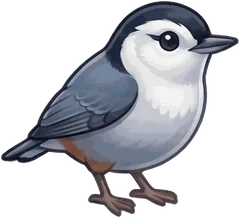 White-breasted Nuthatch
The White-breasted Nuthatch's yank-yank is lower, fuller and more honking, and it comes from oaks and other broadleaf trees. The Red-breasted is higher, tinnier and almost always in conifers.
- ?Pygmy Nuthatch
In western pines the Pygmy Nuthatch gives a monotonous high peep, peep-peep in chattering groups, with none of the nasal horn tone. The Red-breasted's notes are drawn out and nasal.
- ?Brown-headed Nuthatch
In southern pine woods the Brown-headed Nuthatch calls in high, squeaky, piping notes, and it is a permanent resident there. A tin-horn yank in the same pines in winter is a visiting Red-breasted.
Where the Red-breasted Nuthatch card lives
In Warble the same bird can be an easy card in one state and a prized one in another, because each album ranks its birds by how often people really report them there. The Red-breasted Nuthatch appears in 24 state albums:
 Heard one? Open Warble, tap the green button while it sings, and the Red-breasted Nuthatch card flips into your album. Get the app free.
Questions people ask
What bird sounds like a tin horn or a toy trumpet?
The Red-breasted Nuthatch. Its call is a high, thin, nasal yank or ink, often repeated in a series, and it is usually compared to a small tin horn or a child's noisemaker. Listen for it in spruce, pine and fir.
Why do I have Red-breasted Nuthatches this winter and none last winter?
Because their winter range shifts with the northern cone crop. When spruce and fir seeds fail in Canada and the northern forests, large numbers move south, sometimes all the way to the Gulf Coast; when the crop is good, most stay on their territories all winter.
Why do Red-breasted Nuthatches put sap around their nest hole?
The pair smears sticky conifer pitch around the entrance, probably to keep out predators and other creatures that might use the hole. The adults avoid getting stuck by flying straight through the hole without landing on the rim.
Do Red-breasted Nuthatches come to feeders?
Yes, in winter and especially in invasion years, and they are most likely in yards with a few pines or other conifers. They take a seed to a branch or cache it in a bark crevice rather than eating at the feeder.
Sources
- National Audubon Society, Guide to North American Birds: Red-breasted Nuthatch. www.audubon.org/field-guide/bird/red-breasted-nuthatch
- Wikipedia: Red-breasted nuthatch (call, song, irruptions, nesting). en.wikipedia.org/wiki/Red-breasted_nuthatch
- Missouri Department of Conservation, Field Guide: Red-breasted Nuthatch. mdc.mo.gov/discover-nature/field-guide/red-breasted-nuthatch
- National Audubon Society, Guide to North American Birds: Pygmy Nuthatch. www.audubon.org/field-guide/bird/pygmy-nuthatch