 Warble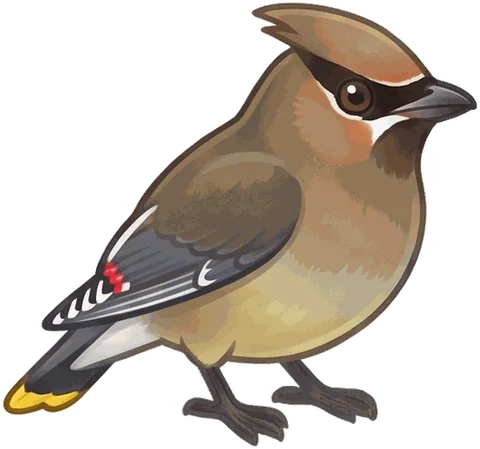
A Cedar Waxwing sounds like a whisper you almost cannot hear: a very high, thin, lisping whistle, zeee or sree, and a short buzzy trill about half a second long, given over and over by a whole flock as it swirls into a fruit tree or streams overhead. The birds have no true song, only these calls, but they use them constantly, especially in flight. The pitch is high enough that some people never hear waxwings at all.
The song: there is not one
Waxwings skipped the songbird part of being a songbird. There is no territorial song, because they barely hold territories; they nest in loose groups and spend the rest of the year in flocks. What they have instead is a small set of extremely high calls. Audubon lists a high-pitched trill and a thin lisping tseee; Wikipedia describes very high whistles and buzzy trills about half a second long; the Missouri field guide calls it a short, high-pitched, whizzy zeeee.
Multiply that by thirty birds and you get the real sound of the species: a soft, sizzling shimmer that seems to come from everywhere at once as the flock settles into a juniper or a crabapple. It is the sound of the tree, not of a bird. The other giveaway is that the calls keep going in flight, so a tight flock passing overhead trails a faint hiss behind it.
The call, and who cannot hear it
The two notes are a thin, level whistle and a shorter, buzzier trill. Both sit at the top of the human hearing range, and the Missouri Department of Conservation notes plainly that some people cannot hear them. If a companion points at a bare tree full of sleek crested birds and asks whether you hear them, and you hear nothing, it is not a trick. Younger ears pick waxwings out of the sky routinely; older ears often find them by the flock alone.
When and where you hear it
Cedar Waxwings occur across nearly all of North America south of the Arctic, nesting in open woods from southern Canada across the northern United States and wintering from the southern states to Central America and northern South America. But the map is only a guide. Waxwings are nomads that follow fruit, and where they breed and where they winter shifts from one year to the next with the berry crop. A town can have hundreds all winter and none the next. Some flocks linger far south into late spring.
In Missouri the field guide files them as a common migrant, an uncommon winter resident and a rare breeder, which is a fair summary of most of the country's middle: you see them passing through, in flocks of 30 to 100 from August onward and hundreds in winter, wherever there are fruiting trees. Look in forest edges, streamsides, orchards, parks, cemeteries, golf courses and yards with cedars, dogwoods, hollies, serviceberries or crabapples. They love running water and bathe in shallow creeks. In Warble they are a flock catch: you will hear five before you see one.
Everything about the bird runs on fruit. Berries and small fruits make up most of the year's diet, swallowed whole, and in summer the birds also sally out over water for insects like a flycatcher. They nest late, mostly from mid-summer, and they feed berries to the nestlings, which few birds do. Courting pairs pass a berry or a petal back and forth, and birds on a branch will hand one down the line until someone eats it. Overripe, fermenting fruit sometimes leaves a flock visibly drunk.
What it looks like
A sleek, medium-small bird, five and a half to almost seven inches, that looks airbrushed: silky brown on the head and chest fading to gray on the wings and rump, a pale yellow belly, a swept-back crest, and a narrow black mask edged in white. The tail ends in a crisp yellow band, or orange in birds that ate the berries of introduced honeysuckle while growing those feathers. The red wax-like tips on the inner wing feathers give the family its name. Males and females look alike; juveniles are streaky and lack the mask but already have the yellow tail band.
Birds that sound similar
- ?Bohemian Waxwing
Its call is a similar high, lisping seeee, but harsher and more grating. Bohemians are winter wanderers of the Northwest and the northern plains that sometimes reach New England, and they are larger and grayer with rusty undertail feathers.
 Golden-crowned Kinglet
A kinglet's call is also a thin, very high note, but it comes as a wiry, rising ti-ti-ti from one or two birds inside a conifer, often followed by a tumbling chatter. Waxwing notes are level or falling and come from a flock in a fruit tree or in the open sky.
Where the Cedar Waxwing card lives
In Warble the same bird can be an easy card in one state and a prized one in another, because each album ranks its birds by how often people really report them there. The Cedar Waxwing appears in 45 state albums:
 Heard one? Open Warble, tap the green button while it sings, and the Cedar Waxwing card flips into your album. Get the app free.
Questions people ask
Do Cedar Waxwings sing?
No. They have no true song, only very high calls: a thin, lisping whistle and a short buzzy trill. Because they nest in loose groups and defend almost no territory, they never needed one. What sounds like a song is many birds calling at once.
Why can't I hear Cedar Waxwings?
The calls are pitched near the top of human hearing, and the Missouri Department of Conservation notes that some people cannot hear them at all. High-frequency hearing fades with age, so waxwings are often the first bird a birder loses.
Why do waxwings show up all at once and then vanish?
They are nomads that follow fruit. Flocks of dozens to hundreds move from one berry crop to the next, strip a tree in a day or two, and leave, and their breeding and wintering areas shift from year to year with the food.
Can Cedar Waxwings get drunk?
Yes. They eat overripe fruit that has started to ferment, and a flock that has been at the wrong berries can be visibly intoxicated.
Sources
- National Audubon Society, Guide to North American Birds: Cedar Waxwing. www.audubon.org/field-guide/bird/cedar-waxwing
- Wikipedia: Cedar waxwing (calls, nomadism, diet, honeysuckle tail tips). en.wikipedia.org/wiki/Cedar_waxwing
- Missouri Department of Conservation, Field Guide: Cedar Waxwing. mdc.mo.gov/discover-nature/field-guide/cedar-waxwing
- National Audubon Society, Guide to North American Birds: Bohemian Waxwing (voice compared). www.audubon.org/field-guide/bird/bohemian-waxwing