 Warble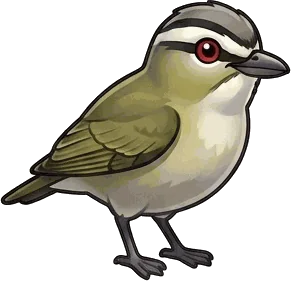
A Red-eyed Vireo sounds like a robin that never finishes a sentence. It sings short, musical phrases of two to four syllables, one about every second, alternating rising and falling ones so they come across as question and answer: look up, see me? over here, do you hear me? The remarkable thing is the persistence. It sings through hot summer afternoons when every other bird is quiet, high in the leaves where you cannot see it. The call is a nasal, whining myaah.
The birder's mnemonic
“look up! see me? over here! do you hear me?” Old books call it the preacher bird because the phrases sound like a sermon of questions and answers that goes on from dawn to dusk.
What the song sounds like
Each phrase is short, clear and slurred, two, three or four syllables, and the bird alternates phrases that slide up with phrases that slide down, so the effect is a conversation held by one bird: a question, a pause, an answer, a pause. The tone is close to an American Robin's caroling, but chopped into separate pieces with a gap of roughly a second between them, and rather less musical. A male has around thirty song types on average, and one studied bird used 73, so the phrases keep changing while the rhythm stays the same.
Then there is the stamina. The Red-eyed Vireo is one of the most persistent singers of any bird. It starts at dawn and keeps going through the midday heat, when robins, thrushes and warblers have all stopped, and one male was recorded singing more than 20,000 songs in a single day. If you are in eastern woods in June and hear a tireless, robin-like voice from the canopy at two in the afternoon, this is the bird. The singer is usually a moving leaf rather than a visible bird; follow the voice and look for a slim olive shape with a striped face working slowly through the foliage.
The call: a nasal whine
Both sexes give a nasal, downslurred, catbird-like mew, written myaah or vray, mostly in aggressive encounters or when a predator comes near the nest. It is the sound you hear in late summer, once the singing tapers off, and it is easy to mistake for a Gray Catbird until you notice it is coming from thirty feet up.
When and where you hear it
Red-eyed Vireos breed in deciduous and mixed forest across southern Canada and most of the eastern United States, west into the northern Rockies. They like woods with a closed canopy and an understory of saplings, but they also settle into well-wooded suburbs, parks and cemeteries with old trees. In Missouri it is a common summer resident statewide, present from April into September. Males arrive first, from mid-March in the South to early May in the North, and females follow a few days to two weeks later.
The whole population winters in South America, mostly in the Amazon basin east of the Andes, where the birds switch from insects to an almost entirely fruit diet. Migration is at night, in May and again in September. It is one of the most numerous forest birds on the continent, with a population estimated around 130 million.
The nest is a neat cup hung by its rim from a horizontal fork, 5 to 30 feet up, woven from bark strips, grass, rootlets and spider silk. The female alone incubates the four eggs for 11 to 14 days. Brown-headed Cowbirds lay in these nests constantly; one study found cowbird eggs in up to a third of them. For Warble players, the song is the reliable way to add this card, since the bird is heard a hundred times for every time it is seen.
What it looks like
A sturdy vireo about five to six inches long with a stout, slightly hooked bill and thick blue-gray legs: olive-green above, white below with a yellow wash on the flanks and undertail, and no wing bars. The face is the field mark: a gray crown bordered by black lines, a bold white eyebrow, and a dark line through the eye. The red iris is real but hard to see at canopy height, and first-year birds have brown eyes anyway. It moves deliberately, peering under leaves for caterpillars, beetles and aphids, hovering briefly to snatch one, and in late summer it takes berries: elderberry, dogwood, Virginia creeper and blackberry.
Birds that sound similar
- ?Philadelphia Vireo
Nearly the same phrases, but higher and slower, from a scarcer bird seen mostly in migration. When a 'Red-eyed' sounds thin and unhurried, look for a yellow-washed breast and a plainer face.
- ?Blue-headed Vireo
Slower and sweeter, with longer pauses between richer, more slurred phrases. Red-eyed is faster, flatter and far more relentless. Blue-headed also arrives earlier in spring.
 American Robin
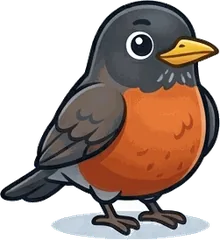
The robin sings the same sort of caroling notes but strings them into a continuous, rising and falling song, cheer-up, cheerily. The vireo stops after every phrase and waits a beat.
Where the Red-eyed Vireo card lives
In Warble the same bird can be an easy card in one state and a prized one in another, because each album ranks its birds by how often people really report them there. The Red-eyed Vireo appears in 37 state albums:
 Heard one? Open Warble, tap the green button while it sings, and the Red-eyed Vireo card flips into your album. Get the app free.
Questions people ask
Why does the Red-eyed Vireo sing all day?
Because the male is advertising a territory, and this species does it with unusual stamina. It sings from dawn through the hottest afternoons when other birds fall silent, and one bird was recorded singing more than 20,000 songs in one day, which is why it is called the preacher bird.
What is the difference between a Red-eyed Vireo and a robin song?
Both use rich, slurred, caroling notes, but the robin runs them together into a longer rolling song while the vireo delivers short phrases of two to four syllables with a pause of about a second after each, alternating rising and falling phrases like questions and answers.
Can you actually see the red eye?
Rarely. Adults do have a dark red iris, but the bird spends its time in the upper canopy, usually backlit, and young birds have brown eyes. Identify it instead by the gray cap, the white eyebrow and the black eye line, and above all by the song.
When do Red-eyed Vireos arrive and leave?
Males arrive from mid-March in the South to early May in the North, with peak spring migration in May. Missouri has them from April through September. Fall migration peaks in September, and the entire population winters in South America.
Sources
- National Audubon Society, Guide to North American Birds: Red-eyed Vireo. www.audubon.org/field-guide/bird/red-eyed-vireo
- Wikipedia: Red-eyed vireo (song record, repertoire, measurements, range and migration). en.wikipedia.org/wiki/Red-eyed_vireo
- Missouri Department of Conservation, Field Guide: Red-eyed Vireo. mdc.mo.gov/discover-nature/field-guide/red-eyed-vireo
- Animal Diversity Web (University of Michigan): Vireo olivaceus. animaldiversity.org/accounts/Vireo_olivaceus/