 Warble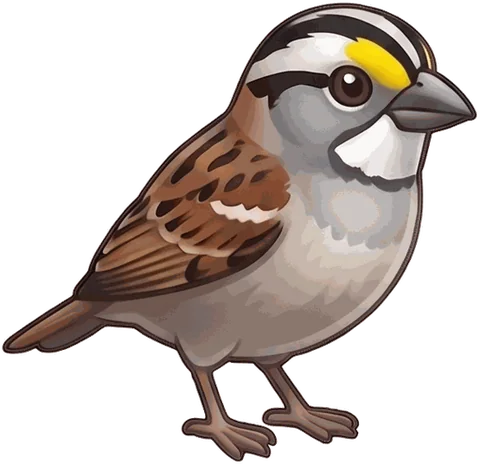
A White-throated Sparrow sounds like someone whistling a slow, slightly out-of-tune phrase: two long, clear notes, then a run of shorter ones on a higher pitch, usually written as Old Sam Peabody, Peabody, Peabody or Oh sweet Canada, Canada, Canada. It is thin, pure and a little wistful, with none of a cardinal's force. You hear it in the northern woods in summer; in winter the same birds shuffle through thickets and under feeders across the eastern United States, giving a sharp pink alarm and a soft tseet.
The birder's mnemonic
“Old Sam Peabody, Peabody, Peabody (or: Oh sweet Canada, Canada, Canada)” Whistle the first two notes slow and the rest as quick triplets a step higher; some guides write the opening as Poor Sam.
What the song sounds like
The song opens with two long, pure whistles, the second usually higher than the first, then settles into a run of short phrases in threes on one pitch: Old Sam Pea-body, Pea-body, Pea-body. Americans hear Sam Peabody; Canadians hear Oh sweet Ca-na-da, Ca-na-da, Ca-na-da, and Audubon notes that the Canadian version is the more accurate one, since most of these birds nest there. The tone is thin and clean, more like a person whistling under their breath than like most birds, and it often sounds slightly flat. That is part of its charm and a useful field mark in itself.
Here is a strange recent twist. For as long as anyone kept notes, the ending was sung in triplets. Then birds in British Columbia started dropping a note and singing doublets, Pea-bo, Pea-bo, Pea-bo, and that version spread east across Canada. A sparrow that seems to skip a syllable is not confused. It has learned the new hit.
The singing happens on the breeding grounds in summer, and white-striped males do more of it than tan-striped ones. In the eastern United States you meet the bird mostly in winter, when the calls far outnumber the song.
The call: a soft tseet and a sharp pink
The everyday call is a soft, lisping tseet, easy to miss. The alarm is not: a sharp, loud pink from inside a thicket when a cat or a person walks past. In fall and winter, when White-throats travel in loose flocks through brush, that pink is usually how you find them before you see one.
They also call while migrating at night. That habit, combined with a pull toward artificial light, makes them one of the birds most often killed at lit buildings, to the point that researchers have called them super colliders.
When and where you hear it
This is a bird of the North in summer. It nests across the forests of Canada and the northern United States, in thickets and brushy undergrowth of conifer and mixed woods, with the nest on the ground under a low shrub, and it stays year-round in the Atlantic provinces. For most Americans it is a winter bird. Flocks drift south fairly late in fall, traveling at night, and settle into woodlots, forest edges, overgrown fields, parks and leafy suburbs across the eastern United States. In winter it is one of the most abundant native birds in the East.
In Missouri the first birds arrive in late September and the last spring migrants are gone by the end of May. Females winter farther south than males, so a January flock in Georgia leans female while one in Ohio leans male. For Warble players in the East it is a winter card, and the sharp pink is often the first clue that the flock has arrived.
Wherever it is, it is on the ground. White-throats feed under thickets, scratching the leaf litter by kicking backward with both feet at once, and they come readily to feeders for millet and sunflower seed, especially what spills underneath. Weed seeds and berries carry them through winter; in summer they eat mostly insects.
What it looks like
A large, handsome sparrow, six to seven inches long, with a clean white throat patch, a plain gray breast, a striped crown and a spot of yellow between the eye and the bill. The back is reddish brown with dark streaks and two whitish wing bars. The head stripes come in two flavors, crisp black and white or brown and tan, and these are not male and female or adult and young. They are two permanent color forms, and a bird of one form almost always mates with a bird of the other. The White-crowned Sparrow is the closest lookalike, but it has a gray throat and no yellow spot.
Birds that sound similar
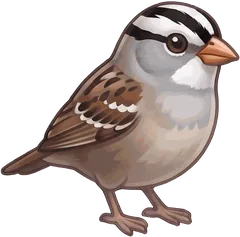 White-crowned Sparrow
The White-crowned Sparrow also opens with clear whistles, but it follows them with buzzy notes and trills instead of a steady run of Peabodys, and the phrase is shorter and less wistful. Its calls are nearly the same sharp pink and soft tseet.
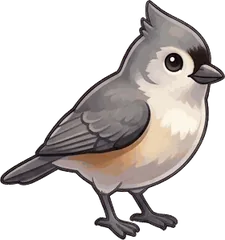 Tufted Titmouse
The titmouse's peter, peter, peter is also a clear whistled series repeated over and over, even during midwinter thaws, but it is louder and faster, rocks between two notes, and never starts with long drawn-out whistles.
Where the White-throated Sparrow card lives
In Warble the same bird can be an easy card in one state and a prized one in another, because each album ranks its birds by how often people really report them there. The White-throated Sparrow appears in 36 state albums:
 Heard one? Open Warble, tap the green button while it sings, and the White-throated Sparrow card flips into your album. Get the app free.
Questions people ask
What bird says Old Sam Peabody?
The White-throated Sparrow. Two slow whistles followed by a run of short phrases sound like Old Sam Peabody, Peabody, Peabody, or, north of the border, Oh sweet Canada, Canada, Canada. The bird nests in Canada and the northern woods and winters across the eastern United States.
Why do White-throated Sparrows hit windows so often?
They migrate at night, they are drawn to artificial light, and they call to each other in flight, so a lit building pulls in more and more birds. Researchers have found them among the species most likely to die in building collisions.
Why do some White-throated Sparrows have white head stripes and others tan?
They are two color forms of the same species, not different ages or sexes. A white-striped bird almost always pairs with a tan-striped one. White-striped birds are more aggressive and sing more; tan-striped birds put more effort into raising the young.
Sources
- National Audubon Society, Guide to North American Birds: White-throated Sparrow. www.audubon.org/field-guide/bird/white-throated-sparrow
- Wikipedia: White-throated sparrow (song, color morphs, migration, collisions). en.wikipedia.org/wiki/White-throated_sparrow
- Missouri Department of Conservation, Field Guide: White-throated Sparrow. mdc.mo.gov/discover-nature/field-guide/white-throated-sparrow
- National Audubon Society, Guide to North American Birds: Tufted Titmouse (voice compared). www.audubon.org/field-guide/bird/tufted-titmouse