 Warble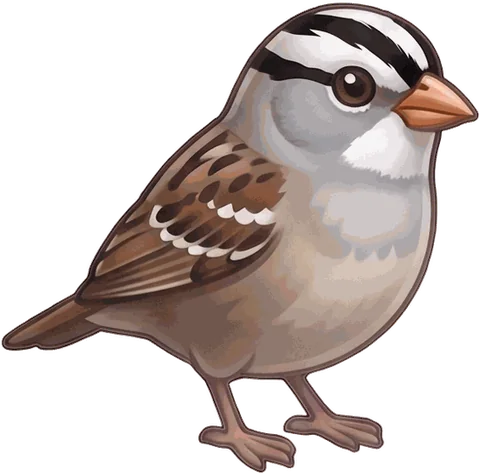
A White-crowned Sparrow sounds like a whistle that loses its nerve: one or two clear, drawn-out notes, then a jumble of buzzes and trills that is over in about two seconds. The opening whistle is the constant. What follows depends on where the bird grew up, because young males copy the adults around them, and the result is local dialects so distinct that two parks a few miles apart can sing different songs. The everyday calls are a sharp pink and a soft tseet, much like a White-throated Sparrow's.
What the song sounds like
Every White-crowned Sparrow song starts the same way, with a pure whistle, sometimes two. Then the bird moves into what researchers call complex notes, a buzz or a slurred phrase or both, and finishes with a trill of repeated notes; in some populations a short buzz follows the trill. The Missouri Department of Conservation sums it up as a variable song of whistles and trills, and variable is the word. The shape stays put, the details do not.
Those details are learned, not inherited. A young male picks up the song of the adults singing near him, not his father, and although he may try several versions he settles on one for life. Because neighbors copy neighbors, males in one area share a trill while males over the ridge sing another. Biologists sort the dialects by those trill notes, and in the year-round California birds each dialect covers a surprisingly small patch of ground.
The best-known case is San Francisco, where Luis Baptista began recording in the late 1960s and found roughly ten dialects around the Bay Area: Marin birds sang differently from the city, and the city itself split into a Presidio dialect, a Lake Merced dialect and more. The Presidio dialect has since died out, replaced by the higher-pitched San Francisco version that carries better over traffic, and the birds now sing it at a higher minimum pitch than they did decades ago.
The call: tseet and pink
Away from the song, the calls are a thin tseet and a sharp, alarmed pink or chink, nearly identical to the White-throated Sparrow's. You hear them from birds working the ground under a hedge and from flocks moving through brush in fall and winter, when the two species often travel together. They migrate at night, so some of the thin notes over a dark yard in October are White-crowns.
When and where you hear it
There are two kinds of White-crowned Sparrow to know about. Along the Pacific coast the birds stay all year and sing in well-wooded suburbs, chaparral and city parks; the Nuttall's race of coastal California never leaves. Everywhere else they are travelers. They nest in dwarf willow thickets at the edge of the tundra, in bushy clearings of the northern forest and in scrub just below timberline, then winter in southwestern lowlands, desert washes, hedgerows and overgrown fields across the southern half of the country. Females winter farther south than males.
For the middle of the country that means a fall, winter and spring bird. In Missouri they are present from early October to the middle of May, and then every one of them heads for northern Canada. They prefer the tangles along a field edge to a feeder, so a yard needs real brush to hold them. Northern birds raise a single brood; the coastal Californians, with a long season, can raise two to four. In Warble the bird sits in albums from California to Texas.
They feed on the ground, hopping and running, and scratch in leaf litter by kicking both feet backward at once. Weed and grass seeds carry them through winter; in summer they add insects and spiders and feed the nestlings little else.
What it looks like
A big, elegant sparrow, about six inches long, with a bold black-and-white striped crown, a plain pearly gray face and breast, a streaked brown back, two white wing bars and a long tail. The bill is pink to orange or yellowish depending on the subspecies. The crown feathers can be raised into a short peak, which squares off the back of the head. Immatures wear the same pattern in brown and tan, and from a distance the crown can look solid rusty. There is no white throat and no yellow spot in front of the eye.
Birds that sound similar
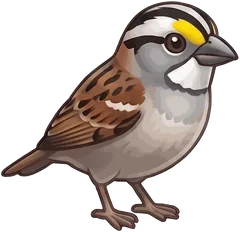 White-throated Sparrow
The White-throated Sparrow's song is all whistles, two long notes and then a steady Peabody, Peabody, Peabody, with no buzz and no trill. The White-crowned's whistle is shorter and quickly gives way to buzzy, trilled notes. The calls are almost the same.
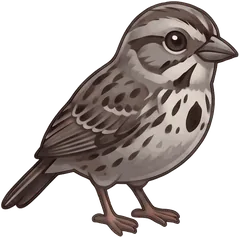 Song Sparrow
A Song Sparrow also opens with clear notes and ends in a trill, but it starts with three short notes rather than one long whistle, and the middle is a jumble of varied phrases. Song Sparrows are year-round across most of the country; White-crowns are seasonal in most places.
- ?Golden-crowned Sparrow
Winter flockmates on the Pacific coast from Vancouver to San Diego. The Golden-crowned's song is three descending, plaintive whistles, often written oh, dear me, with no buzz or trill after them. Its tseet and chink calls are much like the White-crowned's.
Where the White-crowned Sparrow card lives
In Warble the same bird can be an easy card in one state and a prized one in another, because each album ranks its birds by how often people really report them there. The White-crowned Sparrow appears in 25 state albums:
 Heard one? Open Warble, tap the green button while it sings, and the White-crowned Sparrow card flips into your album. Get the app free.
Questions people ask
Why do White-crowned Sparrows in different places sing differently?
Because they learn their songs. A young male copies the adults singing near him, and neighbors end up sharing one version while birds a few miles away share another. Biologists sort these dialects by the trill at the end of the song.
Do White-crowned Sparrows come to feeders?
Sometimes, but they would rather work a brushy hedgerow or the tangles along a field edge. A yard with a thick shrub border and seed scattered on the ground has a chance in fall and winter; an open lawn with a hanging feeder does not.
Where do White-crowned Sparrows go in summer?
Far north or high up: willow thickets at the edge of the tundra, clearings in the northern forest and mountain scrub near timberline. The exception is the Pacific coast, where resident birds nest in suburbs and chaparral all year.
Sources
- National Audubon Society, Guide to North American Birds: White-crowned Sparrow. www.audubon.org/field-guide/bird/white-crowned-sparrow
- Missouri Department of Conservation, Field Guide: White-crowned Sparrow. mdc.mo.gov/discover-nature/field-guide/white-crowned-sparrow
- Bay Nature: Sparrows Lose Their Language With Urban Noise (Baptista's San Francisco dialects). baynature.org/article/the-language-of-sparrows/
- PLOS One via PubMed Central: Song and genetic divergence within a subspecies of white-crowned sparrow (song structure and dialects). pmc.ncbi.nlm.nih.gov/articles/PMC11135742