 Warble


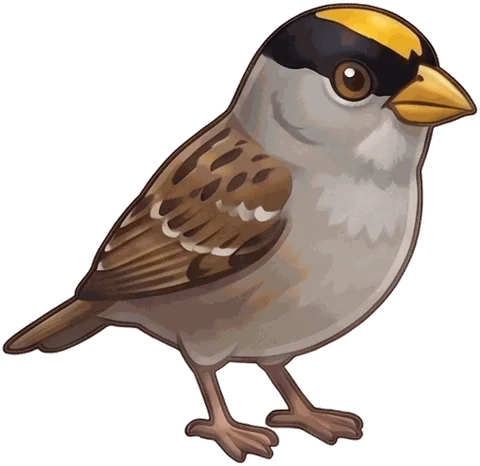
A Golden-crowned Sparrow sounds gently heartbroken. Its song is three clear, whistled notes that slide downhill in a minor key, usually written oh, dear me. Most birds sing it pure, with no buzz or trill. The calls are a thin tseet and a harder chink. On the West Coast you hear it from brushy yards, parks and chaparral between fall and spring, and in summer from willow scrub near treeline in Alaska and western Canada.
The birder's mnemonic
“oh, dear me” Three slow whistles, each step lower than the one before, in a mournful minor key.
What the song sounds like: oh, dear me
The song is short: three plaintive notes that step down the scale, each one whistled clean. Written down it becomes oh, dear me, and the phrase fits, because it sounds like a small, polite complaint. Others hear I'm so weary, and gold miners on the Alaska trails called the bird Weary Willie. A typical song has no buzzy ending, which is the quickest way to separate it from the White-crowned Sparrows it often travels with.
Not every bird sings the same version. In the mountains of British Columbia, the third note is often a trill instead of a clear whistle. On the breeding grounds, males sing through the day from exposed perches such as the top of a willow, and in summer the scrubby country near treeline can ring with these sad, minor-key whistles.
Winter singing is lighter but real. The song is heard on the wintering grounds soon after the birds arrive in fall and again just before they leave in spring, so plenty of West Coast gardeners learn oh, dear me without ever going north.
The calls: tseet and chink
Most of what you hear in winter is call notes. One is a thin, sharp tseet, also written tsew; the other is a harder chink. Golden-crowns feed on the ground close to dense cover, usually in flocks, and duck back into the shrubs when something startles them, so a few call notes from inside a hedge are often all you get.
When and where you hear it
Golden-crowned Sparrows breed in Alaska, including the Aleutians, and in western Canada, in willow and alder scrub at the edge of tundra and in stunted spruce near treeline. Early nests may go into shrubs while snow is still on the ground; later ones sit on the ground in a hollow under dwarf willows. The breeding season runs from late May through early August.
The whole population moves down the Pacific slope for winter, apparently traveling at night, and times it late in fall and early in spring. Birds reach California, western Oregon and western Washington from mid-September through October, are most numerous from late October to early April, and start north in April or May. The winter range runs from southern coastal Alaska to northern Baja California, and the species is common from Vancouver to San Diego. A few stray east, as far as Nova Scotia and Florida.
In winter, look and listen in thick brush: chaparral, thickets, forest edges, parks and gardens, usually denser and damper than the cover White-crowned Sparrows choose. Flocks stick together all winter on a home range of about 15 to 20 acres, and the same birds return to the same spot year after year. They eat mostly seeds of weeds and grasses, plus buds, flowers, new shoots and berries, and they will visit feeders. Early in the 20th century they were counted as garden pests; that reputation did not last. Along the coast, winter is the season for Warble players to catch this card.
What it looks like
A large sparrow, 6 to 7 inches long, with a long tail and a dark bill. In breeding plumage the crown is a broad gold stripe, fading to pale gray at the back, framed by heavy black bands. In winter the black fades and the gold softens, and young birds may show little or no yellow through their first winter, which makes some look like a big, plain female House Sparrow. The rest of the bird is gray below and brown above, with bold back streaks and two white wing bars. The crown doubles as a status badge: the size and color of the gold patch predict who wins a dispute better than body size or sex does.
Birds that sound similar
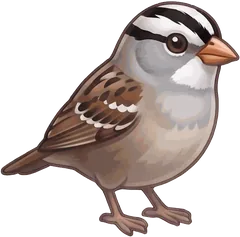 White-crowned Sparrow
The White-crowned Sparrow often travels in the same winter flocks. Its song opens with a few clear whistles but then breaks into buzzy notes. The Golden-crowned sticks to three pure whistles that fall in pitch.
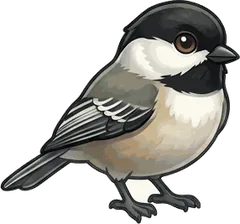 Black-capped Chickadee
The Black-capped Chickadee's fee-bee is another clear, falling whistle, but it has two pitches: the second note is lower and often doubled on the same pitch. The sparrow keeps stepping down through all three notes.
Where the Golden-crowned Sparrow card lives
In Warble the same bird can be an easy card in one state and a prized one in another, because each album ranks its birds by how often people really report them there. The Golden-crowned Sparrow appears in 4 state albums:
 Heard one? Open Warble, tap the green button while it sings, and the Golden-crowned Sparrow card flips into your album. Get the app free.
Questions people ask
What bird sings oh dear me?
The Golden-crowned Sparrow. Its song is three clear, descending whistles in a sad minor key, usually written oh, dear me. In the West you hear it from brushy yards and parks in fall and spring, and in summer near treeline in Alaska and western Canada.
Do Golden-crowned Sparrows sing in winter?
Some. They sing mostly on the breeding grounds, but also on the wintering grounds just after they arrive in fall and again just before they leave in spring, which is why West Coast yards hear the song at all.
Why is the Golden-crowned Sparrow called Weary Willie?
Alaskan gold miners gave it the name because its whistled notes sounded to them like the words I'm so weary.
When do Golden-crowned Sparrows arrive and leave?
They reach California, western Oregon and western Washington from mid-September through October and head north again in April or May. Numbers are highest from late October to early April.
Sources
- National Audubon Society, Guide to North American Birds: Golden-crowned Sparrow. www.audubon.org/field-guide/bird/golden-crowned-sparrow
- Wikipedia: Golden-crowned sparrow (voice, range, behavior). en.wikipedia.org/wiki/Golden-crowned_sparrow
- Seattle Audubon BirdWeb: Golden-crowned Sparrow. www.birdweb.org/birdweb/bird/golden-crowned_sparrow
- National Audubon Society, Guide to North American Birds: White-crowned Sparrow. www.audubon.org/field-guide/bird/white-crowned-sparrow
- National Audubon Society, Guide to North American Birds: Black-capped Chickadee. www.audubon.org/field-guide/bird/black-capped-chickadee