 Warble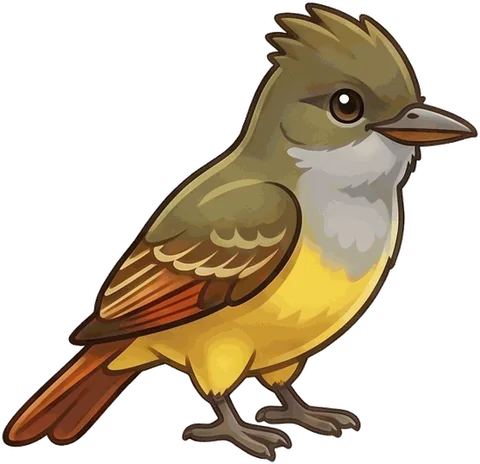
A Great Crested Flycatcher sounds like someone whistling for a dog from the top of a tree: a loud, clear, rising wheep!, slightly buzzy, sometimes given once and sometimes repeated. It also gives a rolling, harsh prrreet and, in disputes, a fast raucous whit-whit-whit-whit. The bird stays high in the canopy of deciduous woods, so from late April to September you will hear it far more often than you see it.
The birder's mnemonic
“wheep” Whistle a single loud note that slurs upward, with a little rasp in it, and you have the call.
What the song sounds like
Flycatchers do not sing the way thrushes do, and the Great Crested Flycatcher's daytime repertoire is mostly calls, so the sound most people think of as its song is the wheep: a loud, emphatic whistle that rises in pitch, with a slight buzz or rasp, also written whee-ipp or wree-eep. It is given from an exposed perch high in a tall tree, singly or in a short series, and it carries far across a woodlot.
There is a true song, but you have to get up for it. In the period before dawn a male runs through his whole repertoire, including a three-part dawn song of two short whistles followed by a soft, low note, repeated from a high perch. Once the sun is up he drops back to the wheep and the other calls, which is why most people never hear it.
The calls: prrreet and whit-whit-whit
The second common sound is a rolling, harsh, rising prrreet, a burry trill that sounds like a fast wheep with a rattle in it. When two birds argue over a territory the wheep shortens and speeds up into a rapid, ascending whit-whit-whit-whit, and the faster it comes, the more upset the bird is; a very fast series can mean a predator near the nest. The wheep itself is the contact call between mates and between parents and fledglings.
When and where you hear it
Great Crested Flycatchers breed across the eastern half of the United States, west to the Dakotas, Oklahoma and Texas, and into southern Canada from Manitoba to Nova Scotia. They want deciduous or mixed woods with an open canopy and edges: forest borders, clearings, old orchards and wooded parks and suburbs, never solid conifers. They winter from southern Mexico through Central America to Colombia, with a regular wintering population in southern Florida, and they migrate mostly at night.
In Missouri they arrive in mid April and stay through late September, common statewide wherever woods meet open ground. The bird is a hole nester. It uses natural cavities and old woodpecker holes, usually twenty to fifty feet up, and will take a bluebird box, a mailbox or a drainpipe. Both sexes build, packing the cavity with leaves, grass, bark, fur and feathers, and the lining almost always includes a shed snakeskin or, when snakeskin is scarce, a strip of clear plastic or cellophane. Four to six eggs, usually five, are incubated by the female for about two weeks; the young leave after about two more weeks. One brood a year. The oldest known bird lived past fourteen.
It hunts from a high perch with a clear view, bobbing its head, then flies out to snatch an insect in the air or hovers to pluck one from the leaves: butterflies, moths, beetles, katydids, grasshoppers, bees and wasps, spiders, and now and then a small lizard. Fruits and berries matter in winter. The population is about 8.8 million and stable, though it depends on dead trees for nest holes.
What it looks like
A big flycatcher, about eight to nine inches long with a thirteen to fifteen inch wingspan, with a large, slightly domed head. The back is olive brown, the throat and chest gray, the belly a bright lemon yellow, and the wings and long tail flash reddish brown, obvious when it flies. The bill is heavy and dark with a pale base. The crest is bushy rather than pointed and is not always raised, so do not wait for it. Males and females look alike, and young birds are duller. The Eastern Kingbird, the other big flycatcher of eastern summers, has no yellow and no rust.
Birds that sound similar
 Eastern Wood-Pewee
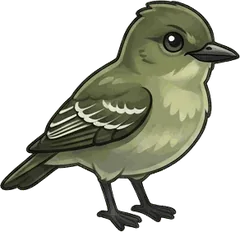
The pewee's pee-ah-weee is slow, sweet and plaintive, with the last note falling, and it keeps going at dusk after most birds have quieted. A wheep is loud, quick and rises.
- ?Ash-throated Flycatcher
The western cousin gives a softer, rolling purreeeer and a soft ka-brick instead of the loud wheep. The two hardly overlap: the Ash-throated lives from Texas west to California.
 Eastern Kingbird
The kingbird's voice is a sharp, buzzy dzeet and a fast stuttering kitter, harsh and electric, from a fence or a treetop over open ground. The flycatcher whistles a clear wheep from inside the woods.
Where the Great Crested Flycatcher card lives
In Warble the same bird can be an easy card in one state and a prized one in another, because each album ranks its birds by how often people really report them there. The Great Crested Flycatcher appears in 35 state albums:
 Heard one? Open Warble, tap the green button while it sings, and the Great Crested Flycatcher card flips into your album. Get the app free.
Questions people ask
What bird says wheep in the trees?
Almost certainly a Great Crested Flycatcher. It gives a loud, rising, slightly buzzy whistle from high in deciduous woods from late April to September across the eastern United States, and the bird itself tends to stay out of sight in the canopy.
Why do Great Crested Flycatchers put snakeskin in their nests?
They just do, reliably. A shed snakeskin goes into the lining of the cavity along with leaves, fur, feathers, string and bits of trash, and where snakeskin is scarce the birds use a strip of clear plastic or cellophane instead.
Will a Great Crested Flycatcher use a nest box?
Yes. It is a cavity nester that depends on old woodpecker holes and hollow trees, and it readily takes a bluebird box, a mailbox or a length of pipe. Boxes matter most where dead trees have been cleared.
When do Great Crested Flycatchers arrive in spring?
Mid to late April in the southern and central states, with Missouri birds present from mid April to late September, and May farther north. Most birds are gone by the end of September.
Sources
- National Audubon Society, Guide to North American Birds: Great Crested Flycatcher. www.audubon.org/field-guide/bird/great-crested-flycatcher
- Wikipedia: Great crested flycatcher (measurements, dawn song, range, nesting). en.wikipedia.org/wiki/Great_crested_flycatcher
- Missouri Department of Conservation, Field Guide: Great Crested Flycatcher. mdc.mo.gov/discover-nature/field-guide/great-crested-flycatcher
- Animal Diversity Web (University of Michigan): Myiarchus crinitus. animaldiversity.org/accounts/Myiarchus_crinitus/