 Warble
A Warbling Vireo sounds exactly like its name: a rapid, bubbling, rambling warble that rolls up and down for three to five seconds and usually ends on a rising note, as if the bird were asking a question at the end of a long sentence. It is cheerful and drowsy at the same time, closer to a finch than to any other vireo, and it comes from high in a cottonwood or a street tree. The bird itself is plain gray and white and hard to pick out, but it keeps singing on hot summer afternoons when most birds have quit.
The birder's mnemonic
“if I sees you I will seize you and I'll squeeze you till you squirt” Say it quickly and run the words together; the point is the tumbling rhythm and the squeak at the end, not the exact syllables.
What the song sounds like
Most vireos sing in short phrases with pauses between them. The Warbling Vireo does not. Its song is one continuous run of rapid, warbling, bubbling notes that rise and fall through the whole series, lasting about three to five seconds, and it usually finishes on a high or rising note. The Missouri Department of Conservation compares it to the ascending piano flourish that opens Chopin's Fantaisie-Impromptu, which is fair if you imagine the piano played very fast and slightly out of tune. Audubon calls it drowsy and rambling. Both are right.
It sings a lot. Males keep singing through hot summer days when most other birds have gone quiet, and the song runs from arrival in spring well into late summer. The eastern birds, the ones this page is about, end on the rising note; the western birds, split off in 2025 as a separate species, sing a slightly shorter, rougher, burrier version that usually does not rise at the end.
The calls
Away from the song the Warbling Vireo is a quiet bird. Mates keep in touch with short contact notes, fledglings beg with a thin insistent call, and both sexes give a harsher warning note when a predator is near the nest. None of these carry far, and in practice almost every Warbling Vireo you find, you find by the song.
When and where you hear it
This is a bird of open, broken woodland rather than deep forest: aspen and poplar groves, cottonwoods along rivers and streams, orchards, campgrounds, city parks and the big shade trees of older suburbs. It avoids unbroken mature forest and is often in an isolated grove near water. The breeding range covers most of the United States and southern Canada apart from the Southeast, from central Alberta and Montana eastward and south. In Missouri it is a common summer resident from April through September, with numbers highest from May to August.
Eastern birds winter in southern Mexico and Central America and get there the long way, traveling north and south through Texas and Mexico rather than across the Gulf. They migrate at night. The wintering birds hold remarkably small territories in open tropical woods, including shade-grown coffee plantations that keep their native canopy trees.
The nest is a deep, compact cup hung by its rim from a forked twig, sometimes 90 feet up in the East, built by both birds over six or seven days from grass, bark strips, leaves, feathers and hair. Four white eggs speckled with brown are incubated by both parents for 12 to 14 days, and the young fledge after about two weeks. Brown-headed Cowbirds commonly lay in these nests, and the vireos have no defense against the foreign egg. One bird banded in California was recaptured 13 years later. In Warble the card carries the newer eBird name, Eastern Warbling Vireo.
What it looks like
Small and plain: about five inches long, olive-gray above and whitish below, with no wing bars and a face that has almost nothing on it. There is a white eyebrow and a faint gray line through the eye, and the gray crown barely contrasts with the back, which gives the bird a blank, gentle expression. Unlike the Red-eyed Vireo, there is no black border above the eyebrow. The eye is brown, the bill is stout and dark, and the legs are thick and blue-gray. Fall birds are greener above with yellowish sides and flanks. It moves slowly through the outer leaves of a tree, picking caterpillars and other insects from the foliage and hovering briefly to reach the undersides, and it adds berries in late summer and fall.
Birds that sound similar
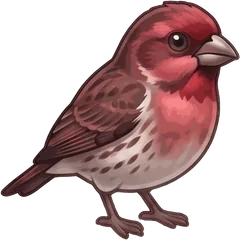 Purple Finch
The Purple Finch's rich, musical warble is the classic confusion; it is faster, sweeter and more jumbled, and usually has no rising note at the end. Finches also sing from conifer tops and fly off in bounding flocks; the vireo stays in a leafy hardwood.
 Red-eyed Vireo
The Red-eyed Vireo sings the same sort of slurred notes, but in short phrases with a pause after each one. The Warbling Vireo runs everything together into a single continuous warble.
 Painted Bunting
A Painted Bunting's warble has a similar cheerful, rolling quality where the two overlap in the South, but it is thinner and comes from a brushy edge rather than a tall shade tree.
Where the Warbling Vireo card lives
In Warble the same bird can be an easy card in one state and a prized one in another, because each album ranks its birds by how often people really report them there. The Warbling Vireo appears in 29 state albums:
 Heard one? Open Warble, tap the green button while it sings, and the Warbling Vireo card flips into your album. Get the app free.
Questions people ask
Is the Warbling Vireo now two species?
Yes. In 2025 the eBird/Clements taxonomy split the eastern and western populations into Eastern Warbling Vireo and Western Warbling Vireo. The western bird is slightly smaller with a darker crown and a thinner, darker bill, and its song is shorter and burrier and usually does not end on a rising note. This page covers the eastern bird.
What is the Warbling Vireo mnemonic?
The traditional one is 'if I sees you I will seize you and I'll squeeze you till you squirt', spoken fast so the words tumble over each other and end on a squeak. It captures the rhythm and the rising finish better than any transcription of the notes.
How do you tell a Warbling Vireo from a Purple Finch by song?
Listen for the ending and the tempo. The vireo's warble is slightly slower, rambles up and down for three to five seconds and usually climbs to a high note at the end; the finch's is quicker, richer and more jumbled without that rising finish. Then look: a plain gray-white bird in a hardwood is the vireo.
When do Warbling Vireos arrive in spring?
In April across the middle of the country. Missouri birds are present from April through September, with the most singing from May to August. They leave by early fall for southern Mexico and Central America.
Sources
- National Audubon Society, Guide to North American Birds: Eastern Warbling Vireo. www.audubon.org/field-guide/bird/warbling-vireo
- Wikipedia: Warbling vireo (song, measurements, range, nesting and the 2025 split). en.wikipedia.org/wiki/Warbling_vireo
- Missouri Department of Conservation, Field Guide: Eastern Warbling Vireo. mdc.mo.gov/discover-nature/field-guide/warbling-vireo
- Animal Diversity Web (University of Michigan): Vireo gilvus. animaldiversity.org/accounts/Vireo_gilvus/