 Warble
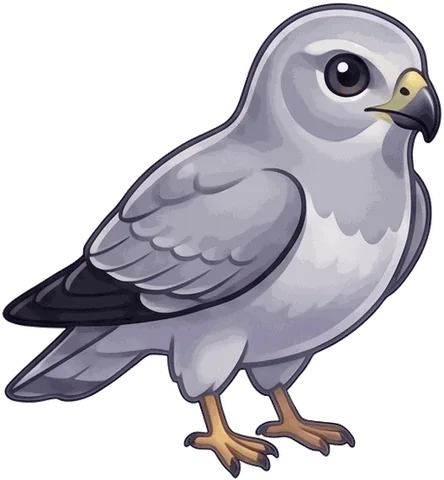
A Northern Harrier is usually silent, but near its nest it gives a fast series of sharp kek notes lasting a second or two, a kee-kee-kee-kee, and high, sharp whistles. The Missouri Department of Conservation adds barks to the list. In the breeding season the female screams loudly to get the male to bring food. You hear these calls over marshes, prairies and hayfields, from a slim, long-tailed hawk gliding low over the grass with its wings held in a shallow V.
What the calls sound like
Harriers do not sing, and most of the year they barely make a sound: Audubon calls the species usually silent. The noise starts near the nest. Both sexes give a fast run of kek notes that lasts one or two seconds. Audubon writes the nest call as kee-kee-kee-kee and also describes a sharp whistle; the Missouri Department of Conservation lists high whistles, barks and long, rapid series of kek notes.
The pitch tells you something about the mood. When a predator comes near, or a mob of smaller birds surrounds the hawk, the kek notes go higher. Both parents defend the nest with alarm calls and will strike intruders with their talons.
The female's scream and the food delivery
The loudest harrier sound belongs to the female. In the breeding season she gives a loud scream that prompts the male to mate or to bring her food. While she incubates and tends the young chicks, the male does the hunting and passes prey to her, and she feeds it to the brood. After about two weeks the female takes over much of the hunting herself.
Harrier households can be crowded: one male may have two or more mates in a season, and Wikipedia records up to five. Courtship is a show of its own: the male climbs and dives again and again in a roller-coaster flight.
When and where you hear it
Harriers live in open country with good ground cover, wet or dry: marshes, prairies, hayfields and coastal wetlands. They nest on the ground in dense vegetation and breed mostly across Canada and the northern United States. Birds from Canada and the northern Great Plains winter in the American South, Mexico and Central America, while in the Midwest, the mountain West and the northern Atlantic states some stay all year. Migrants travel alone, never in flocks, over a long stretch of spring and fall.
In Missouri the harrier is an uncommon migrant and winter resident and a rare, local nester in big grassland landscapes, and it is listed as endangered in the state. Numbers there peak from late February through April and from mid-September through November. In spring and fall harriers gather at grass and crop-stubble fires to catch animals fleeing the flames. Across its range the species has vanished from many former nesting areas, especially in the south, and drained wetlands and cleared grassland are among the threats.
Hunting by ear
Up close, a harrier's face looks like an owl's. It has the same round facial disk that owls use to funnel sound to their ears, which gives it unusually sharp hearing for a hawk that hunts by day. The two groups are not related; most other hawks rely mainly on sight. A harrier flies low and slow, a few yards above the grass, circling a patch while it listens and looks, then hovers and drops feet first onto its prey. Males fly lower and faster than females.
Small mammals such as voles, cotton rats and mice make up most of the diet, along with songbirds, snakes, frogs and large insects. Harriers often steal prey from Short-eared Owls, which hunt the same fields.
What it looks like
About the size of a crow, with a wingspan around three and a half feet and, relative to its body, the longest wings and tail of any raptor in North America. The bright white rump patch shows on every bird. The adult male is pale gray above and white below with black wingtips and a dark trailing edge to the wing, which is why he is nicknamed the Gray Ghost. Females are brown and streaked below; juveniles are brown above and rusty orange below. The best mark is behavior: no other hawk flies so low over a field with its wings raised in a shallow V.
Birds that sound similar
- ?Short-eared Owl
It hunts the same marshes and prairies and is also usually silent. Audubon describes barks, hisses and squeals on its nesting grounds, mostly at dawn and dusk. A harrier calls in daylight, with a rapid kek series or a high whistle.
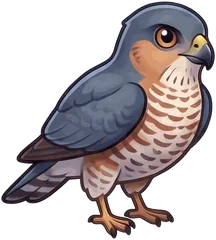 Sharp-shinned Hawk
A slim, long-tailed hawk calling near open ground could also be a sharp-shin, but the Missouri Department of Conservation notes that sharp-shins rarely use grasslands and have shorter, rounder wings. A bird calling as it glides low over a marsh or hayfield is the harrier.
Where the Northern Harrier card lives
In Warble the same bird can be an easy card in one state and a prized one in another, because each album ranks its birds by how often people really report them there. The Northern Harrier appears in 33 state albums:
 Heard one? Open Warble, tap the green button while it sings, and the Northern Harrier card flips into your album. Get the app free.
Questions people ask
Is the Northern Harrier the same bird as the Hen Harrier?
Not anymore. American harriers were formerly treated as the same species as the Hen Harrier, Circus cyaneus, and some catalogs, including Warble's, still file them under that name. Audubon and Wikipedia now treat the American bird as its own species, Circus hudsonius. Its males are darker gray than Hen Harriers and its females darker and more rufous.
Are northern harriers endangered?
Not globally: the IUCN lists the species as Least Concern, and Audubon estimates about 820,000 birds. But it has disappeared from many former nesting areas and is still declining in parts of North America. Missouri lists it as endangered, and heavy pesticide use in the 1970s and 1980s caused declines.
Why is the male northern harrier called the Gray Ghost?
Because the adult male is pale gray and white with black wingtips, and he drifts low over the fields like a phantom. Females and young birds are brown, so the nickname fits only grown males.
What does the word harrier mean?
It comes from an old word meaning pillager or plunderer. Older names for the bird include marsh hawk and ring-tailed hawk.
Sources
- National Audubon Society, Guide to North American Birds: Northern Harrier. www.audubon.org/field-guide/bird/northern-harrier
- Wikipedia: Northern harrier (calls, taxonomy, hunting, breeding, range). en.wikipedia.org/wiki/Northern_harrier
- Missouri Department of Conservation, Field Guide: Northern Harrier (calls, status, facial disk, name). mdc.mo.gov/discover-nature/field-guide/northern-harrier
- National Audubon Society, Guide to North American Birds: Short-eared Owl. www.audubon.org/field-guide/bird/short-eared-owl