 Warble


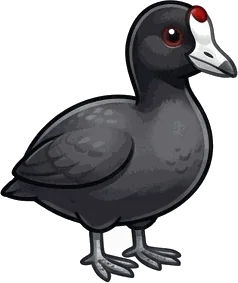
An American Coot sounds like a barnyard that has floated out onto the pond. It has no pretty song, just a running conversation of grunts, clucks, cackles and other harsh notes, plus short, chicken-like calls written puhlk, poonk and pow-ur. Coots usually travel in flocks, sometimes thousands strong in winter, and they squabble a lot, so a raft of these black, white-billed birds on a lake or park pond is rarely quiet for long.
What coots sound like: grunts and clucks
There is no song to learn, which is part of the charm. Audubon sums up the repertoire as a variety of clucks, cackles, grunts and other harsh notes. Missouri's field guide describes a series of chicken-like notes plus grating and crying sounds. Put a flock together and you get a steady, low-grade racket of hen-yard noises drifting over the water.
The fights are a big part of the soundtrack. Coots are noisy and aggressive, especially over territory, and rivals rear up and strike at each other with their feet. Both members of a pair defend the nest area hard.
The calls: puhlk, poonk and pow-ur
Wikipedia gives the coot a small vocabulary with a twist: males and females sound different. The male's alarm call is written puhlk and the female's poonk. A stressed male says puhk-cowah or pow-ur, while a stressed female says cooah. So the two members of a pair do not sound alike.
When and where you hear it
Coots live on reed-ringed lakes and ponds, open marshes and slow rivers, and they prefer fresh water, though some use salt marshes and sheltered bays in winter. For nesting they need fairly shallow water with plenty of marsh plants. Outside the breeding season they spread onto almost any open water, including reservoirs, golf course ponds and city parks, where they walk on the grass and graze.
Western birds in the Pacific states, the Southwest and Mexico stay all year. Eastern birds move to the southern United States for the winter, heading south from August to December and returning from late February to mid-May. In Missouri coots are most abundant in April and again in October and November and scarce from mid-December to early March. Migration probably happens mostly at night, and wintering flocks stay as far north as open water allows. In Warble the coot is a common card in western albums such as California, Arizona, Nevada and Utah.
Audubon estimates about 7.1 million coots and notes declines in some regions, especially the East. They are common enough to be called pests in places, and hunters rarely target them because the meat is less prized than duck, though some are shot for sport, especially in the Southeast, and coot turns up in Cajun gumbo. Bald eagles are less picky: in some areas coots make up more than 80 percent of an eagle's diet. Coots also absorb pollutants from the wetlands they live in, so researchers use them to track pollution, and Missouri's guide notes that a coot can live more than 20 years.
What it looks like
A charcoal-gray waterbird, about 13 to 17 inches long, with a blacker head and neck and a thick white bill topped by a white shield running up the forehead, marked with a small reddish-brown spot. It swims like a duck and nods its head as it goes. But the coot is not a duck at all. It belongs to the rail family, and instead of webbed feet it has broad, lobed toes that fold back with each step, which lets it walk well on land.
Watch one take off and you will see it run across the surface, wings beating hard, until it finally gets airborne. Coots feed by dabbling, tipping up, diving and grazing on shore, mostly on pondweeds, sedges, grasses and algae, and they will steal food from ducks. The chicks are a surprise: black, with bright orange-tipped plumes on the front of the body that fade after about six days. Experiments have shown that parents favor the chicks wearing them.
Birds that sound similar
- ?Common Gallinule
Missouri's guide notes the gallinule's call is higher and more nasal than a coot's, while the coot sounds louder and more grating. On sight, the gallinule's red bill and red forehead shield settle it.
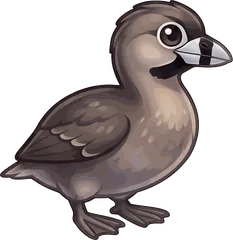 Pied-billed Grebe
The grebe makes clucking sounds too, but its signature is a long, hollow, cuckoo-like cow-cow-cow-cowp, cowp that slows at the end. Coot notes are rougher: grunts, cackles and grating, chicken-like sounds.
Where the American Coot card lives
In Warble the same bird can be an easy card in one state and a prized one in another, because each album ranks its birds by how often people really report them there. The American Coot appears in 32 state albums:
 Heard one? Open Warble, tap the green button while it sings, and the American Coot card flips into your album. Get the app free.
Questions people ask
What bird makes grunting and clucking sounds on a pond?
Very often an American Coot. Coots have no real song, just a constant mix of grunts, clucks, cackles and harsh notes, and because they gather in flocks and quarrel a lot, a group on a lake or park pond can be very noisy.
Is a coot a duck?
No. Coots swim like ducks but belong to the rail family, only distantly related to ducks. The lobed toes, the thick white bill and the habit of running across the water to take off all give it away.
What is a mud hen?
Mud hen is a common nickname for the American Coot. Cajun French speakers call it pouldeau, a word from the French poule d'eau, meaning water hen. A group of coots is called a cover or a raft.
Why do coots run on the water?
To get airborne. A coot takes off by running along the surface of the water while flapping hard, and keeps going until it lifts off.
Sources
- National Audubon Society, Guide to North American Birds: American Coot. www.audubon.org/field-guide/bird/american-coot
- Wikipedia: American coot (calls by sex, names, migration, chicks, predators, hunting). en.wikipedia.org/wiki/American_coot
- Missouri Department of Conservation, Field Guide: American Coot. mdc.mo.gov/discover-nature/field-guide/american-coot
- National Audubon Society, Guide to North American Birds: Pied-billed Grebe. www.audubon.org/field-guide/bird/pied-billed-grebe