 Warble


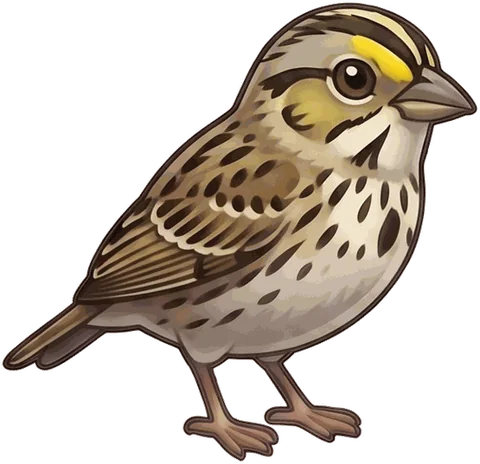
A Savannah Sparrow sounds more like an insect than a songbird: a thin, high, buzzy song of two to three seconds, written tsip-tsip-tsip-se-e-e-srr. It opens with a few sharp, high chips, slides into a long, sizzling buzz, and ends on a lower note. Males sing it from a fence wire or a weed stalk in open fields, pastures, meadows and marsh edges, and it is high and thin enough to pass for an insect.
What the song sounds like: an insect-like buzz
The song has three parts, and once you hear them you will notice it in nearly every open field. First come several short, high chips, tsip-tsip-tsip. Then a long, thin buzz, the part that makes people think of insects. Last, a short drop to a lower, rougher note at the very end, the srr in the usual spelling. The buzz sits very high, around 7,200 cycles per second, and the closing notes fall to roughly 4,400, which is why the ending sounds like a little shrug.
The whole song lasts two to three seconds. Animal Diversity Web calls the buzzy middle insect-like, which is exactly why the bird is easy to overlook in a summer hayfield. The fix is to listen for structure: a short phrase with chips at the front and a drop at the end, repeated after a pause.
Males sing to defend a territory and attract a mate, often from an exposed perch. In courtship a male lifts his tail, lets his feet dangle and flutters slowly over the grass. In southern populations some males have more than one mate, while northern birds, with a short summer to work with, tend to pair off one to one.
The call: high, thin chips
Both sexes use short calls to stay in touch and to warn of danger. Audubon lists them as high chips, buzzes and trills that tend to fall in pitch, and they are thin enough to be easy to miss. Outside the breeding season Savannah Sparrows travel in small, loose flocks, sometimes with other species.
When and where you hear it
Savannah Sparrows live across nearly all of the United States at one season or another, in open fields, meadows, pastures, alfalfa, prairies, marsh edges, dunes and shores. In summer some nest as far north as the tundra; in winter they turn up on beaches and in weedy vacant lots. They occur from sea level up to about 4,500 meters, and one resident population in Mexico lives mainly between 2,000 and 3,000 meters.
Migration happens mostly at night, in early spring and late fall, though it can drag on for weeks either way. Migrants head south from September to October, and in spring males reach the breeding grounds about a week ahead of females.
Unlike many grassland sparrows, this one is fairly bold and often perches in the open on a weed or fence wire, so you can often watch it sing. In Warble it is a common card in Alaska, uncommon in Washington, Montana and Texas, and a legendary find in states such as Florida and Michigan.
What it looks like
A small, streaky brown sparrow with a heavily streaked chest, a strong face pattern, a narrow white stripe down the middle of the crown and, often, a wash of yellow in front of the eye. The sexes look alike. It varies a great deal from place to place: the Ipswich form is a large, pale bird of Atlantic beaches and dunes, especially in winter, and the Belding's form is a blackish bird of California salt marshes. Some of these forms were once treated as separate species.
Savannah Sparrows feed by walking and running through grass, catching beetles, grasshoppers, caterpillars and flies in summer and switching to grass and weed seeds in the colder months; coastal birds add tiny crustaceans and mollusks. The female builds a grass cup on the ground, hidden under matted dead plants, with a tunnel-like entrance at one side, and lays two to six eggs, usually four. Both parents feed the young.
Birds that sound similar
- ?Grasshopper Sparrow
Its song, sip-sip, tuhzeeeeee, is two short notes and then a long buzz that simply ends. The Savannah Sparrow opens with a run of three or so chips, and its buzz drops to a lower final note.
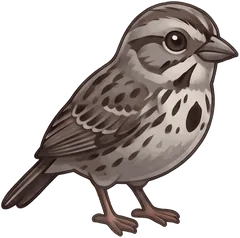 Song Sparrow
A Song Sparrow also starts with a few short notes, but then rolls into a varied trill, the Madge, Madge, Madge, put on your tea-kettle pattern. The Savannah's middle is a thin buzz instead, and it sings from open grass rather than shrubby cover near water.
Where the Savannah Sparrow card lives
In Warble the same bird can be an easy card in one state and a prized one in another, because each album ranks its birds by how often people really report them there. The Savannah Sparrow appears in 32 state albums:
 Heard one? Open Warble, tap the green button while it sings, and the Savannah Sparrow card flips into your album. Get the app free.
More about the Savannah Sparrow on this site
Questions people ask
What bird sounds like an insect in a field?
Often a Savannah Sparrow. Its thin, high, buzzy song is described as insect-like, and it sings from fence wires and weed stalks in open fields and pastures. If the buzz comes in a short, repeated phrase with chips at the start and a lower note at the end, it is a bird, not a cricket.
How do you tell a Savannah Sparrow from a Song Sparrow by ear?
Listen to the middle of the song. The Savannah Sparrow's is a thin, high, insect-like buzz. The Song Sparrow follows its opening notes with a varied trill, the tea-kettle part of its mnemonic. Habitat helps too: open grassland for Savannah, shrubby cover near water for Song.
Why do Savannah Sparrows look so different in different places?
The species is spread across a huge range and has developed distinct local forms, from the large, pale Ipswich birds of Atlantic dunes to the dark Belding's birds of California salt marshes. Several were once considered separate species.
Sources
- National Audubon Society, Guide to North American Birds: Savannah Sparrow. www.audubon.org/field-guide/bird/savannah-sparrow
- Animal Diversity Web (University of Michigan): Passerculus sandwichensis. animaldiversity.org/accounts/Passerculus_sandwichensis/
- Missouri Department of Conservation, Field Guide: Grasshopper Sparrow. mdc.mo.gov/discover-nature/field-guide/grasshopper-sparrow
- National Audubon Society, Guide to North American Birds: Song Sparrow. www.audubon.org/field-guide/bird/song-sparrow