 Warble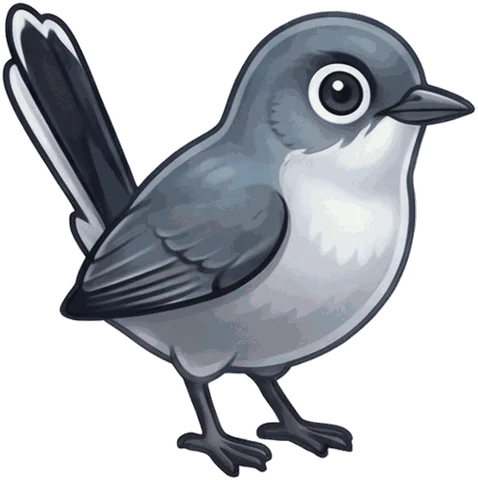
A Blue-gray Gnatcatcher sounds like a tiny complaint coming from the canopy: a thin, nasal, whining pzzzz or zkreee, buzzy and drawn out, repeated as the bird works the outer twigs of an oak with its long tail cocked and twitching. The song is a quiet, wheezy, squeaky warble that sounds more like an insect than a bird. Once you know the whine, you will find gnatcatchers everywhere from April to September.
What the song sounds like
The song is easy to walk past. It is a thin, soft, rambling warble made of buzzy, wheezy, squeaky notes, with phrases that come out something like szpree and spreeeeey, and the overall effect is closer to a cicada or a katydid than to a thrush. It drifts down from twenty or thirty feet up in the leaves, which is why many people hear it for years without connecting it to a bird.
Males arrive on the breeding grounds ahead of the females and sing to claim a territory and attract a mate, so the song is mostly a spring sound, strongest in April and May. You hear it almost only on the breeding grounds; the call, by contrast, is given all year and everywhere the bird goes. A rival on the territory gets the song plus a raised tail and an audible clapping of the bill.
The call: a nasal whine
The call is the sound to learn. It is a short, whining, nasal pzzzz, sometimes stretched into a longer buzzy pzeeee or run into a series, zkreee, zkreee, zkreee. It carries better than the song does. Gnatcatchers give it constantly as they forage, so a pair moving through a tree announces itself the whole way. Once the whine registers, look up for a slim gray bird flicking a black-and-white tail from side to side.
When and where you hear it
Blue-gray Gnatcatchers breed across the eastern United States from Florida to southern Ontario and west across the Plains, and again through the Southwest and California, and they have been spreading north through the Northeast over the past century. Eastern birds like open deciduous woods of oak, ash and maple and southern pine woods, especially moist bottomlands and edges; western birds use pinyon-juniper, chaparral and streamside thickets. Every North American population migrates, with peaks in April and September, to winter in the southern states, Mexico, Central America and the Caribbean.
In Missouri they arrive in late March and are gone by mid September, common statewide and at their peak from mid April through late August. A pair builds a compact cup nest together, over about two weeks, from grass, plant fibers and bark, lines it with down, hair and feathers, and covers the outside with spider silk and flakes of lichen, so that it looks like a knot on the horizontal limb it sits on, usually twenty to forty feet up. Four or five eggs are incubated by both parents for about thirteen days, the young fly at ten to fifteen days, and many pairs raise two broods.
Despite the name, gnats are a small part of the diet. Gnatcatchers eat leafhoppers, treehoppers, plant bugs, small beetles, caterpillars, flies, small wasps and many spiders, picked from twigs and leaves or snatched in the air. Anything large gets beaten against a branch first. The population is around 260 million and stable or increasing.
What it looks like
A very small, slim, long-tailed bird, four to four and a half inches long and about six grams, with a thin, sharp bill. Blue-gray above and whitish below, with a neat white eye ring that gives it a wide-eyed look, and a long black tail edged in white; from below, with the tail closed, it looks all white. In spring and summer the male wears a thin black eyebrow that the female lacks, and he is a shade bluer; young birds are grayer with a greenish tinge. The tail is the field mark in motion: held cocked like a wren's and jerked from side to side as the bird hops through the outer branches in short, moth-like flights.
Birds that sound similar
- ?Ruby-crowned Kinglet
The kinglet's song is loud and musical for its size, high notes followed by low trills and a galloping three-note phrase. The gnatcatcher's is soft, wheezy and insect-like, and its call is a nasal whine rather than a chip.
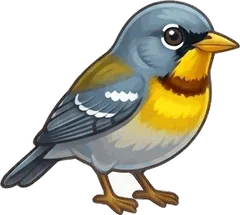 Northern Parula
The parula's song is a rising buzz that drops abruptly at the end, bzzzzz-zip, tight and confident. A gnatcatcher's whine is flatter and more nasal, and its song wanders without a clear ending.
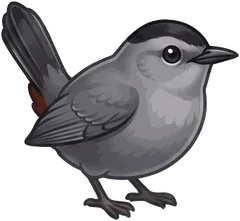 Gray Catbird
The catbird's mew is louder, lower and more cat-like, and comes from a thicket near the ground. A gnatcatcher's whine is thin, buzzy and high, and comes from the outer branches overhead.
Where the Blue-gray Gnatcatcher card lives
In Warble the same bird can be an easy card in one state and a prized one in another, because each album ranks its birds by how often people really report them there. The Blue-gray Gnatcatcher appears in 30 state albums:
 Heard one? Open Warble, tap the green button while it sings, and the Blue-gray Gnatcatcher card flips into your album. Get the app free.
Questions people ask
What does a Blue-gray Gnatcatcher's call sound like?
A thin, nasal, whining pzzzz, sometimes stretched into a longer buzzy pzeeee or repeated in a series. It sounds slightly annoyed and slightly electronic, and the bird gives it all day as it forages in the outer branches, which makes it the easiest way to find one.
Do gnatcatchers actually eat gnats?
Rarely. Gnats are a small part of the diet. Gnatcatchers mostly eat leafhoppers, plant bugs, small beetles, caterpillars, flies, small wasps and spiders picked from twigs and leaves, and they beat larger prey against a branch before swallowing it.
When do Blue-gray Gnatcatchers arrive in spring?
Late March to April across most of the East, with migration peaking in April; in Missouri the first birds show up in late March. Males arrive first and start singing. Fall migration peaks in September and most birds are gone by the end of the month.
Why does a gnatcatcher keep flicking its tail?
The tail is held cocked and swung from side to side while the bird forages and while it defends a territory. The white outer feathers flash with every swing, which may help startle insects out of the leaves and clearly signals to other gnatcatchers.
Sources
- National Audubon Society, Guide to North American Birds: Blue-gray Gnatcatcher. www.audubon.org/field-guide/bird/blue-gray-gnatcatcher
- Wikipedia: Blue-gray gnatcatcher (measurements, calls, range and expansion). en.wikipedia.org/wiki/Blue-gray_gnatcatcher
- Missouri Department of Conservation, Field Guide: Blue-gray Gnatcatcher. mdc.mo.gov/discover-nature/field-guide/blue-gray-gnatcatcher
- Animal Diversity Web (University of Michigan): Polioptila caerulea. animaldiversity.org/accounts/Polioptila_caerulea/