 Warble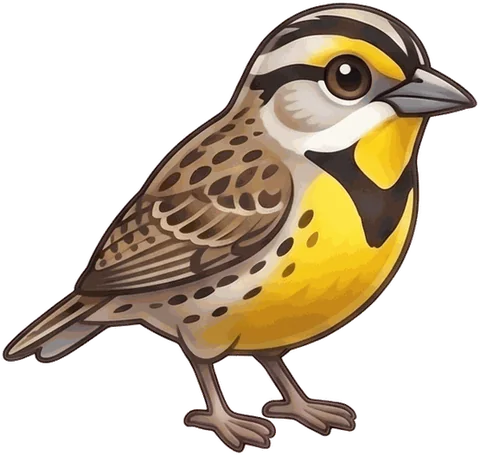
An Eastern Meadowlark sounds like a slow, clear whistle sliding down in pitch: two to four pure notes, written see-you, see-yeeer and remembered as spring of the year. It is a sweet, slightly sad sound with no buzz, given from a fence post or wire over an open field, and it carries a long way. The everyday call is a short, harsh, buzzy dzert, plus a dry rattle when the bird flushes. Where its range meets the Western Meadowlark, that simple whistled song is the surest way to tell the two apart.
The birder's mnemonic
“spring of the year” Say it slowly with each word sliding downward, or hear it as see-you, see-yeeer. Some people hear sweet spring is here instead.
What the song sounds like
The song is a short phrase of clear, mellow whistles, each note slurred and most of them falling in pitch. The classic version is a pair of two-note whistles, tsee-you, tsee-yer, the second drawn out and drooping at the end. Written as words it becomes spring of the year, which fits the mood: plaintive and unhurried, more like someone whistling wistfully than a bird showing off. There is no trill and no gurgle, just three or four pure notes and then a pause.
A single male does not stick to one phrase. One bird in New York was recorded switching among more than a hundred song patterns, so a meadowlark you have listened to for ten minutes may suddenly sound like a different bird. The tone stays the same: clean, whistled, downward.
Males sing from anything that sticks up above the grass: fence posts, wires, a lone treetop. Females sing too, softly, while preening in the early morning. It is one of the first songs of spring on farmland, since males claim territories in March, weeks before the females arrive, and on bright moonlit nights a male will sometimes sing after dark.
The call: a buzzy dzert and a rattle
The bird you hear most often is an unmusical one. The common call is a short, harsh, buzzy dzert, given when something mildly bothers the bird. When it flushes it gives a loud, dry rattle or a raspy chatter, often several in a row, and there is a high, thin whistle for real alarm, such as a hawk overhead. A rattle from a bird flashing white outer tail feathers as it drops back into a field is a meadowlark.
When and where you hear it
Eastern Meadowlarks live east of the Rockies, from the Great Plains to the Atlantic and from southern Canada through the Gulf states, with more populations in Mexico, Cuba and northern South America. Across most of the United States they stay all year. Only the northernmost birds move south, by day, leaving around the end of November and returning in March. In places like Tennessee and Missouri there is hardly a month without a meadowlark in the pasture.
The habitat is open grass: native prairie, hayfields, weedy pastures, airports, the grassy margins of crop fields. They want room, several acres per territory. In the Midwest, where both meadowlarks occur, the Eastern takes the taller, damper grass and leaves the shorter, drier ground to the Western. In winter the singing stops and loose flocks of a few dozen birds walk through stubble and around livestock pens picking up spilled grain.
Listen for the song from March through July, strongest in the first hours after sunrise. Because the whistle carries so far, this is one of the easier grassland birds to catch in Warble from a quiet country road. Numbers have fallen by as much as half since the 1960s as hayfields are cut earlier and pastures become row crops or subdivisions, and the species is listed as Near Threatened.
What it looks like
A chunky, short-tailed bird about the size of a robin, 9 to 10 inches long with a long, pointed bill. From the front it is bright yellow with a bold black V across the chest; from behind it is streaked brown and buff, which makes it vanish the moment it lands in grass. The face has a white eyebrow and a white stripe under the cheek. In flight the white outer tail feathers flash. Males and females look the same; in fall and winter the colors dull. Despite the name it is not a lark but a relative of blackbirds and orioles, which explains the sharp bill and the walking gait.
Birds that sound similar
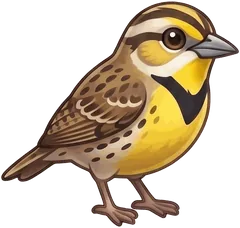 Western Meadowlark
The Western opens with a whistle or two, then tumbles into a rich, flute-like, gurgling jumble that runs down the scale. The Eastern stays with plain, slurred whistles and never gurgles. Western calls are a low chuck, not a buzzy dzert.
- ?Chihuahuan Meadowlark
Split from the Eastern in 2022 and found in the desert grasslands of Arizona, New Mexico and west Texas. Its song is three to five descending whistles, so close to the Eastern that range is the practical clue.
- ?Dickcissel
Shares the same fence posts and has a yellow breast with a black bib, but the song is a sharp dick-dick followed by a buzzy, hissed cissel, repeated over and over. Nothing about it is whistled.
Where the Eastern Meadowlark card lives
In Warble the same bird can be an easy card in one state and a prized one in another, because each album ranks its birds by how often people really report them there. The Eastern Meadowlark appears in 22 state albums:
 Heard one? Open Warble, tap the green button while it sings, and the Eastern Meadowlark card flips into your album. Get the app free.
Questions people ask
Which bird sings spring of the year?
The Eastern Meadowlark. The phrase matches its two to four clear, slurred whistles that slide downward, sung from fence posts and wires over open fields from March into summer. The same song is also written see-you, see-yeeer.
How do you tell an Eastern Meadowlark from a Western by sound?
By the shape of the song. The Eastern gives a few simple, plaintive whistles and stops. The Western starts with a whistle and breaks into a flute-like, bubbling jumble that descends the scale. The calls differ too: a buzzy dzert for the Eastern, a low chuck for the Western.
Do meadowlarks sing at night?
Occasionally. Eastern Meadowlarks are daytime singers, loudest around dawn, but on bright moonlit nights in spring a male will sometimes sing from his perch.
Are Eastern Meadowlarks declining?
Yes. Populations have dropped by as much as half since the 1960s and the species is listed as Near Threatened. The cause is lost grassland: hayfields cut earlier, pastures turned into crops, open land built over. Mowing a little later gives ground nests time to fledge.
Sources
- National Audubon Society, Guide to North American Birds: Eastern Meadowlark. www.audubon.org/field-guide/bird/eastern-meadowlark
- Tennessee Wildlife Resources Agency: Eastern Meadowlark (song, size, seasons, night singing). www.tn.gov/twra/wildlife/birds/grassland-and-shrub-birds/eastern-meadowlark.html
- Missouri Department of Conservation field guide: Eastern Meadowlark. mdc.mo.gov/discover-nature/field-guide/eastern-meadowlark
- Wikipedia: Eastern meadowlark (comparison with Western Meadowlark, Chihuahuan split, decline). en.wikipedia.org/wiki/Eastern_meadowlark